
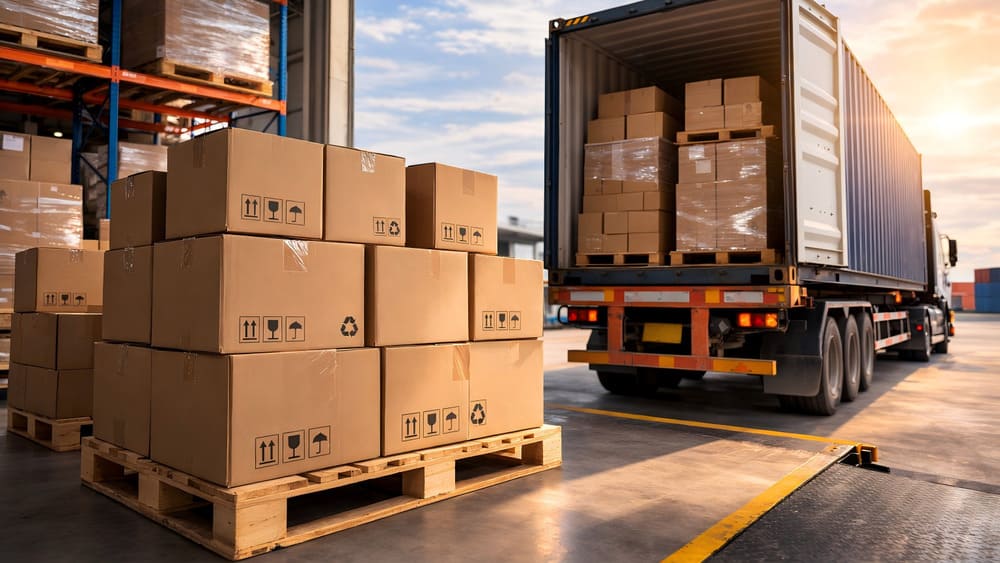
When sourcing packaging internationally, the unit price is rarely the real cost.
Freight, container loading efficiency, and customs duties often influence the final project cost more than the factory quote.
That is why experienced buyers focus on total landed cost before selecting a supplier.
What Is Total Landed Cost in Packaging — and When It Actually Matters
Definition of Total Landed Cost
In packaging sourcing, the factory quote is only part of the cost.
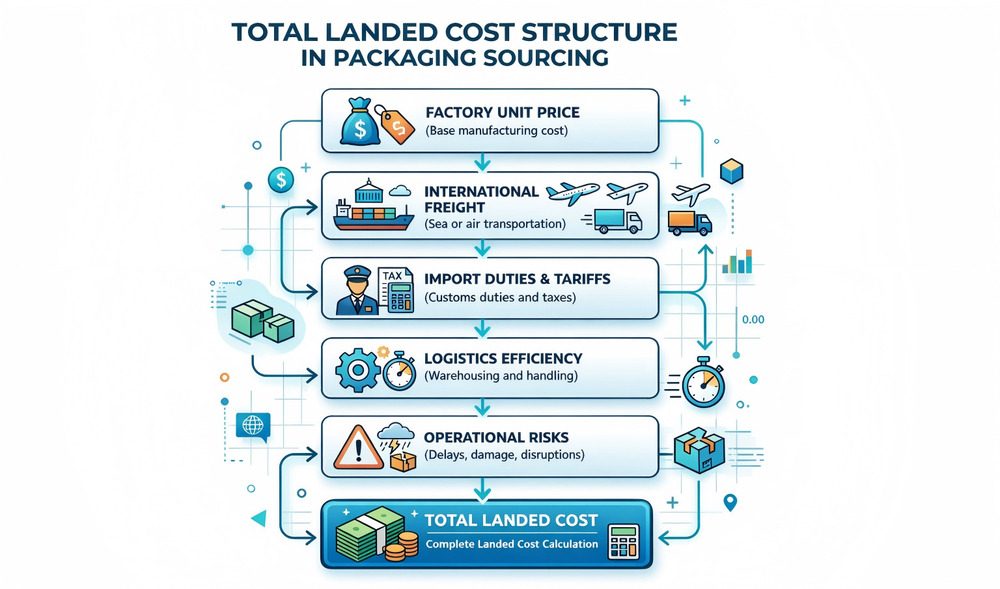
Total landed cost is the real cost of getting packaging from the supplier to your warehouse, ready for use.
It usually includes:
- manufacturing cost
- freight and logistics
- import duties and taxes
- compliance and documentation
- project-related risk costs
Put simply:
Landed cost tells you what each box really costs after import, not just what the factory charges.
Unit Price vs Total Landed Cost
Many buyers compare packaging quotes like this:
- Supplier A: $0.52 per box
- Supplier B: $0.56 per box
That comparison is incomplete.
A lower unit price does not always produce a lower total cost. In packaging imports, freight, duty exposure, and loading efficiency can easily erase the apparent savings.
This is why packaging sourcing should not be judged by the quote alone.
What Costs Are Included in Packaging Imports
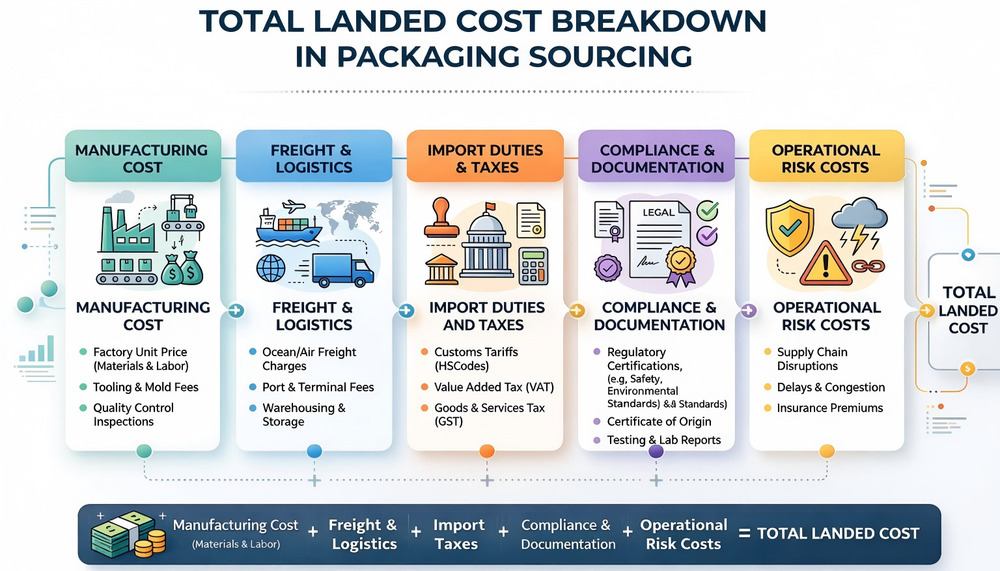
In most packaging import projects, landed cost includes five main layers:
Manufacturing cost
The direct cost of producing the packaging.
Freight and logistics
Ocean freight, inland transport, and loading efficiency.
Import duties and taxes
Costs tied to HS classification, country of origin, and trade policy.
Compliance and documentation
Customs paperwork and required supporting documents.
Operational risk costs
Reprints, delays, inefficient packing, or avoidable execution losses.
| Cost Component | Example Cost (per box) |
| Factory price | $0.48 |
| Ocean freight | $0.085 |
| Import duty (10% CIF estimate) | $0.056 |
| Destination charges & clearance | $0.003 |
| Total landed cost | $0.624 |
When Landed Cost Matters Most in Packaging Procurement
Not every packaging order needs detailed landed cost analysis.
But it becomes important when:
- the packaging is imported into the U.S. market
- the structure is bulky and freight-sensitive
- the SKU will be reordered repeatedly
In these situations, even a small mistake in assumptions can turn into a real cost problem.
In real packaging projects, the first cost mistake is usually not production. It is cost visibility.
Buyers think they are comparing box prices, but in reality they are often comparing incomplete supply chain assumptions.
The Landed Cost Framework: A Practical Way to Calculate Real Packaging Cost
Most buyers do not need a complicated landed cost model.
What they actually need is a clearer view of the real project cost, not just the factory quote.
In packaging sourcing, the key question is rarely:
“What is the unit price?”
The more useful question is:
“What will this packaging actually cost once it is produced, shipped, cleared through customs, and ready to use?”
A practical landed cost framework simply breaks that answer into several cost layers.
Not to build a complex spreadsheet, but to understand where the real cost is formed.
Basic Landed Cost Formula
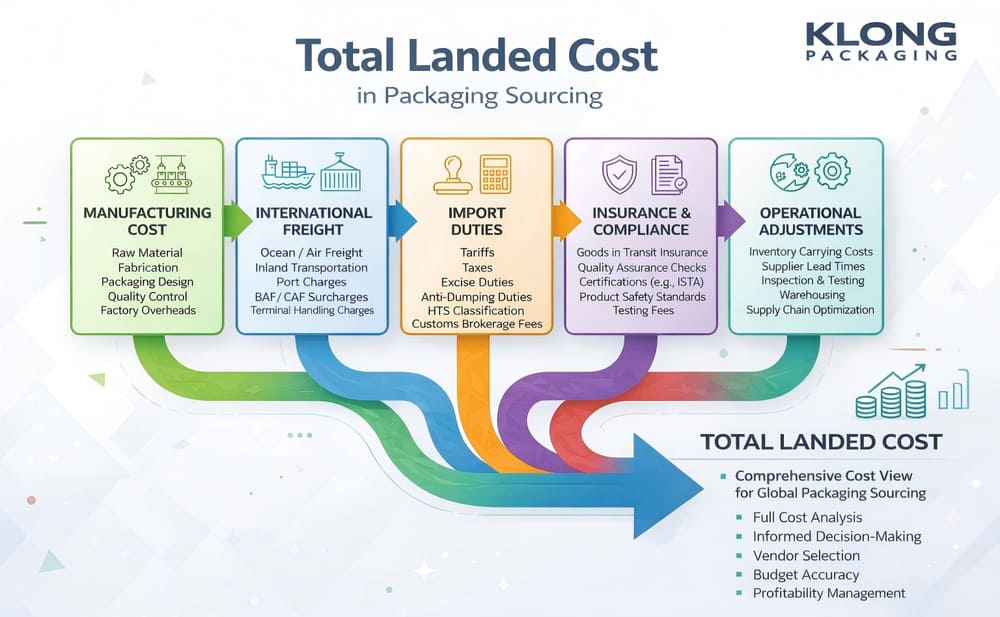
A simple structure for packaging landed cost looks like this:
Total Landed Cost per Unit =
Manufacturing Cost
- International Freight
- Import Duties / Tariffs
- Insurance & Compliance
- Operational Adjustments
The formula itself is simple.
What matters more is understanding how these costs influence each other, and which of them can already be estimated during sourcing.
Breaking Down the Cost Components
On paper, these cost layers look straightforward.
In real projects, the difference usually lies in when these factors are considered together.
Manufacturing and purchase cost
Manufacturing cost is the most visible number in any packaging quotation.
For established packaging programs, experienced suppliers can usually estimate it quite accurately during the RFQ stage.
But production cost alone never tells the full story.
Packaging dimensions, packaging inserts, and carton configuration can directly influence logistics efficiency later.
When these factors are considered early, the manufacturing quote becomes far more meaningful.
International freight
Freight is often where packaging sourcing starts to get interesting.
Packaging is usually light but bulky, so transportation cost is driven more by volume than weight.
Small changes in carton size, packing density, or container loading can quickly shift freight cost per unit.
That is why freight should not be treated as a number added after the quotation.
In many projects, it is already shaped earlier—when packaging structure and carton plans are decided.
Import duties and tariffs
Import duties mainly depend on classification, origin, and destination market.
When these elements are clear, tariff exposure can often be estimated early in the sourcing stage.
The important part is confirming these assumptions before production decisions are finalized.
Insurance and compliance costs
Insurance and compliance costs are usually smaller compared with manufacturing or freight, but they are still part of the landed cost structure.
Insurance protects against the worst-case scenarios during transport.
Compliance relates to documentation, material information, and regulatory requirements in the destination market.
These costs may not dominate the calculation, but ignoring them early can still create friction later.
Operational adjustments
Not every cost can be fixed at the beginning of a sourcing project.
What helps most is clarity early on.
When the buyer’s real requirements are clearly communicated, experienced packaging suppliers usually evaluate the project with those conditions in mind—from structure to logistics assumptions.
Testing feedback, structural refinement, or final carton configuration may still create adjustments.
That is normal.
The goal is simply to keep those adjustments small rather than disruptive.
Which Costs Can Be Estimated Early — and Which Must Be Validated Later
For packaging that has already been produced before, landed cost can often be estimated quite accurately during the RFQ stage.
Manufacturing cost, freight range, expected duties, and basic logistics assumptions are usually predictable when specifications are already known.
New packaging projects are different.
When structure, carton configuration, or logistics assumptions are still evolving, early costing naturally contains more estimates.
In these situations, the accuracy of landed cost depends not only on the quotation itself, but also on how clearly the project requirements are defined and how early logistics considerations enter the discussion.
Once samples are confirmed, dimensions fixed, and packing plans validated, the landed cost picture usually becomes much clearer.
The formula for landed cost is easy.
The real test is simpler:
When your supplier quotes packaging, are they only calculating the box — or already thinking about the container?
The 164.75% Anti-Dumping Trap in the US Market: Why 4819.20.0040 Requires Early Review
Most landed cost discussions focus on freight and duties.
But for some packaging imported into the United States, classification alone can completely change the cost structure.
Folding cartons classified under HS Code 4819.20.0040 in U.S. imports may fall under the U.S. anti-dumping order A-570-866, which carries a duty rate of 164.75%.
If this risk is not reviewed early, a packaging project that looked competitive on paper can quickly become commercially impossible.
Typical HS Code Paths for Paper Packaging Boxes
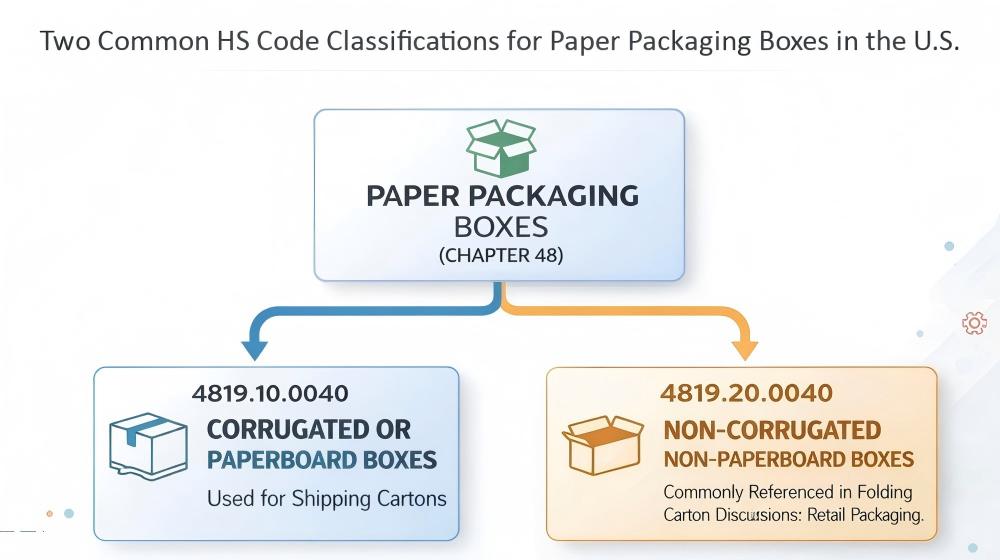
Paper packaging boxes imported into the U.S. usually fall into two different HS classifications.
Although they may look similar, the tariff treatment can be very different.
4819.10.0040
Corrugated or paperboard shipping cartons
This classification generally applies to corrugated or paperboard shipping cartons used primarily for transport packaging.
These cartons are designed mainly for logistics protection during shipping.
They are not part of the anti-dumping scope discussed in this article.
4819.20.0040
Folding cartons (non-corrugated paperboard)
This classification generally applies to folding cartons made from single-sheet paperboard, commonly used for retail packaging.
Typical materials include:
- SBS paperboard (around 250–400 gsm)
- clay-coated news back
- kraft paperboard
These cartons are widely used in packaging for electronics, cosmetics, supplements, and other consumer products.
Certain imports under this classification may fall under the U.S. anti-dumping order A-570-866.
How A-570-866 Can Distort Landed Cost Assumptions
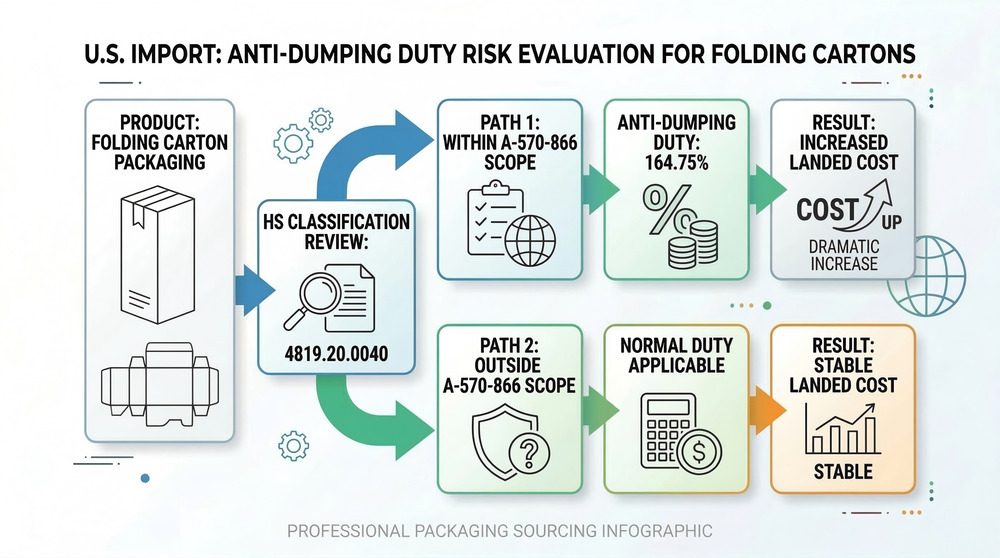
The U.S. anti-dumping order A-570-866 covers certain folding carton imports.
When the order applies, the duty rate is 164.75%.
At that level, the impact on landed cost is dramatic.
A packaging quote that once looked cheaper can quickly become the most expensive option once the correct tariff exposure is applied.
This is why HS classification is not just a customs detail.
It can fundamentally change the economics of a packaging sourcing decision.
Why This Risk Must Be Reviewed Before Packaging Production
Whether a carton falls under the A-570-866 order depends on these technical variables:
- Carton structure
- Material composition
- Physical dimensions
- Production characteristics
Ignoring these early can trigger a 164.75% duty, wiping out your project’s profit. A professional audit during the [packaging structure design] stage allows for strategic adjustments to qualify for legal exemptions before it’s too late.
Waiting until the goods arrive at the port is too late. For a detailed breakdown of legal exemptions, refer to our guide on [How to Avoid the A-570-866 Anti-Dumping Duty on Folding Cartons].
Where the Exclusion Analysis Begins
When anti-dumping exposure exists, the next step is determining whether a specific packaging product falls inside or outside the scope of A-570-866.
This typically involves reviewing:
- carton structure
- material specifications
- production process
- classification interpretation
Because these details can be technical, exclusion analysis should be approached carefully.
A separate article will explain this process in more detail and outline how some packaging projects can be structured to avoid unnecessary tariff exposure.
Many teams spend weeks negotiating a few cents on the box price.
But a much bigger question often goes unasked:
Has anyone actually checked whether the carton falls under A-570-866?
Because if that question is asked after production starts,
the answer usually comes too late.
Design for Duties: Strategic Packaging Engineering to Manage Tariff Exposure
Many buyers think about tariffs only when goods reach customs.
In packaging sourcing, that is often too late.
Choices made during packaging design — especially structure, materials, and dimensions — can shape how packaging is produced, shipped, and interpreted during import.
That is why packaging engineering is not only about design.
It is also part of landed cost planning.
Why Tariff Strategy Begins During Packaging Design
Some sourcing risks begin long before customs clearance.
They often start with early decisions such as:
- carton structure
- board materials
- insert design
- outer carton configuration
Once packaging enters production, these choices are much harder to change.
That is why experienced teams review sourcing risk while the packaging is still being designed.
How Packaging Structure Can Influence Classification Interpretation
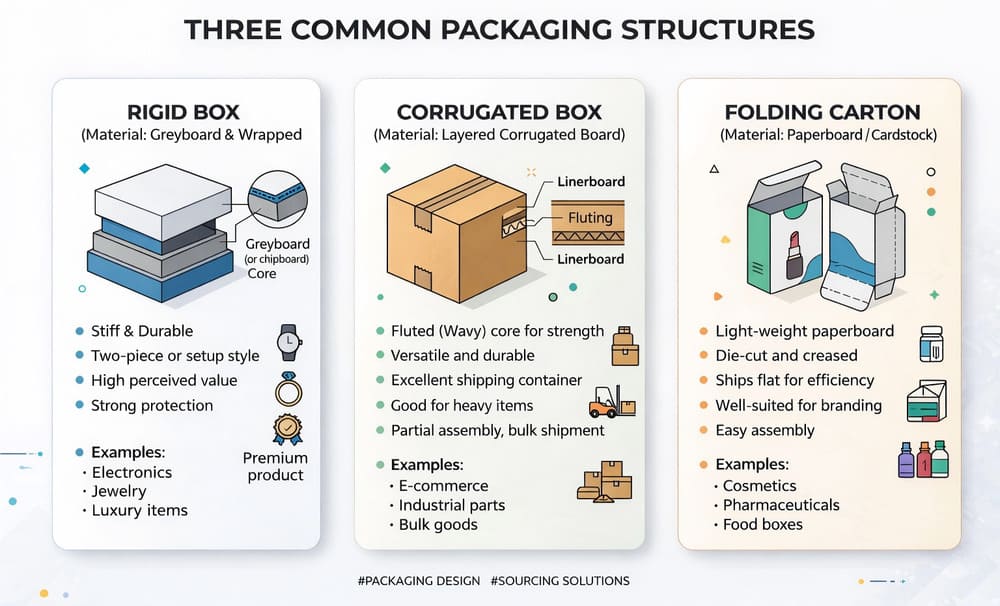
Different packaging structures follow different manufacturing paths.
These differences influence production methods, shipping efficiency, and sometimes sourcing assumptions.
Common examples include:
| Packaging Type | Typical Material | Common Use |
|---|---|---|
| Rigid boxes | Greyboard + wrapped paper | Luxury products |
| Corrugated boxes | Fluted board | Shipping and e-commerce |
| Folding cartons | Paperboard | Retail packaging |
- Rigid boxes — made from greyboard (around 600–2000 gsm) laminated with printed paper
- Corrugated boxes — made from single- or double-wall corrugated board, sometimes laminated with printed paper
- Folding cartons — typically made from 250–400 gsm paperboard and designed to fold into many structural forms
These structural differences affect how packaging is produced, shipped, and in some cases, how classification is interpreted.
Alternative insert materials
Inserts are another important design variable.
Common options include:
- paperboard inserts
- molded pulp trays
- plastic trays
- foam inserts
Plastic or foam inserts are sometimes used for protection, but many brands now prefer paper-based or molded pulp alternatives for sustainability reasons.
Insert choices affect packaging weight, complexity, and overall efficiency.
Design for Manufacturing: Structural Adjustments That Reduce Risk
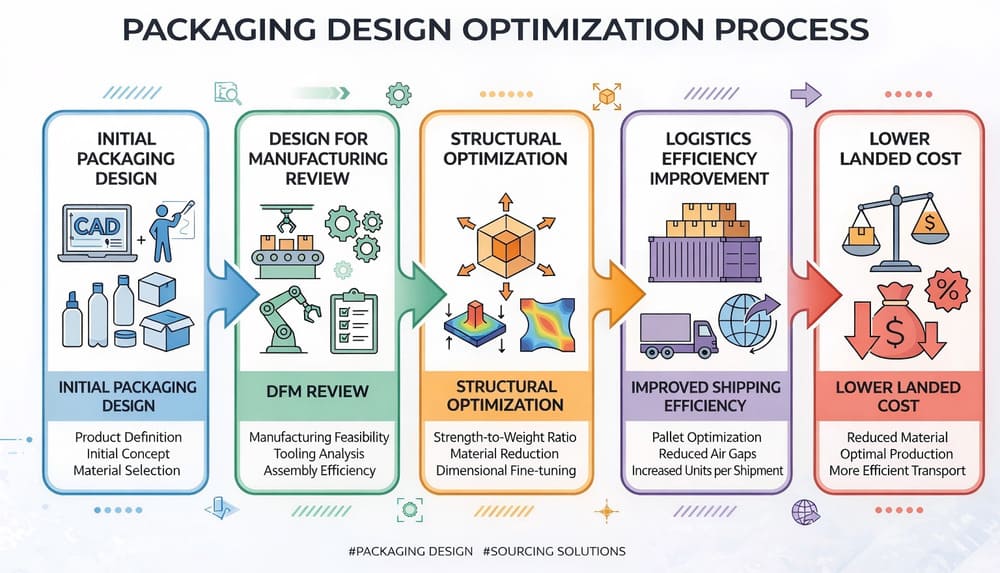
During packaging development, small structural adjustments can prevent bigger problems later.
Typical examples include:
- simplifying carton structures
- adjusting board specifications
- optimizing insert layouts
These changes may look minor during design, but they can influence production efficiency, shipping density, and packaging cost.
Experienced suppliers usually review these details before tooling and production are locked in.
Optimizing Packaging to Reduce Landed Cost
Packaging engineering also affects sourcing efficiency.
Three common optimization approaches are:
Minimizing box dimensions
Reducing unnecessary volume improves container utilization and lowers freight cost per unit.
Reducing material usage
Efficient structural design can reduce paperboard usage while maintaining strength.
Optimizing packaging configuration
Adjusting insert layout or folding structures can simplify assembly and reduce packaging components.
Across large production volumes, these improvements can materially reduce total landed cost.
In packaging sourcing, the expensive mistakes usually do not start at customs.
They start earlier — when structure, materials, or insert choices are approved without enough discussion.
If your packaging ships often or in large volume, ask a hard question early:
Has this design been reviewed as part of the supply chain — or only as part of the product?
How Packaging Dimensions Affect Freight Cost and Container Loading Efficiency
Freight cost is not only a logistics issue.
In many packaging projects, it begins much earlier — during packaging design.
Small differences in packaging dimensions — especially outer carton size — can significantly change how efficiently products fit into a container.
As shipment volumes increase, these differences quickly translate into real freight cost differences.
Container Loadability and Packaging Density
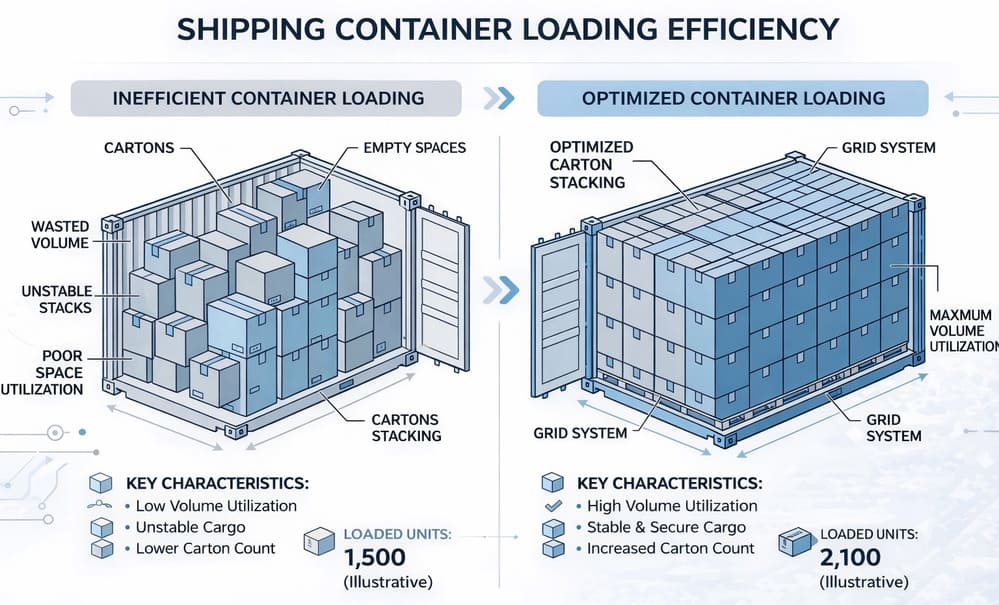
Container space is fixed, but packaging density is not.
The more efficiently products fill the container, the lower the freight cost per unit.
Packaging design influences container loading through:
This is particularly relevant for corrugated shipping boxes designed for transport efficiency.
- unit packaging dimensions
- outer carton configuration
- packing density
Even when the product itself does not change, packaging adjustments can noticeably improve container utilization.
The 40HQ Truth: Theoretical Volume vs Practical Planning Volume
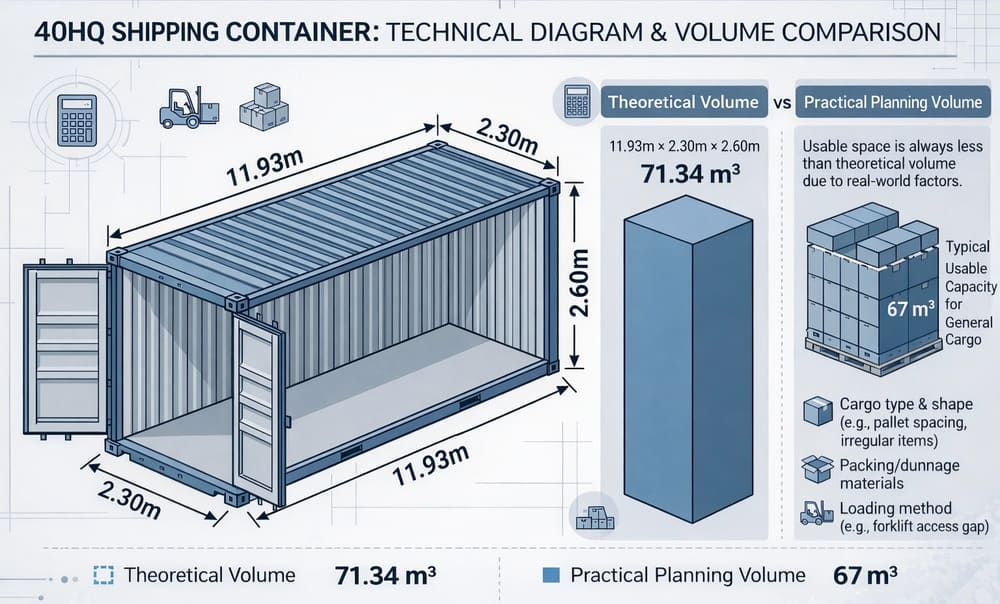
Container specifications show theoretical capacity.
Real shipment planning always uses a smaller number.
11.93 × 2.30 × 2.60 m
Theoretical volume
71.34 m³
Practical planning volume
≈ 67 m³ (about 94–95% usable)
The remaining space accounts for carton tolerances, stacking patterns, and operational constraints.
Experienced packaging teams usually plan container loading using this practical volume.
Carton Optimization and Container Utilization
Container efficiency often improves through packaging adjustments rather than product changes.
Typical approaches include:
- redesigning outer carton dimensions to better match container space
- adjusting unit box size to improve carton packing density
- for rigid box projects with large shipment volumes, offering fold-flat shipping structures instead of fully assembled boxes
When carton dimensions are already optimized, improvements often come from small adjustments to the unit packaging size.
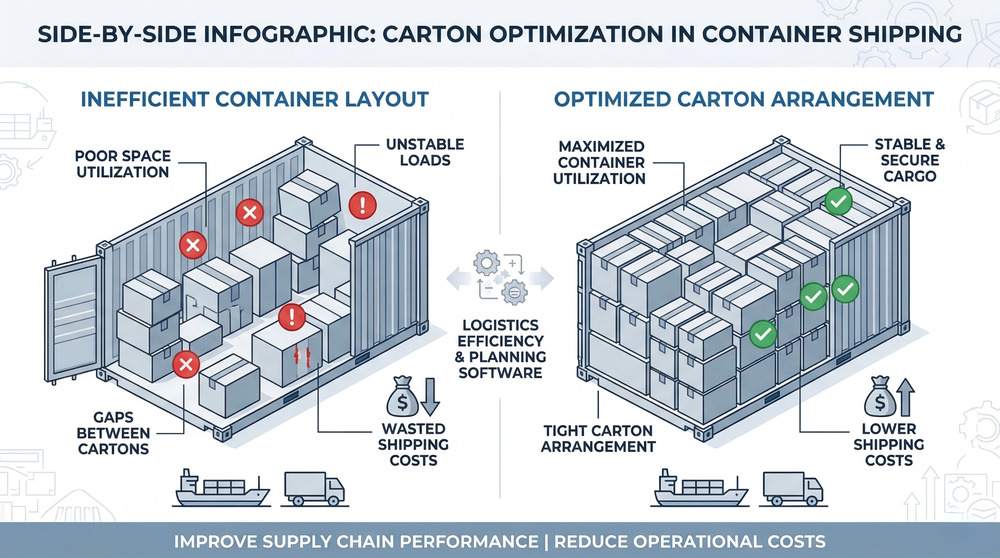
Real Example: Carton Optimization in Practice
In one project, a small adjustment to the outer carton size significantly improved container loading.
Before carton redesign:
52,500 pcs / 40HQ
After carton adjustment:
58,400 pcs / 40HQ
Result:
about 10–11% higher container utilization
The product itself did not change.
Only the carton configuration was optimized.
Across large production volumes, improvements like this directly reduce freight cost per unit.
The Different Roles of Packaging Engineers and Freight Forwarders
Freight forwarders typically work with the packaging specifications provided by the supplier.
Their responsibility is transport arrangement rather than packaging engineering.
They schedule containers based on carton dimensions and shipment volume.
Packaging optimization usually happens earlier — during packaging design and engineering, especially in structural design work such as custom folding cartons for retail packaging.
Using Remaining Container Space to Reduce Freight Cost
In practice, many shipments are close to a full container but still leave unused space.
When suppliers manage the shipping arrangement, experienced teams often calculate the remaining usable volume.
Based on that space, they may recommend adding frequently reordered items so the container can be filled more efficiently.
This helps buyers spread freight cost across more units and reduce the effective shipping cost per product.
How a 10% Loadability Gain Can Reduce Freight Cost by 8–12%
In full-container shipping, freight cost is largely fixed per container.
If packaging optimization allows more units to fit into the same container, freight cost per unit decreases.
In practice, improving container loadability by around 10% often reduces unit freight cost by about 8–12%.
Across large shipments, this difference quickly becomes meaningful.
Insight from Real Export Projects
Many sourcing teams focus heavily on negotiating box price.
But in large export projects, the bigger savings often come from how efficiently packaging moves through the supply chain.
If container loading has never been reviewed during packaging design, one question is worth asking:
Are we optimizing the box price — or the entire shipment?
Why Buyers Often Underestimate the Real Cost of Packaging Imports
In packaging imports, the factory quote is only the starting point.
Some of these cost changes become more visible when packaging design also affects freight efficiency and container planning.
As a project moves from concept to production, development work, internal approvals, and production adjustments can gradually change the real cost of the packaging.
These factors are rarely visible when suppliers are first compared, but they often shape the final landed cost of the project.
Sampling and Testing Loops
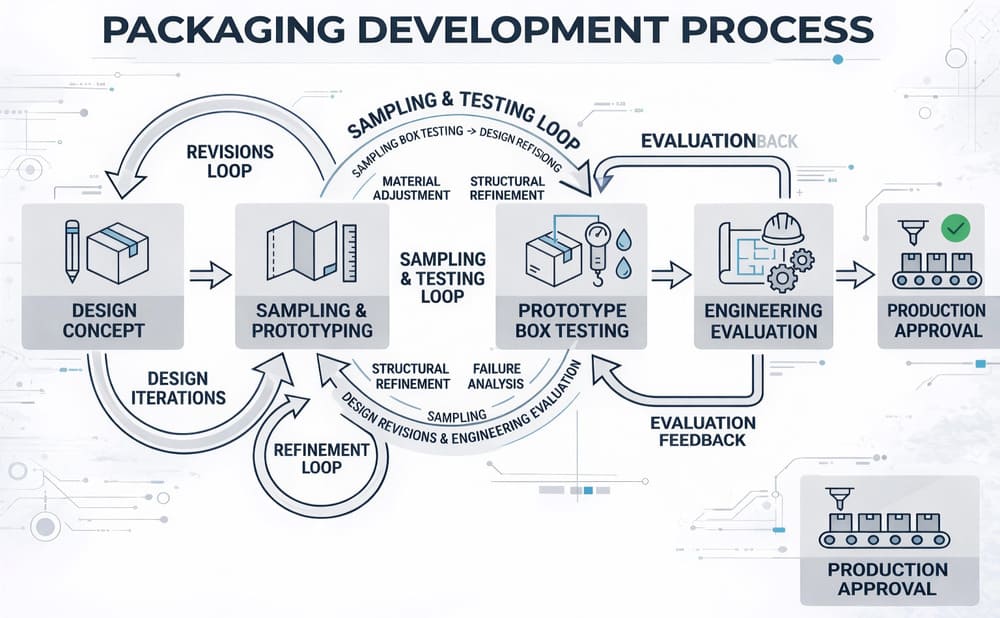
Most packaging projects require several rounds of sampling and testing before structure, materials, and printing specifications are finalized.
Early prototypes often reveal improvements in product protection, assembly, or printing results.
Each round helps refine the design, but it also extends the development process.
Coordination Between Teams
Packaging decisions rarely come from a single department.
Design teams focus on brand presentation.
Procurement teams evaluate cost and suppliers.
Manufacturers review engineering feasibility.
When these perspectives are not aligned early, even small adjustments can trigger new reviews or structural revisions.
Production Variations and Reprint Risk
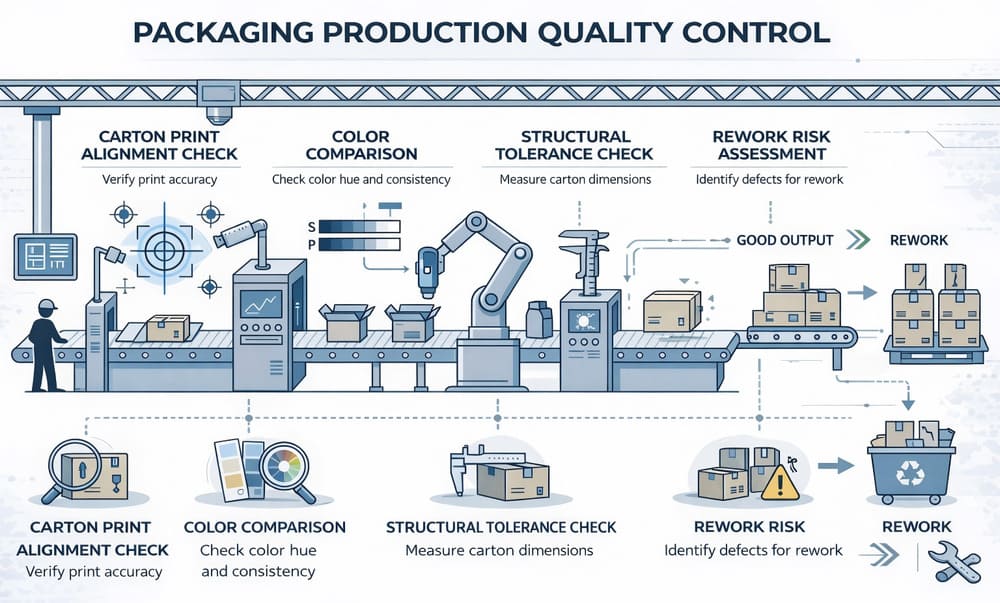
Quality defects discovered after arrival lead to expensive local reprints and lost sales time.
To protect your investment, we implement a rigorous [Packaging Quality Control] system to ensure ‘first-time-right’ manufacturing.
A Real Landed Cost Example: Corrugated Box Imports
A sourcing team compared two suppliers for the same corrugated box project.
At first glance, the cheaper quote seemed obvious.
Supplier A quoted $0.48 per box.
Supplier B quoted $0.49 per box.
But once the packaging dimensions and container loading were reviewed, the conclusion changed.
Initial Quote vs Actual Shipping Capacity
The simplified comparison looked like this:
| Item | Supplier A | Supplier B |
|---|---|---|
| Unit price | $0.48 | $0.49 |
| Master carton size | 119.5 × 65.5 × 23.5 cm | 115.5 × 65 × 23 cm |
| Cartons per container | 340 | 396 |
| Boxes per container | 34,000 | 39,600 |
| Freight per container | $5,000 | $5,000 |
| Freight per box | $0.147 | $0.126 |
| Total landed cost | $0.627 | $0.616 |
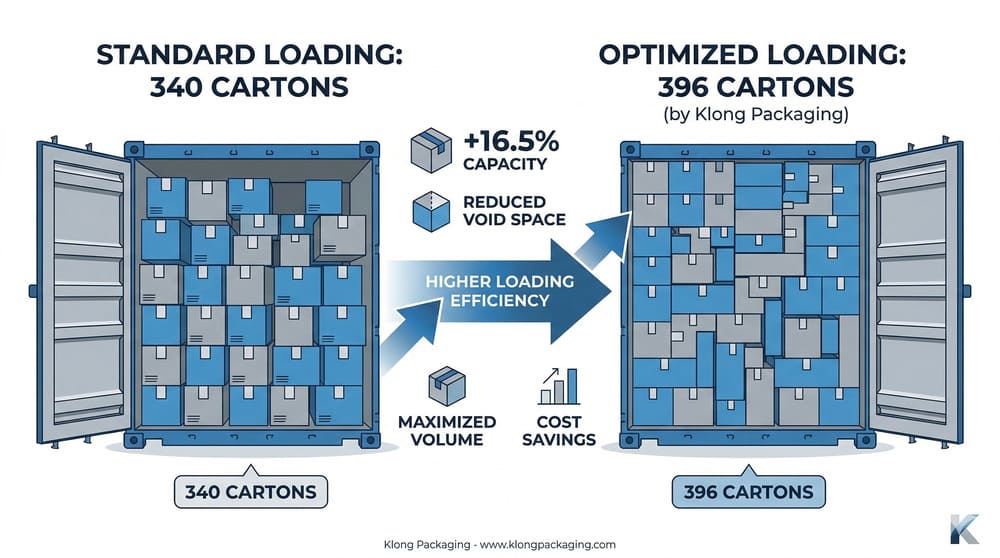
At the quotation stage, the difference appeared to be only one cent per box.
But the packaging dimensions told a different story.
What Actually Changed the Cost
The freight quote from the forwarder was the same for both suppliers.
What changed the result was container loading efficiency.
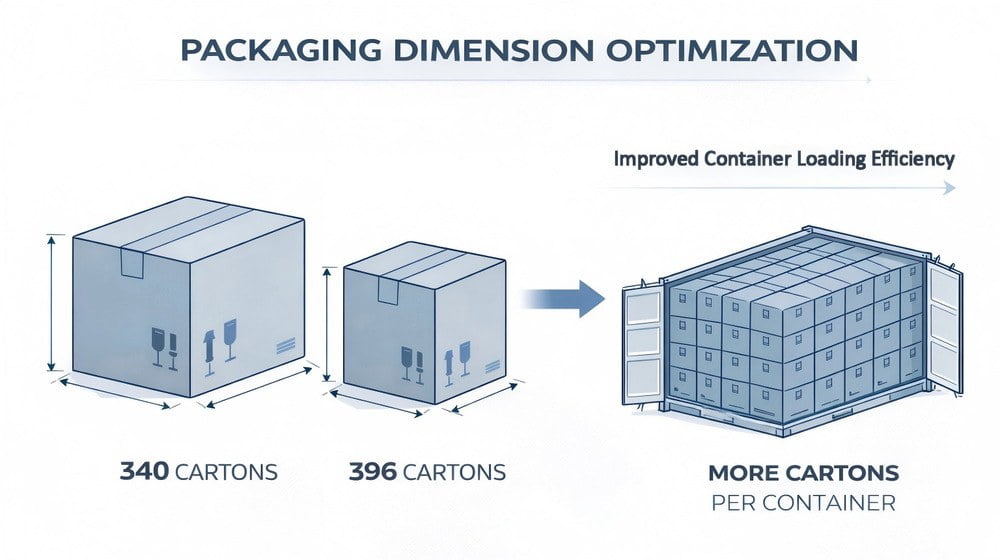
A small adjustment in packaging dimensions allowed Supplier B to load more cartons into the same container.
Shipment capacity increased from 34,000 boxes to 39,600 boxes per container.
That change reduced freight cost per box by about two cents.
Small structural changes can quietly create large logistics differences.
Final Sourcing Decision
When the landed cost was recalculated, the result changed.
Supplier A had the lower factory price.
But Supplier B had the lower total project cost.
A one-cent difference in box price was reversed by a two-cent difference in freight.
The cheaper quote became the more expensive project.
Real-World Insight
A one-cent price difference can easily be offset by a two-cent freight difference.
In packaging sourcing, container loading efficiency often matters more than the factory quote.
What This Example Shows
Container loading efficiency is rarely checked during packaging sourcing.
Yet it can outweigh small differences in unit price.
Many packaging projects become expensive simply because container loading was never reviewed during packaging design.
How Experienced Buyers Evaluate Packaging Suppliers Beyond Unit Price
Why Unit Price Is Often the Wrong Starting Point
Many packaging RFQs start with unit price comparison.
A difference of one or two cents per box often becomes the focus.
But real project cost is rarely decided there.
Landed cost in packaging sourcing, cost is often driven by factors that do not appear in the quotation:
- tariff exposure
- packaging structure
- container loading efficiency
For example, in the U.S. market, certain paperboard cartons classified under HS Code 4819.20.0040 have faced anti-dumping duties in the U.S. market.
If that risk is missed, landed cost assumptions can change dramatically.
Because of this, experienced teams rarely start with price.
They start with risk.
The Real Decision Sequence in Packaging Sourcing
In practice, supplier comparison usually follows a different order.
Not price first.
But risk and feasibility first.
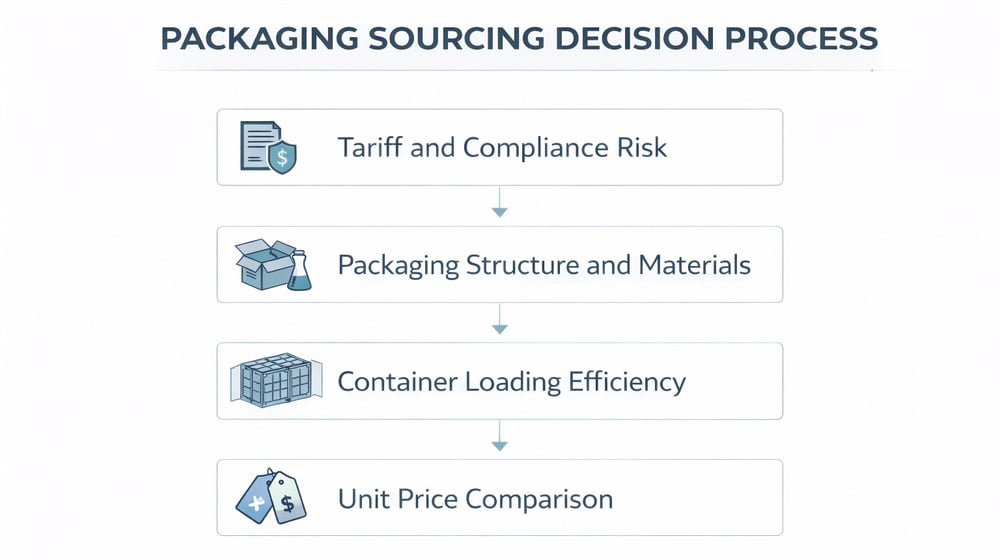
A typical review sequence looks like this:
1️⃣ tariff and compliance risk
2️⃣ packaging structure and materials
3️⃣ container loading efficiency
4️⃣ unit price comparison
Only after the first three factors are clear does price become meaningful.
How Cheap Quotes Turn Into Expensive Projects
Low quotes often look attractive in early supplier comparisons.
But many packaging projects become expensive later.
Common reasons include:
- inefficient container loading
- unexpected tariff exposure
- structural adjustments during production
- reprints caused by quality issues
Each issue looks small.
But together they can change the real landed cost of the project.
A Simple Landed Cost Review Before Placing an Order
Before confirming a supplier, experienced teams usually review a few simple questions:
- Is the HS classification correct?
- Is there tariff exposure in the destination market?
- Has the packaging structure been validated?
- Is container loading efficiency optimized?
- Does the freight estimate reflect realistic shipment conditions?
These checks are simple.
But they often reveal cost differences that do not appear in quotations.
Many packaging projects focus on price first — and review the real cost much later.
But tariffs, structure, and container loading often determine cost long before the first shipment.
If these factors were never reviewed in your current project, it may be worth checking them before the next order.
Small structural or logistics adjustments can change the real landed cost more than most buyers expect.
FAQ: Total Landed Cost in Packaging Sourcing
What is included in landed cost for imported packaging?
Landed cost is the total cost required to bring the packaging to your warehouse.
It usually includes:
– freight
– duties and taxes
– customs and logistics costs
This is the real amount paid for the packaging, not just the supplier quote.
What is the difference between unit price and landed cost?
Unit price is the factory price of the box.
Landed cost is the total cost per box after freight, duties, and logistics are included.
If other conditions are not considered, a box with a lower factory price can still end up costing more after import.
How do you calculate landed cost for packaging imports?
A simple way to estimate landed cost is:
factory price + freight + duties + import costs
But for packaging projects, container loading efficiency must also be considered.
Small dimension changes can significantly change freight cost per unit.
What costs are often missed when calculating landed cost?
The most common missing costs are:
– inefficient container loading
– additional sampling rounds
– packaging redesign
– reprints caused by production issues
These costs often appear after the quotation stage.
How can packaging design affect total landed cost?
Packaging design affects more than appearance.
It can change:
– material usage
– carton packing density
– container loading efficiency
Even small structural changes can significantly change freight cost per unit.
How does carton optimization reduce freight cost?
Freight is usually charged per container.
If carton dimensions are optimized, more units can fit into one container.
That lowers freight cost per unit without changing the factory price.
What is the usable loading volume of a 40HQ container?
A 40HQ container has a theoretical internal volume of about 71.34 m³.
In real loading plans, usable volume is usually around 67 m³, assuming about 95% loading efficiency.
This difference exists because packaging dimensions and carton layout rarely match the container perfectly.
That is why packaging and carton dimensions should be designed with container size in mind.
Does anti-dumping duty apply to all paper packaging boxes?
Anti-dumping duties apply only to specific classifications and product types.
Whether they apply depends on HS classification and market regulations.
Why is HS Code 4819.20.0040 important in U.S. packaging imports?
Because certain paperboard cartons classified under HS Code 4819.20.0040 may face anti-dumping duties of up to 164.75% in the U.S. market.
If this classification applies, the additional duty can exceed the value of the packaging itself.
In practice, this level of duty is rarely absorbable by either the buyer or the supplier.
At what order volume does landed cost analysis become necessary?
Landed cost analysis becomes important when shipment scale is large enough for logistics efficiency to affect cost.
Typical situations include:
– repeat orders with stable demand
– full-container shipments
– packaging designs that do not match container dimensions efficiently
In these cases, container loading efficiency can significantly affect total cost.
Why do cheap packaging quotes often become expensive later?
Because quotations usually show only the visible cost.
Hidden costs appear later through:
– inefficient container loading
– tariff exposure
– packaging redesign
– reprints
That is why quotes should be evaluated as projects, not just prices.
Final Takeaway
Packaging sourcing often looks simple when comparison focuses only on unit price.
But real project cost is often determined earlier — by tariff exposure, packaging structure, and container loading efficiency.
If these factors have never been reviewed in a current project or repeat order, it may be worth checking them before the next shipment.
A small price difference is easy to see.
A hidden logistics difference often is not.