
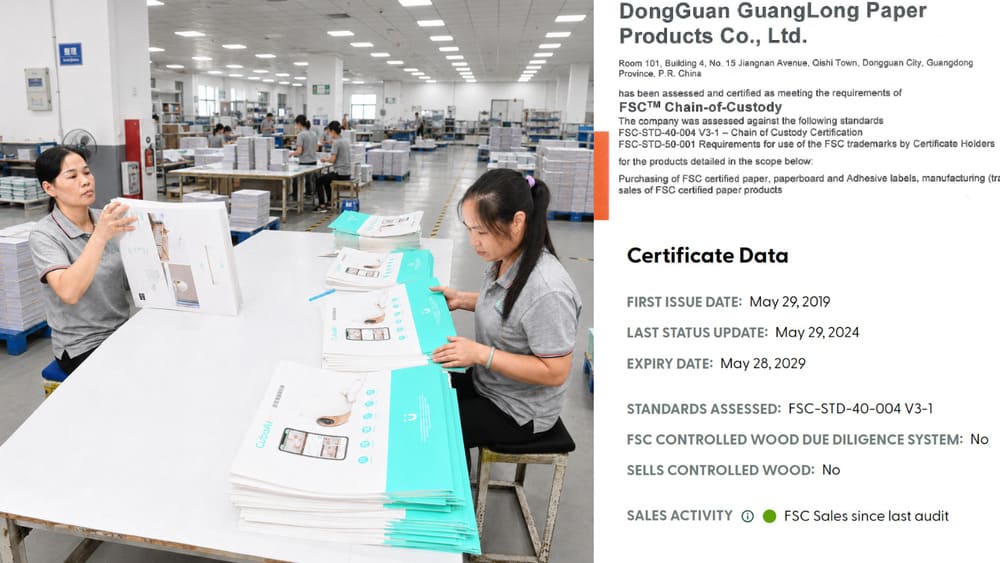
An FSC label printed without proper trademark control can create more than an artwork problem. If the claim cannot be supported, buyers may face packaging rework, audit non-conformities, delayed approvals, and reputational risk in the markets where the product is sold.
That is why choosing an FSC certified packaging manufacturer should start with one question: can the supplier prove that its certificate, scope, trademark use, and order-level FSC documentation are all correctly controlled?
Table of Contents
What Does “FSC Certified Packaging Manufacturer” Actually Mean for Buyers?
For buyers, an FSC certified packaging manufacturer should mean more than a supplier that shows an FSC certificate or says “FSC available.” The real question is whether the FSC claim can be supported for the packaging project you are actually buying.
FSC Certification Should Be Treated as a Supply Chain Claim, Not a Marketing Phrase
When an FSC packaging supplier says “FSC available,” buyers should distinguish between:
- General sustainability language
- FSC-certified paper or paperboard
- A valid FSC Chain of Custody system
- An FSC claim that actually applies to the finished packaging order
These are not the same thing. FSC Chain of Custody requires certified organizations to control eligible FSC inputs, verify relevant suppliers and claims, and maintain traceability through sourcing, processing, labelling, and sale.
At Klong, we sometimes receive artwork where the buyer has already placed an FSC label and assumes it can simply be printed. That is a signal to stop and confirm the applicable FSC requirements before production—not to treat the FSC label as another graphic element in the artwork.
Why Chain of Custody Matters in Packaging Procurement
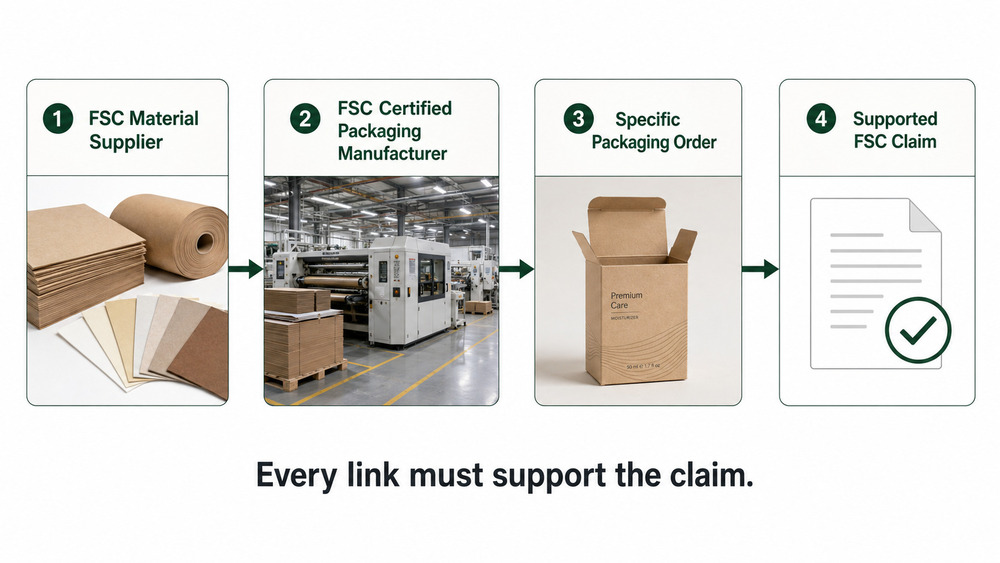
FSC Chain of Custody is what connects an FSC sourcing claim to the actual packaging supply chain. The factory’s own certificate is only one part of that chain. For FSC inputs purchased with an FSC claim, the material supplier and supporting purchasing documents must also support that claim.
For procurement and ESG teams, the useful question is not simply “Did the factory buy FSC paper?” It is “Can the factory trace the FSC material and claim through the order we are buying?”
Certification Scope Matters as Much as Certificate Status
A valid FSC certificate should not automatically be treated as covering every product, site, or manufacturing activity a supplier offers. Buyers should check whether the relevant packaging product and activity fall within the supplier’s certified scope.
This distinction matters because an FSC certificate proves that a certified system exists; it does not by itself prove that the specific packaging order qualifies for the intended FSC claim.
So instead of stopping at:
“Is this supplier FSC certified?”
ask:
“Does this supplier’s FSC certification actually cover the packaging product and activity we are buying?”
How Buyers Should Verify an FSC Packaging Supplier Before Approval
An FSC packaging supplier should be approved on evidence, not on a logo or a sustainability statement. Buyers should be able to verify the certified company, confirm the scope applies to the packaging being purchased, and know that any FSC label used on the artwork has gone through the correct approval process.
Step 1: Request the Current FSC Certificate
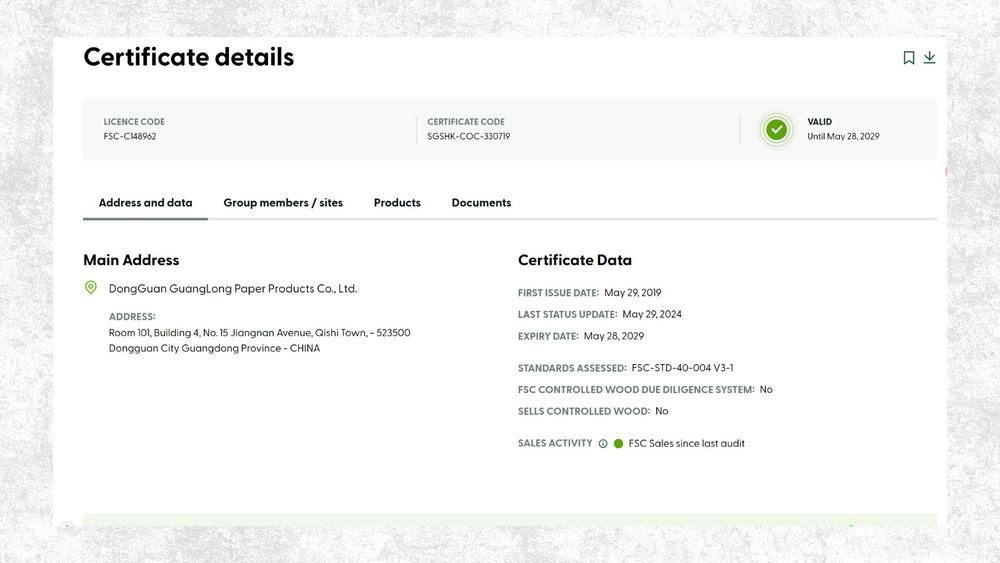
Start with the supplier’s current FSC Chain of Custody certificate. Check the legal organization name, certificate code, validity, and relevant certificate information rather than relying on a website badge or sales presentation.
The certificate is the starting point. It confirms the certified entity; the next steps determine whether that certification actually supports your packaging project.
Step 2: Verify the Supplier in the FSC Public Certificate Search
Search the supplier in the official FSC public certificate database using its organization name, FSC Certificate Code, or FSC Trademark Licence Code where available.
Confirm:
- The organization matches your supplier
- The certificate is valid
- The published information matches the certificate you received
This turns a supplier-provided document into independently verifiable evidence.
Step 3: Check the Certificate Scope Against the Packaging You Are Buying
A valid FSC certificate does not automatically cover every product, site, or manufacturing activity. Check whether the relevant packaging product and production activity fall within the supplier’s certified scope.
For buyer approval, the question is simple:
Does the certificate scope actually cover the packaging product and activity we are buying?
Step 4: Confirm the FSC Evidence Supporting the Project
Most buyers do not need the manufacturer’s full FSC audit trail for every order. If the supplier understands and controls the FSC process correctly, the buyer’s job is relatively simple: confirm that the manufacturer is genuinely FSC Chain of Custody certified and that any FSC label used on the packaging has been properly reviewed before production.
In Klong projects reviewed through SGS, buyers most commonly request the current FSC CoC certificate and, when needed, the Excel or email evidence used during label review.
Behind that buyer-facing evidence, Klong records the material supplier name, material name, and supplier FSC Certificate Code for the FSC input, together with the FSC label used for the project. These records support the manufacturer’s own traceability and audit process; buyers do not normally need to collect the full purchasing and production record themselves.
The practical rule is:
Buyers should verify the supplier and the approved FSC label—not recreate the manufacturer’s entire FSC audit process.
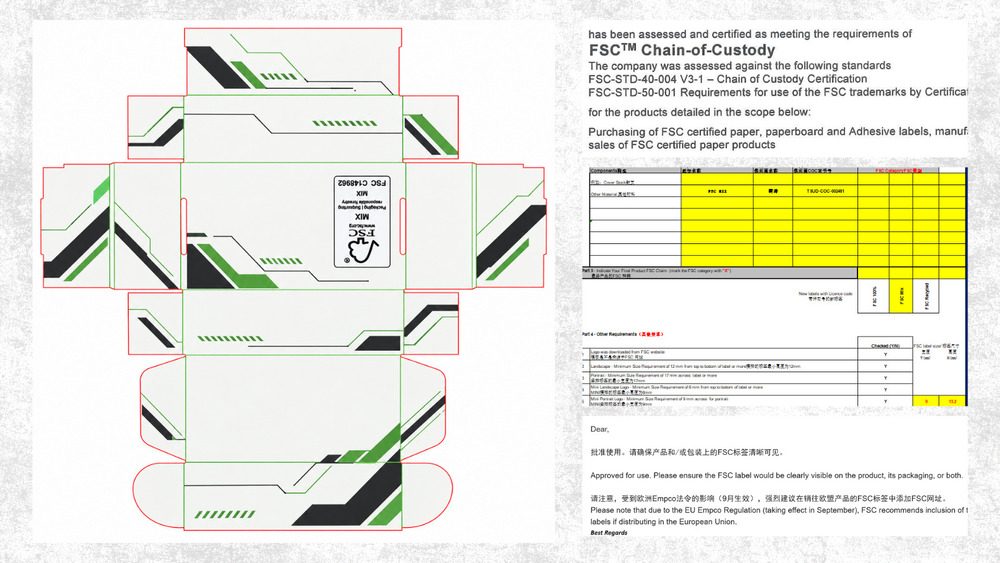
Step 5: Verify FSC Label Approval Before Printing
An FSC label is not simply another graphic that can be added to packaging artwork.
In real Klong projects, some buyers send artwork with an FSC label already placed. We do not release that artwork directly for production. The process is:
Confirm sales country or region → generate the correct FSC label for the intended sales market → place it into the final artwork → submit the artwork to SGS → receive SGS approval by email → release for mass production → send the approved artwork to the customer for record.
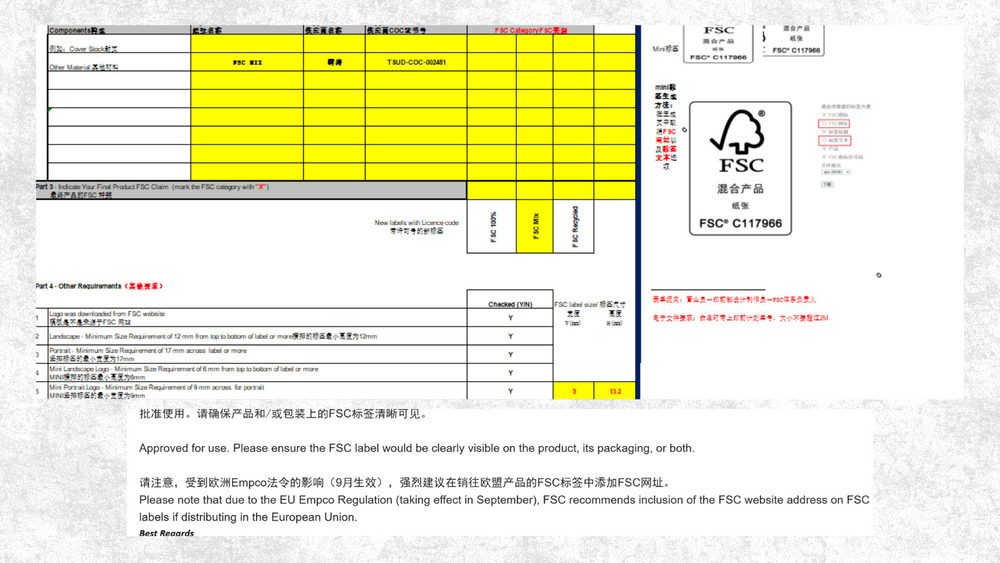
The sales market matters because trademark presentation and label application requirements can vary by market.
The FSC label uses the certificate holder’s FSC Trademark Licence Code. This is different from the FSC Certificate Code recorded for the material supplier in the project’s sourcing documentation.
For Klong, SGS is the current Certification Body. Other FSC certificate holders may use another FSC-accredited Certification Body or an approved Trademark Use Management System.
Before releasing artwork for printing, buyers should confirm:
- Which FSC Trademark Licence Code will appear
- Whether the correct FSC label has been generated for the intended sales market
- How the trademark use was approved
- Whether approval evidence has been retained
If the factory cannot clearly explain this process, do not release the artwork for printing yet.
FSC Supplier Verification Checklist
| Verification Item | What Buyers Should Check | Why It Matters |
|---|---|---|
| FSC Certificate | Current certificate and correct legal organization | Confirms the certified supplier |
| Public Verification | Certificate can be independently verified in the FSC database | Confirms current status and identity |
| Certificate Scope | Relevant packaging product and activity are covered | Confirms the certificate applies to the project |
| Material Chain | Material supplier, material name, and supplier FSC Certificate Code are documented for the FSC input | Confirms the manufacturer is controlling the sourcing chain |
| FSC Label Approval | Label uses the correct FSC Trademark Licence Code and follows the supplier’s approved review process | Prevents incorrect trademark use |
| Project Evidence | FSC CoC certificate and label approval evidence can be provided when required | Gives buyers enough evidence without adding unnecessary audit work |
A credible FSC supplier review connects:
Certificate → Public Verification → Scope → Material Chain → Trademark Approval → Project Evidence
That is the difference between “we can offer FSC packaging” and an FSC claim the buyer can actually verify.
What Sustainability Evidence Should Buyers Keep for Audit and ESG Review?
FSC evidence is most useful when it is retained during supplier approval, not reconstructed only after an audit or customer request appears.
Build an Audit-Ready FSC Evidence File
Buyers do not need to copy the manufacturer’s full FSC audit system. They need enough evidence to show which supplier, FSC claim, and artwork were actually verified and approved for the project.
In Klong projects, the document buyers most often retain is the final artwork with the approved FSC label. Some buyers also request the current FSC CoC certificate and the SGS label-review Excel or approval email.
A practical buyer file may therefore include:
- Final artwork with the approved FSC label
- Current FSC CoC certificate
- FSC public-search verification or saved certificate record
- Relevant certificate scope information
- SGS label-review Excel or approval email, when requested
- Internal supplier approval record, where applicable
Klong separately keeps the purchasing, material-supplier, production, artwork-approval, and transaction records required for its own FSC traceability and audit process. Buyers normally do not need to recreate that internal evidence chain.
In practice, the most useful buyer-side FSC record is often the final approved artwork—not the manufacturer’s complete internal audit file.
Separate FSC Sourcing Evidence From Material Compliance Evidence
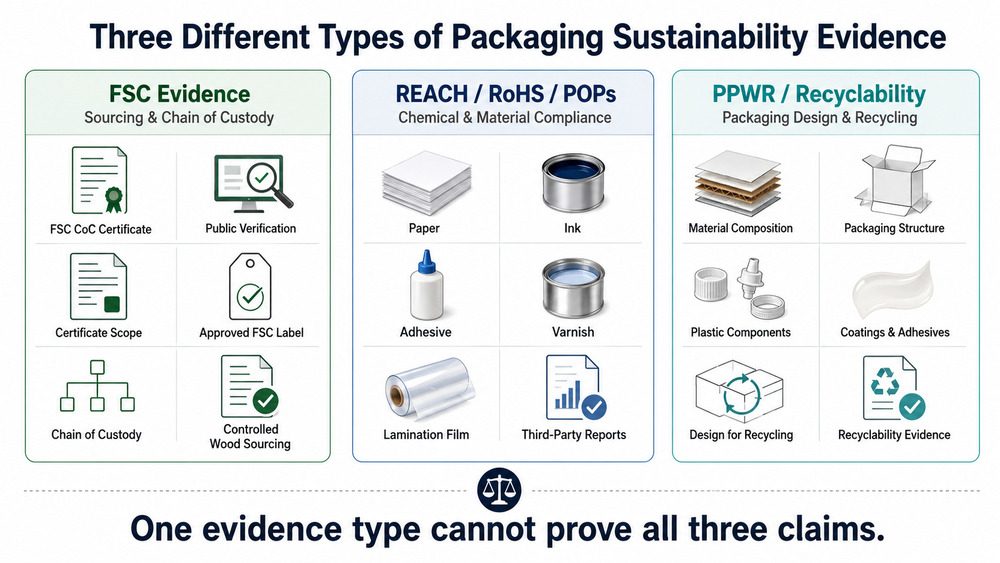
FSC, chemical compliance, and recyclability evidence answer different questions.
FSC evidence supports responsible forest-based sourcing, Chain of Custody, and the FSC claim used for the packaging.
REACH, RoHS and POPs evidence addresses restricted substances and material compliance. In Klong projects, buyers commonly rely on third-party or supplier reports covering materials such as paper, ink, adhesive, varnish, lamination film, and other relevant components.
PPWR evidence addresses a different issue: whether the packaging design is compatible with EU recyclability and design-for-recycling requirements. PPWR uses recyclability performance grades rather than treating “paper packaging” or “plastic-free” as automatic proof of recyclability.
This distinction already affects real packaging decisions. Buyers have asked Klong whether gloss or matte film lamination should still be used for EU packaging. While these finishes are not simply prohibited today, packaging intended for the EU increasingly needs to be designed around recyclability, so unnecessary plastic films should be reviewed early to reduce future redesign risk.
A paper box should not be called “highly recyclable” only because its main substrate is paper. Film lamination, plastic windows, foam, magnets, handles, coatings, adhesives, and other components can change the recyclability assessment of the complete packaging structure.
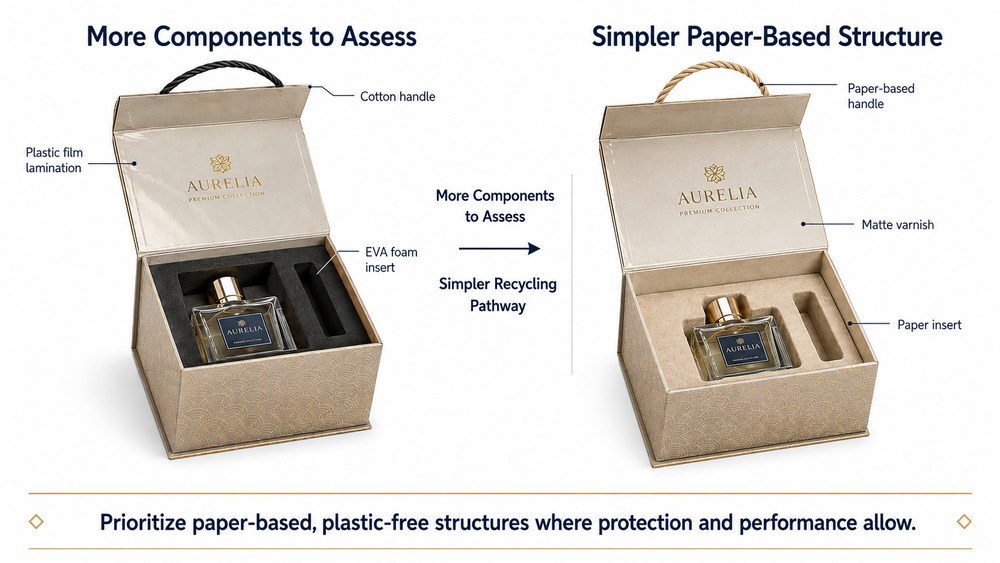
Where product protection and performance requirements allow, Klong generally recommends prioritizing paper-based, plastic-free structures because they can simplify the recycling pathway and reduce future redesign risk.
An FSC certificate therefore proves sourcing, not chemical compliance or recyclability.
When Sustainability Evidence Becomes Part of Supplier Audit
During a supplier audit, FSC is usually only one verification item. If FSC-certified packaging is required, buyers commonly confirm that the supplier’s certificate exists and remains valid.
Broader supplier audits usually focus more heavily on actual process controls and the evidence showing those controls are being followed.
That boundary matters:
FSC evidence supports the sourcing claim; it does not replace the supplier’s wider quality, production, or compliance evidence.
Evidence vs. Green Marketing: A Simple ESG Decision Test
Terms such as “eco-friendly,” “recyclable,” “plastic-free,” or “FSC available” are useful only when the supplier can show what supports the claim.
For buyers, use a simple test:
FSC claim
→ Certificate + Public Verification + Scope + Approved Label Evidence
Chemical compliance claim
→ Relevant material and third-party compliance reports
Recyclability claim
→ Packaging structure + Material composition + Applicable recyclability evidence
Decision:
If the evidence supports the actual claim being made, the claim can be treated as verifiable.
If the evidence does not match the claim, it should not be treated as audit-ready.
FAQ: FSC Certified Packaging Manufacturer Questions ESG Teams Ask
Use these FAQs to verify an FSC packaging supplier, understand what evidence matters, and avoid common certification, artwork, trademark, and compliance mistakes before approving your packaging project.
How can I verify whether a packaging manufacturer is FSC certified?
Do not rely on an FSC logo or sustainability statement alone. Ask for the supplier’s current FSC certificate, then verify the legal organization name, certificate status, and applicable scope through the official FSC public certificate search. The key question is whether the certification actually covers the packaging product and manufacturing activity you are buying.
What FSC evidence should buyers request and keep from a packaging supplier?
Start with the final artwork showing the approved FSC label, which is often the most practical buyer-side record. Keep the current FSC CoC certificate and public verification record for supplier approval, and retain applicable label-review or trademark approval evidence when your ESG, customer, or audit process requires it. You do not need the manufacturer’s complete internal FSC audit file.
What is FSC Chain of Custody in packaging?
FSC Chain of Custody is the system used to control and trace eligible FSC forest-based materials and related claims through the applicable supply chain. For packaging buyers, it provides the traceability behind an FSC claim—from eligible material sourcing through the certified manufacturing process to the packaging you purchase.
Does every packaging order from an FSC-certified manufacturer automatically qualify for an FSC claim?
No. A manufacturer holding FSC certification does not mean every packaging order automatically qualifies for an FSC claim. You still need to confirm that the relevant product and activity are within scope and that the applicable material, FSC claim, documentation, and trademark requirements are correctly controlled for your specific order.
Can a packaging supplier simply print the FSC logo on a box?
No. An FSC label is not simply another artwork element. If your artwork already contains an FSC logo, the supplier should verify the intended sales market, generate the correct authorized label, update the artwork, complete the applicable trademark review, return the approved artwork to you for record, and only then release it for mass production.
Does FSC certification prove REACH, RoHS, POPs, or PPWR compliance?
No. FSC supports responsible forest-based sourcing and Chain of Custody, while REACH, RoHS, and POPs address chemical or restricted-substance compliance. PPWR addresses broader EU packaging requirements, including recyclability and design for recycling. You should therefore treat FSC sourcing evidence, chemical compliance reports, and PPWR-related recyclability evidence as separate checks.
Do buyers or brands need their own FSC certification to use FSC-certified packaging?
Usually not simply to buy and use finished FSC-labelled packaging. In normal packaging projects, the FSC label is handled by the certified packaging manufacturer and uses that certificate holder’s authorized FSC Trademark Licence Code. If your company needs to transfer FSC claims, transform, relabel, or otherwise handle certified products within the FSC Chain of Custody system, confirm whether additional certification is required.
What is the difference between an FSC Certificate Code and an FSC Trademark Licence Code?
An FSC Certificate Code identifies the certification record, while an FSC Trademark Licence Code, typically formatted as FSC-CXXXXXX, identifies authorized FSC trademark use. They are not interchangeable. When reviewing packaging, use the Certificate Code to understand certification evidence and check that the FSC label uses the appropriate Trademark Licence Code.
Can a brand promote FSC-certified packaging on its own website or marketing materials?
Not automatically. An FSC label approved for your packaging does not necessarily give your brand permission to reuse the FSC logo on websites, catalogues, social media, or other marketing materials. Check the applicable FSC promotional trademark requirements separately before using FSC trademarks outside the approved packaging artwork.
Conclusion: Don’t Risk Legal Penalties on Fake FSC Claims
Printing an invalid FSC logo isn’t just greenwashing—it triggers customs holds and retailer rejections. A generic supplier certificate won’t protect you during a compliance audit.
Don’t let fake sustainability claims ruin your product launch.
Download the Compliance & Greenwashing Checklist to verify supplier documents and protect your brand from costly penalties.