
Last reviewed for PPWR regulatory updates: September 2026
A paper box is not automatically PPWR-ready just because most of it is paper. If recyclability risks are discovered too late, buyers may face redesign, re-sampling, reapproval, and avoidable disruption before future PPWR requirements apply.
PPWR Design for Recycling is therefore a complete packaging-system engineering task—not simply a material swap. This guide shows what buyers should review now to reduce recyclability risk and prepare for future Grade A, B and C assessment.
Table of Contents
What PPWR Grade A, B and C Mean for Packaging Design
PPWR already defines the Grade A, B and C thresholds. But paper content, a plastic-free claim, or a supplier sustainability statement is not proof of a final recyclability grade.
The PPWR Recyclability Performance Grades
Under PPWR Annex II:
- Grade A: ≥95%
- Grade B: ≥80%
- Grade C: ≥70%
- Below 70%: technically non-recyclable
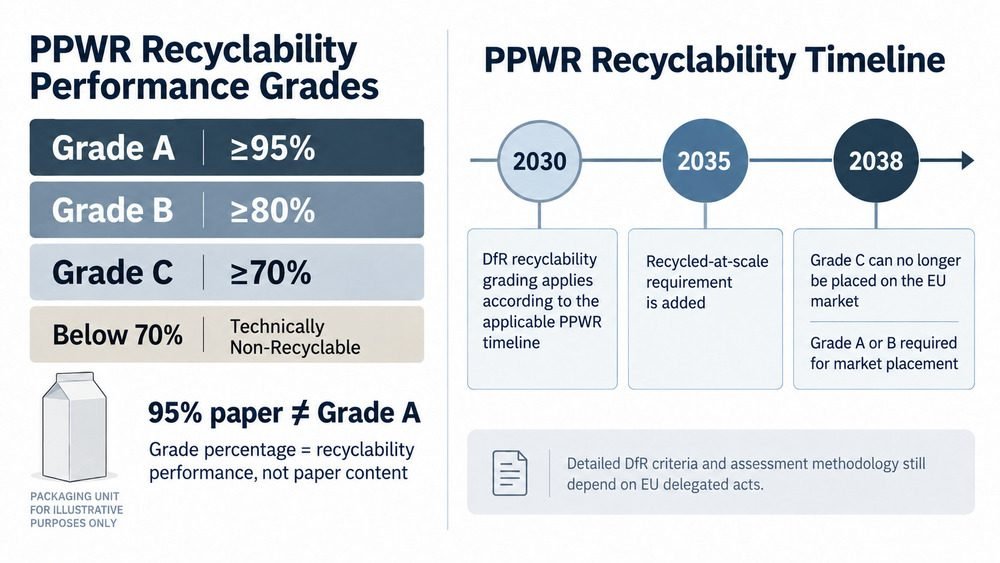
These percentages are DfR recyclability-performance thresholds for the packaging unit. They are not paper-content percentage, recycled-content percentage, collection rate, or a simple recyclable-material percentage. A box that is 95% paper by weight does not automatically qualify as Grade A; final assessment depends on the complete packaging construction, the applicable DfR criteria, component separability, and the relevant recycling pathway.
In current buyer discussions, PPWR readiness is often reduced to: “Can we remove gloss or matte plastic lamination and make the packaging plastic-free?” That can be a useful design direction, but it does not prove a final PPWR grade.
What Is Already Confirmed—and What Still Depends on EU Delegated Acts?
For a current packaging project, buyers should separate three statuses:
- Confirmed: Grade A, B and C thresholds; below 70% = technically non-recyclable; Grade C loses EU market-placement eligibility from 2038.
- Preparatory: DfR readiness review using currently available engineering evidence.
- Not yet proven: A final Grade A, B or C result for a specific design without the applicable official assessment methodology.
The detailed category-specific DfR criteria, assessment methodology, parameter weighting, and treatment of specific packaging constructions still depend on EU delegated acts. For supplier approval today, ask what was reviewed, which packaging components were considered, and what evidence supports the DfR-readiness claim. We see the same pattern in current projects, including requirements from a B Corp customer: the immediate request is often to move toward plastic-free packaging, while final grading still requires the applicable official assessment basis.
Why 2030 Should Influence Packaging Design Before 2030
The applicable DfR grading requirement begins from 1 January 2030 or 24 months after the relevant delegated acts enter into force, whichever is later. From the applicable 2035 stage, packaging must also meet the PPWR recycled-at-scale requirement. From 1 January 2038, Grade C still exists as a classification, but Grade C packaging can no longer be placed on the EU market; Grade A or B becomes the minimum market-access level.
For procurement teams, the risk starts earlier. A packaging specification approved today may still be used for repeat orders when formal grading applies. If it later needs material or structural changes, the buyer may face re-sampling, artwork reapproval, material requalification, customer sign-off, and delayed production release.
Preparing for plastic-free packaging and reducing obvious recyclability risks before specification lock can lower future redesign exposure. It does not guarantee Grade A, lower EPR fees, or automatic future compliance.
Which Packaging Components Can Affect Paper Packaging Recyclability?
Paper packaging recyclability should be reviewed as a complete packaging system, not judged only by the outer paperboard. Before specification approval, buyers should challenge any component that is unnecessary, difficult to separate, permanently bonded without a clear function, or likely to interfere with fibre recovery or screening.
Start With the Predominant Material and the Complete Packaging BOM
Review the complete packaging BOM: main paperboard, inks, coatings, laminations, adhesives, windows, labels, barriers, inserts, reinforcement parts, closures, decorative accessories, and other mixed-material components.
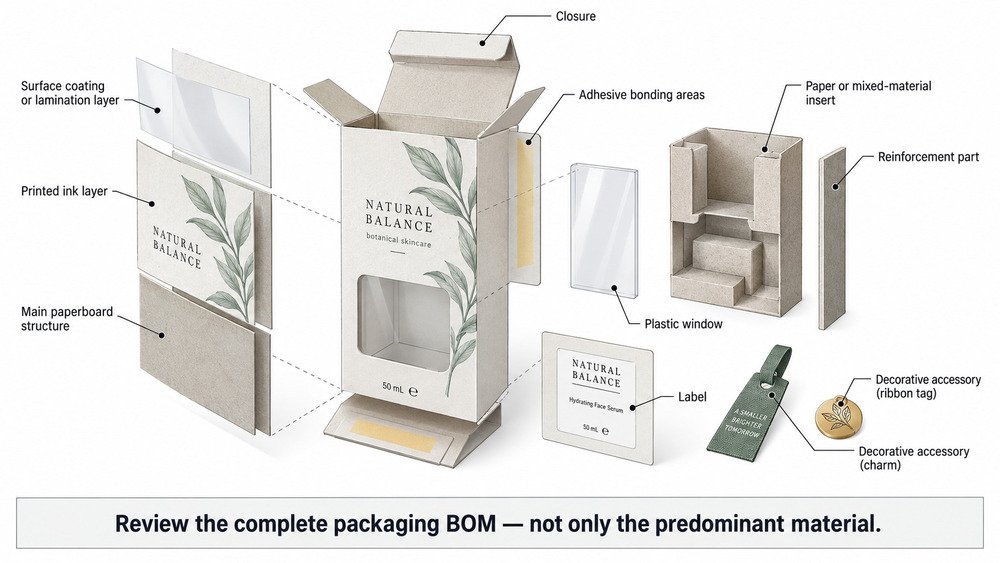
For each component, ask:
- Is it functionally necessary?
- Can it be removed, simplified, or separated?
- Can the same function be achieved with less recycling interference?
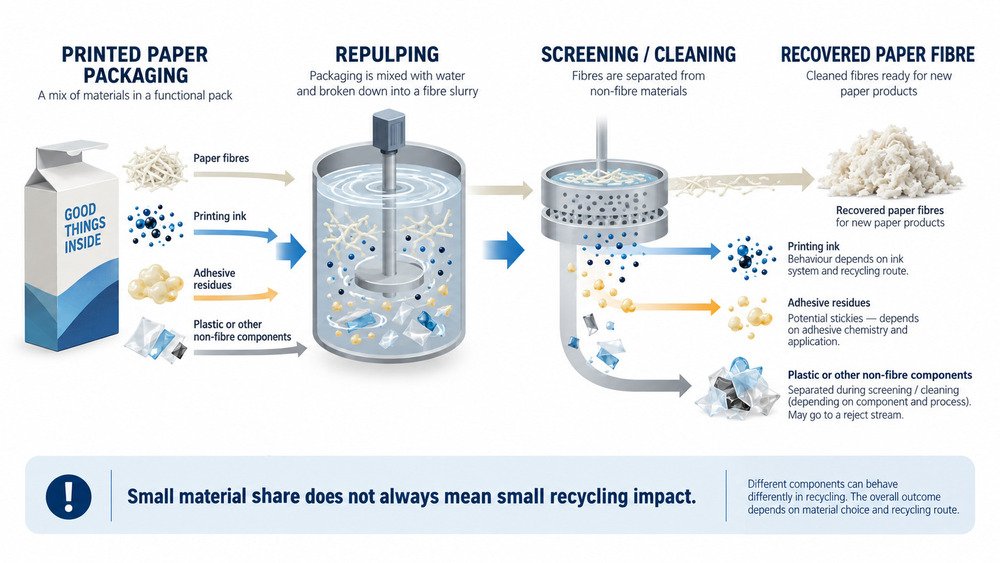
- What happens to it during sorting, repulping, and screening?
A small component can still matter if it disrupts separation or fibre recovery. Weight alone is not enough.
In Klong projects, BOM data is normally recorded by practical material unit—for example the box, insert, transit carton, desiccant, quantity used, and component weight. Ink, adhesive, and varnish are not artificially split into unsupported micro-weight estimates when reliable unit data is unavailable.
If a component’s recycling impact cannot be supported by reliable material data or is unclear for the intended recycling route, treat it as a verification point—not an assumption.
Printing Inks: De-Inking and Recycled Fibre Quality
Ink chemistry and coverage can affect how printed paper behaves during recycling, including residual colour, process-water contamination, and de-inking compatibility where relevant.
Not every mill uses the same recycling route, so buyers should focus on the actual print system: ink type, coverage, heavy solid-colour areas, and UV-cured or other special systems where applicable. Supplier technical data and relevant test evidence can support the review, but they should not be treated as automatic proof that the finished package is recyclable.
Adhesives: Small Material, Potentially Large Stickies Risk
Adhesive may represent only a small share of packaging weight, but problematic residues can still affect repulping and screening. Tacky contaminants are commonly described as macrostickies and microstickies and may reduce pulp cleanliness or create deposits during recycling.
The useful buyer review is not simply whether the glue is “water-based.” Check the adhesive chemistry, application area and amount, bonding structure, and expected behaviour during repulping and screening. Not every adhesive creates stickies, and no adhesive type should be assumed universally PPWR-compatible.
Material Separability: Can Different Components Be Removed?
Mixed-material packaging creates more recycling complexity when secondary parts remain permanently bonded to the paper structure. Typical examples include plastic windows or trays, foam, magnets, metal accessories, fabric ribbons, and multi-material inserts.
Where practical, the design can be simplified, converted to a paper-based structure, mechanically assembled, or made easier to separate. Klong can document major components by material, weight, and separability, for example:
Outer paper box — 300 g — paperboard
Foam insert — 20 g — foam
Assembly — not glued; manually separable
The key is reliable project data, not false precision. For minor layers such as ink, adhesive, or thin coatings, supplier specifications and applicable technical evidence are more useful than invented gram-level estimates.
Plastic Windows, Laminations and Barrier Layers
Thin plastic layers can still affect recycling performance even when paperboard is the predominant material. Review the material, surface coverage, bonding method, separability, and whether the function is actually necessary.
The useful buyer questions are:
- Why is the plastic needed?
- Can the same function be achieved another way?
- Can the component be removed or separated?
If the plastic layer adds avoidable recycling complexity without a necessary function, it should be challenged before specification lock. Its presence—or removal—alone is not enough to determine a PPWR recyclability grade.
Decorative Accessories: The Small Parts Buyers Forget
Magnets, ribbons, plastic handles, metal eyelets, decorative plaques, and non-paper closures are easy to overlook because they are not the main packaging material.
Each accessory should justify its function, brand value, recycling impact, and separability. If it adds little value but creates unnecessary recycling complexity, it should be removed, replaced, or redesigned before approval.
Plastic-Free Coatings vs. Plastic Lamination: Recyclability, Performance and Cost
Removing gloss or matte plastic lamination simplifies the surface construction, but not every film-free finish delivers the same performance. Buyers need to decide whether the priority is lowest cost, laminated-like appearance, stronger surface durability, or a balance of all three.
In this section, a film-free surface treatment means replacing the plastic lamination layer. It does not automatically mean the complete packaging system is plastic-free; windows, inserts, handles, bags, and other auxiliary components must be reviewed separately.
Removing Plastic Lamination Is Not a One-for-One Material Swap
Traditional gloss or matte lamination adds a continuous plastic film over the printed paperboard.
Once that film is removed, Klong generally works with two surface-treatment levels:
- Standard gloss or matte varnish: the lower-cost route when the buyer mainly wants to remove lamination and can accept more visible fold wear.
- Premium plastic-replacement gloss or matte coating: a higher-performance route when the buyer wants the surface appearance, touch, rub resistance, and fold performance to remain much closer to conventional lamination.
Removing the film normally does not cause an obvious loss of box stiffness by itself. Structural strength still depends mainly on the paperboard, box structure, and internal protection system.
It can simplify the material construction, but it does not by itself prove a higher PPWR recyclability grade. Final recyclability depends on the complete packaging system and the applicable DfR assessment method.
Why Standard Varnish and Premium Plastic-Replacement Coatings Perform Differently at Folds
The practical buyer question is:
“After removing lamination, how close can the fold still look to the original box?”
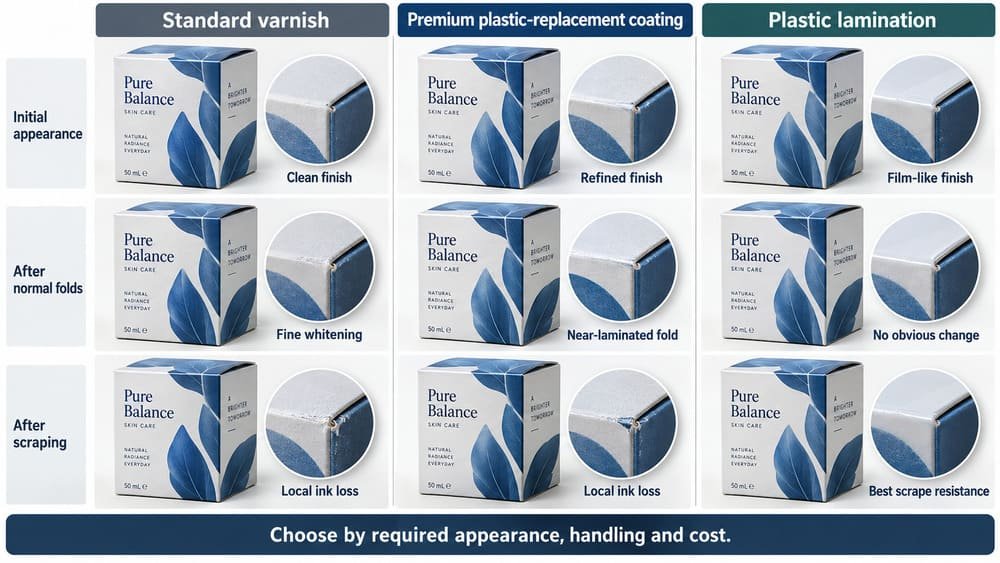
With standard gloss or matte varnish, the surface may look acceptable when first produced, but after several forward and reverse folds Klong commonly sees light surface cracking or fine white lines around the crease.
Premium plastic-replacement coatings behave differently. When combined with a stable paperboard and suitable creasing, normal forward and reverse folding can remain visually very close to laminated packaging. Premium matte systems in particular can achieve a surface appearance and feel very close to conventional matte lamination.
The difference is that coating does not have the same stretch as a plastic film. Under aggressive scraping with a fingernail or another hard, pointed object, local coating and ink can still be removed.
That is a real material limit, but it is usually not a normal-use requirement for paper packaging.
The approval standard should therefore reflect real handling, folding, abrasion, and end-use conditions—not an artificial abuse test the finished pack is never expected to pass.
Substrate Quality Is Part of the Coating System
The coating cannot be judged separately from the paperboard underneath it.
In Klong projects, there are usually two practical routes:
- Cost-first: standard board + standard gloss or matte varnish, accepting a higher chance of fold whitening or light surface cracking.
- Appearance-first: more consistent branded paperboard + premium plastic-replacement coating, accepting a higher material and finishing cost to achieve a result much closer to gloss or matte lamination.
Higher-performance plastic-replacement finishes may use a two-stage process—base coat followed by top coat—rather than the single-pass varnish used on a basic cost-first specification.
Once a board + coating combination has been approved, Klong locks the paper grade/source, coating product, application method, and approved sample. If the paper, coating product or supplier, or coating process changes, a new sample must be approved before mass production.
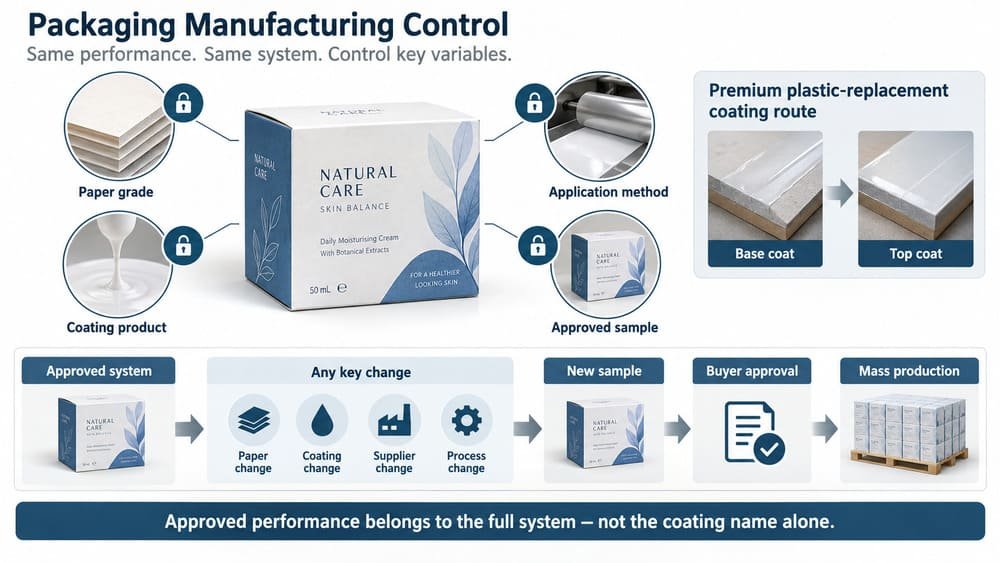
Grain direction and crease design still matter, but they are only part of the system. A coating name alone is not enough for approval—the board, print, coating, grain, and crease combination must work together.
Validate the Replacement Before Mass Production
A film-free conversion should be approved on a physical, production-relevant sample—not from a coating name or supplier datasheet alone.
Depending on the project, Klong reviews:
- Surface appearance
- Gloss or matte consistency
- Rub and scratch resistance
- Crease and fold appearance
- White-line or ink-loss risk
- Finished-box appearance
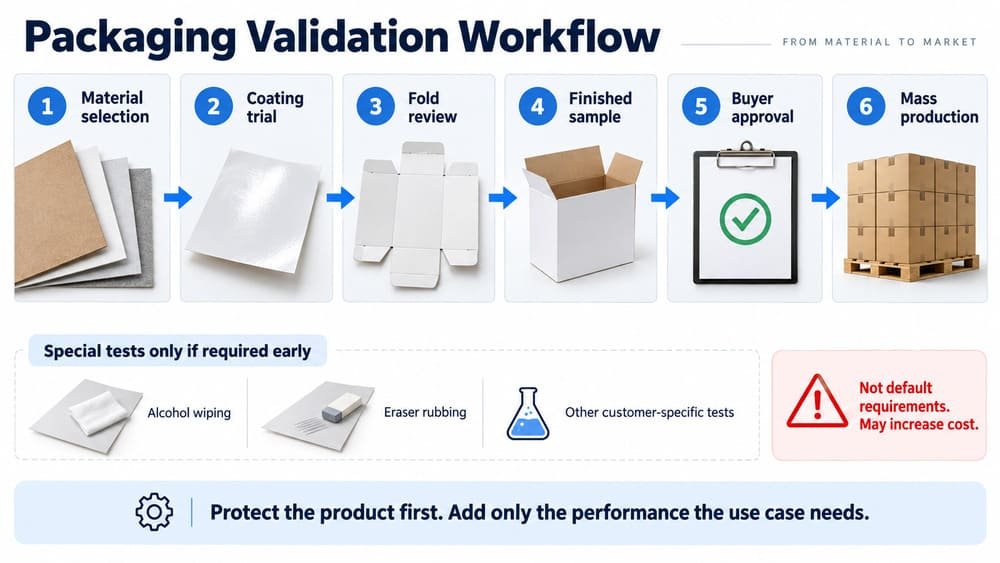
If the original packaging has already passed a drop test and only the surface lamination changes to coating, Klong does not normally repeat the drop test automatically. Re-testing is more relevant when the product is unusually heavy, the change may affect protection, or the buyer specifically requires it.
Special requirements such as alcohol wiping or eraser rubbing must be specified before coating selection and sampling because they may require a different formulation and added cost.
The engineering priority remains simple: protect the product first, then add only the surface performance the actual use case requires.
Final approval may be recorded by email or by a signed returned sample, depending on the buyer’s approval process.
Release the new surface system only after the actual board, print, coating, and crease combination meets the agreed appearance, folding, protection, and end-use requirements.
The Commercial Reality: Upfront Cost vs. Future EPR Exposure
Many buyers want to remove plastic lamination without increasing packaging cost. In practice, that depends on the performance level they expect.
Standard gloss or matte varnish can support a lower-cost film-free conversion and may cost less than conventional lamination. If the buyer expects the finished surface and fold performance to remain much closer to gloss or matte lamination, premium plastic-replacement coating—and sometimes a more consistent paperboard—will normally increase cost.
Additional requirements such as alcohol resistance or special rub performance can also increase cost because they may require a different coating formulation or validation process.
There is no useful universal percentage because the difference depends on quantity, box size, substrate, print coverage, structure, and coating process.
The right comparison is not the coating price alone, but the long-term packaging cost: manufacturing + material upgrade + validation/requalification + redesign risk + future EPR exposure.
Under PPWR, EPR financial contributions are to be modulated according to recyclability performance grades 18 months after the relevant delegated and implementing acts enter into force. Plastic lamination does not automatically create a fixed EU penalty, and replacing it with a coating does not guarantee a lower national EPR fee.
If future PPWR assessment methods show that a laminated packaging construction cannot achieve the required recyclability grade, that structure will need to be redesigned. Replacing the film with a suitable coating may be one route, but the decision must be based on the complete packaging assessment.
Klong can provide the packaging material data needed for buyer EPR reporting, while the final fee remains subject to the applicable national system.
The buyer should therefore compare the approved performance level and total packaging cost—not the coating price alone.
How Buyers Should Prepare Paper Packaging for PPWR Design for Recycling
PPWR Design for Recycling should be handled as a controlled packaging review, not as a last-minute compliance check. Buyers need a clear baseline showing what the pack contains, what can be simplified, what has been validated, and what evidence supports the approved version.
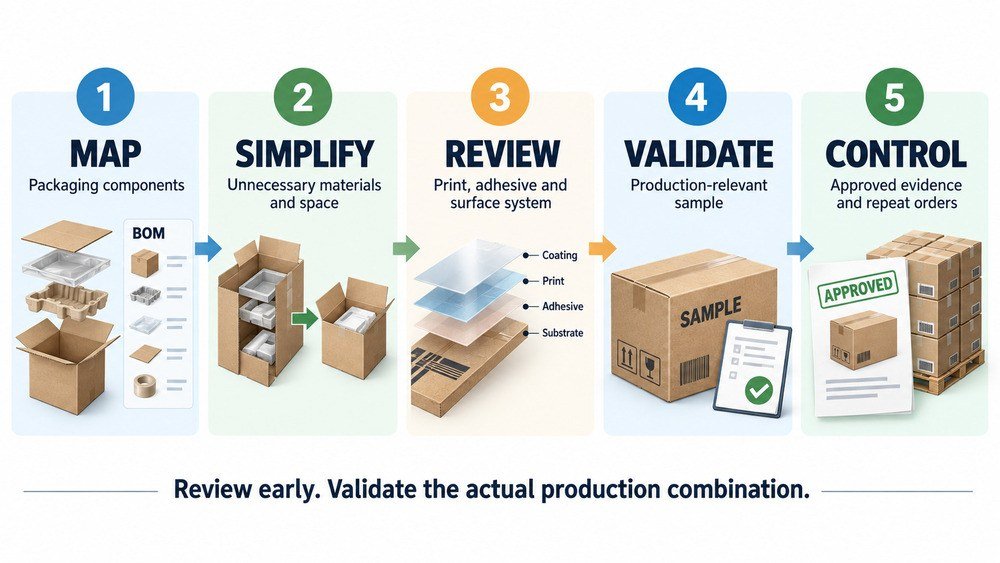
Step 1: Start With the Existing Pack or New Project Brief
For an existing pack, Klong can usually start with the physical sample + current material information.
For a new EU-bound project, review should begin before structure and sample approval so avoidable plastic, excess packaging size, and unnecessary cushioning can be reduced early.
Start a working BOM covering the main paperboard, inserts, printing inks, coatings or lamination, adhesives, windows, labels, barrier layers, closures, and decorative accessories.
For major separable components, record where practical:
- Component
- Material
- Unit weight
- Bonded or separable
Example:
Outer paper box — paperboard — 300 g
Foam insert — foam — 20 g
Assembly — not glued; manually separable
Do not create false precision. If reliable gram-level data for ink, adhesive, or thin coatings is unavailable, use supplier specifications or other technical evidence instead.
Step 2: Reduce Unnecessary Material, Space and Mixed Components
For every non-paper or mixed-material component, ask:
- Is it needed for protection?
- Is it needed for function?
- Is it needed for branding?
- Can it be reduced, replaced, or separated?
The same principle applies to packaging size and cushioning. Where protection allows, Klong normally recommends reducing unnecessary box volume and filler because oversized packaging also increases logistics and storage cost.
Protect the product first, then remove avoidable material and empty space.
Step 3: Review Printing, Adhesives and Surface Treatment as One Production System
For each ink, adhesive, coating, or lamination system, confirm:
- What is used
- Where it is used
- What supplier evidence is available
- What still requires verification
Then review the actual board + print + adhesive + surface-treatment combination, not isolated datasheets.
For printing, check ink type, coverage, and de-inking relevance where applicable.
For adhesives, check chemistry, application area, and whether screening or stickies behaviour needs further review.
For surface treatment, validate the actual board and finishing combination used in production.
Approve the production combination, not the material name alone.
Step 4: Prototype, Validate and Decide What Needs Re-Approval
A DfR change should be validated on a production-relevant sample before the specification is frozen.
Typical checks may include:
- Surface appearance
- Folding and crease performance
- Structural performance
- Assembly
- Product protection
- Production feasibility
Not every change requires the same response:
- Artwork-only change: version control and artwork approval
- Material or process change: re-sample the changed production combination
- Protection reduction: revalidate structural or drop performance where relevant
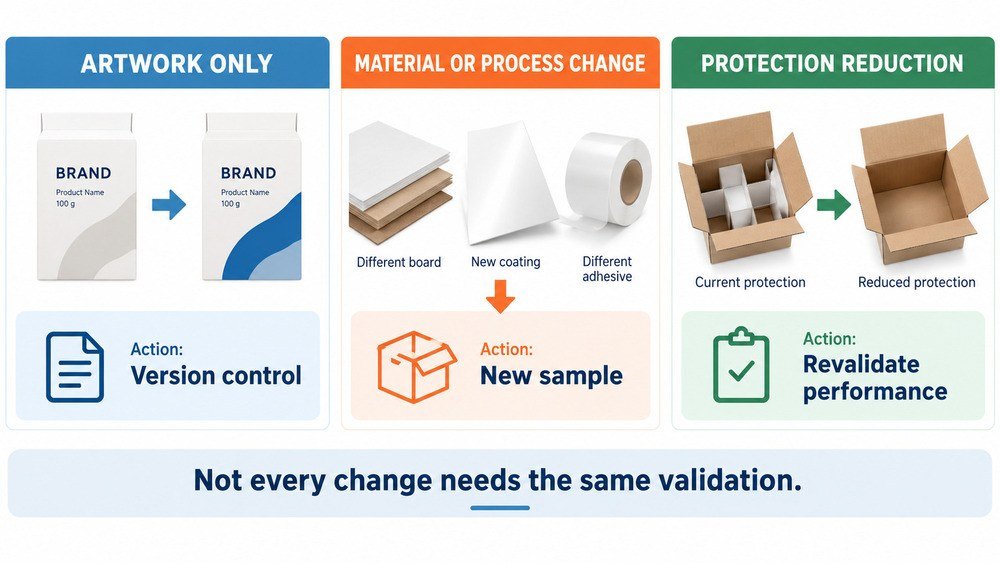
For major protective-insert reductions, test conditions follow the applicable project or customer requirement. Some customers specify a 1 m drop sequence covering one corner, three edges, and six faces after the full product and accessories are packed.
Do not freeze the specification while protection, production feasibility, appearance, or recycling interaction still requires verification.
Step 5: Build the Approved Evidence Baseline and Control Repeat Orders
After validation, convert the working BOM into the approved packaging baseline.
Keep the evidence focused on the approved version:
- Controlled BOM and major component weights
- Material and component specifications
- Ink, adhesive, and surface-treatment information
- Structural / separability information
- Applicable compliance and technical evidence
- Sample, approval, test, and change records
Not every ink, adhesive, or coating is universally required by PPWR to have its own individual third-party report. Evidence should match the actual material, destination market, buyer requirement, and approval need.
For repeat orders, Klong checks the latest approved version and retained sample, verifies incoming material against the work order, and uses the approved reference through printing, die-cutting, and box forming.
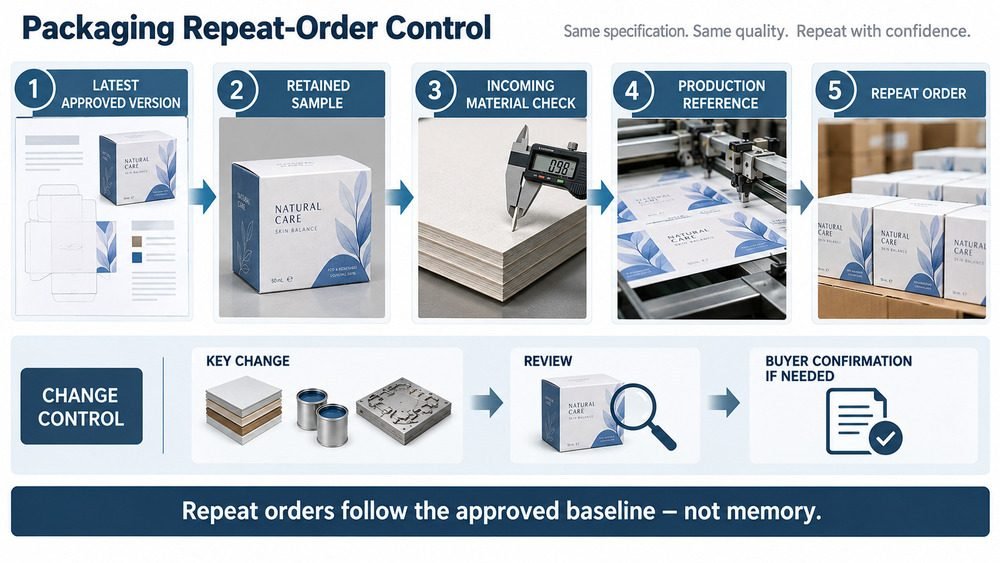
If a key supplier, material, coating, structure, or production process changes, the change is reviewed before production. If the risk cannot be closed internally, it is escalated to the buyer for confirmation.
This gives the buyer a controlled baseline for future PPWR DfR assessment.
PPWR Design for Recycling Engineering Review Matrix
| Design Element | Buyer Question | Potential Risk | Validation Direction |
|---|---|---|---|
| Paperboard | Is the substrate appropriate and consistent? | Material variability or recycling interaction | Material spec + finished-system review |
| Printing Ink | How does the ink system behave during recycling? | De-inking, fibre-quality or process-water risk | Ink type + coverage review |
| Plastic Lamination | Is the film functionally necessary? | Added material layer / recycling complexity | Compare alternative surface systems |
| Film-Free Coating / Varnish | Does it meet appearance and production needs? | Recycling interaction, abrasion or fold limits | Supplier evidence + coating trial |
| Adhesive | Could residues affect screening or fibre recovery? | Stickies / pulp contamination risk | Adhesive specification review |
| Plastic Window | Can it be removed or separated? | Mixed-material complexity | Remove, replace or separate |
| Barrier Layer | Is the barrier function necessary? | Multi-layer complexity | Functional requirement review |
| Decorative Accessories | Does the part add enough value? | Sorting / separation complexity | Remove, replace or redesign |
| Grain / Crease | Can the selected surface system withstand folding? | White lines, ink loss or appearance risk | Physical sample validation |
| Insert | Is it necessary and properly sized? | Excess material or reduced protection if over-simplified | Structure + protection validation |
This matrix identifies engineering risks and verification needs. It does not assign PPWR Grade A, B, or C.
FAQ: PPWR Design for Recycling Questions Packaging Engineers Ask
These FAQs address the buyer questions that matter most before approving paper packaging for the EU: how PPWR recyclability is assessed, which assumptions are wrong, what material changes matter, what evidence to request, and when a packaging design should be reviewed again.
What is PPWR Design for Recycling, and how is it different from “recycled at scale”?
PPWR Design for Recycling evaluates whether a packaging design is compatible with sorting and recycling, while “recycled at scale” looks at whether that packaging is actually collected, sorted, and recycled at sufficient scale in practice. They are separate PPWR requirements and apply at different stages.
What are PPWR recyclability Grades A, B and C?
PPWR defines Grade A as ≥95%, Grade B as ≥80%, Grade C as ≥70%, and below 70% as technically non-recyclable. These are recyclability-performance thresholds for the complete packaging unit, not paper-content percentages. From 2038, Grade C will no longer meet the EU market-placement requirement.
Is PPWR Grade A a certification, and can a supplier confirm it today?
No. Grade A, B and C are PPWR recyclability-performance grades, not supplier-issued certificates. Buyers are already asking for plastic reduction and paper-based alternatives, but a final grade should not be claimed until the packaging can be assessed under the applicable official DfR methodology.
Does a 100% paper box automatically achieve PPWR Grade A or B?
No. An all-paper box does not automatically achieve Grade A or B. The complete packaging unit still includes printing, coatings, adhesives, labels, barriers, decorative treatments, separability, and interaction with the relevant recycling process.
Does recycled content improve the PPWR recyclability grade?
Not automatically. Recycled content and recyclability performance are separate PPWR requirements. A box can contain recycled fibre without achieving a higher recyclability grade, while a highly recyclable design does not by itself prove any specific recycled-content level.
Does removing plastic lamination automatically improve the PPWR recyclability grade?
No. Removing plastic lamination is a design change, not proof of a higher PPWR grade. It can simplify the material construction, but the result still depends on the replacement surface treatment, paperboard, inks, adhesives, other components, and the applicable DfR methodology.
Can a film-free coating replace gloss or matte plastic lamination?
In many applications, yes, but it is not a one-for-one replacement. Buyers usually need to confirm final colour, crease appearance, drop-test impact, and cost on the actual sample. Surface-treatment changes can shift printed colour, especially on colour-sensitive artwork, so artwork alone is not enough for approval.
Do printing inks, adhesives, foil stamping, or Spot UV affect PPWR recyclability?
They can, but none automatically fails PPWR. The impact depends on material chemistry, coverage, separability, recycling interaction, and the applicable DfR criteria. Buyers should review the complete print, adhesive, decorative, and surface-treatment system rather than judging one finishing process in isolation.
What packaging data and evidence should buyers request from their supplier?
Buyers should request the data needed to identify and control the approved packaging version: BOM, major material types and weights, separability, surface-treatment details, material specifications, applicable compliance evidence, and sample or change records. In Klong projects, PPWR-related, RoHS, REACH, and heavy-metal test evidence are commonly requested where applicable.
When should PPWR recyclability be reviewed again after packaging is approved?
Not every change needs the same response. Artwork-only changes usually need version control; paper, coating, adhesive, window, or process changes normally require re-sampling; and a major reduction in protective packaging should trigger renewed performance validation. Repeat orders should also be checked against the latest approved version.
Should buyers redesign now if the final PPWR grading methodology is not yet fully established?
Yes—where obvious recyclability risks can already be reduced without compromising protection or production performance. Buyers can simplify materials, remove unnecessary plastic, improve separability, validate film-free surface options, and build a controlled BOM and evidence baseline without claiming a final grade.
Conclusion: Don’t Lock In a Design That Will Fail EU Grade C Standards
Under the upcoming PPWR timeline, falling below the Grade C recyclability threshold means your packaging will face a legal market ban. Discovering this after mass production guarantees dead stock and an expensive, forced redesign.
Don’t wait for a compliance failure to change your packaging design.
Validate your materials early using the Klong DfR Engineering Framework™ to remove recyclability risks before your specifications are locked in.