
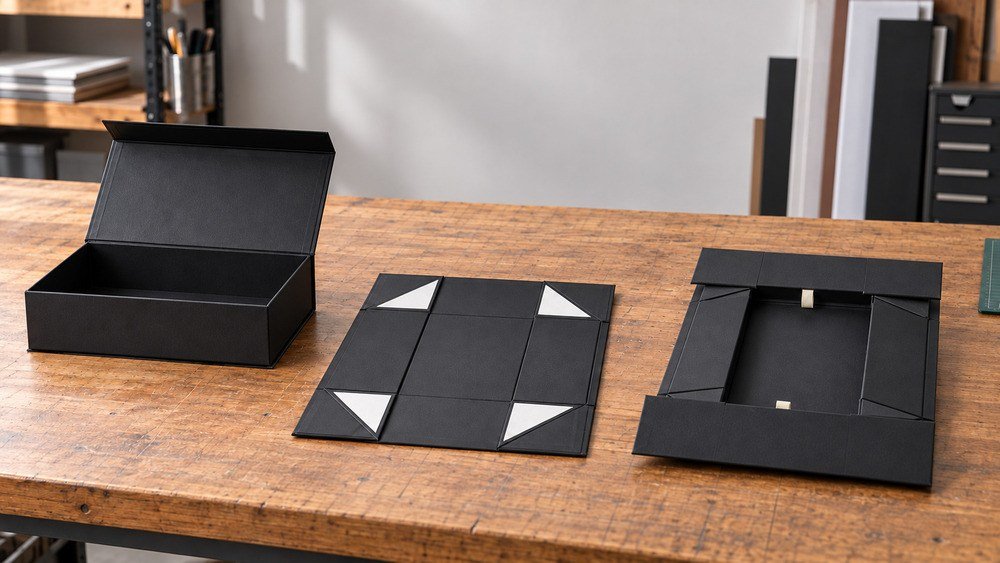
A flat-packed rigid box can save freight and warehouse space, then give those savings back through higher factory costs and slower assembly. The difference becomes obvious when packing teams must peel adhesive liners, manage scraps, and build every box before filling it.
The right choice is not simply traditional versus collapsible. It is whether a traditional, 5-piece, or 7-piece rigid box delivers the required premium experience at the lowest practical total cost—with a workable assembly method, dependable insert fit, and materials suited to the destination market.
Table of Contents
Collapsible vs Traditional Rigid Boxes: What Is the Structural Difference?
Traditional rigid boxes ship fully formed, while collapsible rigid boxes ship flat and require final assembly. Both can offer a premium presentation, but differ in assembly steps, structural support, and manufacturing requirements.
Traditional Rigid Boxes: Fixed Geometry, Minimal Final Assembly
Traditional rigid boxes have permanently formed corners and arrive ready to fill. Common designs include lid-and-base and book-style boxes.
Depending on the structure and order quantity, factories use manual or automated forming. These boxes offer stable geometry and minimal packing work, but occupy their full volume during shipping and storage.
The 5-Piece Collapsible Rigid Box: Simpler Flat-Pack Construction
In Klong's 5-piece book-style design, the outer cover is preassembled while the inner box lies flat against it. Lid closure and inner box fixation are separate choices. The lid may use magnets, fabric or paper ribbons, or a paper tuck-in tab.
Adhesive-fixed: The customer peels four release liners from triangular adhesive areas, then presses the corners into place. The discarded liners accumulate at the packing station, and once bonded, the box is generally not intended to fold flat again.
Magnet-fixed: Magnets hold the inner box corners and side panels, not just the lid. They eliminate adhesive-liner peeling and can allow repeated folding and reopening, but add component cost and require attention to how the magnets are separated from the paperboard at end of life.

EU recyclability consideration: The EU Packaging and Packaging Waste Regulation (PPWR) does not impose a blanket ban on magnets in rigid boxes. For EU-bound designs, however, permanently embedded or bonded magnets deserve an early review because they can complicate separation and paper recycling. The practical question is whether the closure design is compatible with the intended collection and recycling route—not whether a magnetic closure looks premium.
Factory forming: Klong can produce 5-piece boxes manually for smaller orders or by machine for larger runs. Small quantities do not automatically rule out this structure.
The 7-Piece Collapsible Rigid Box: Faster Final Forming and Stronger Structural Support
Klong's 7-piece design adds two reinforcement panels. The customer opens the collapsed inner box and folds these panels inward to secure and reinforce it—without peeling corner adhesive liners or using structural magnets.
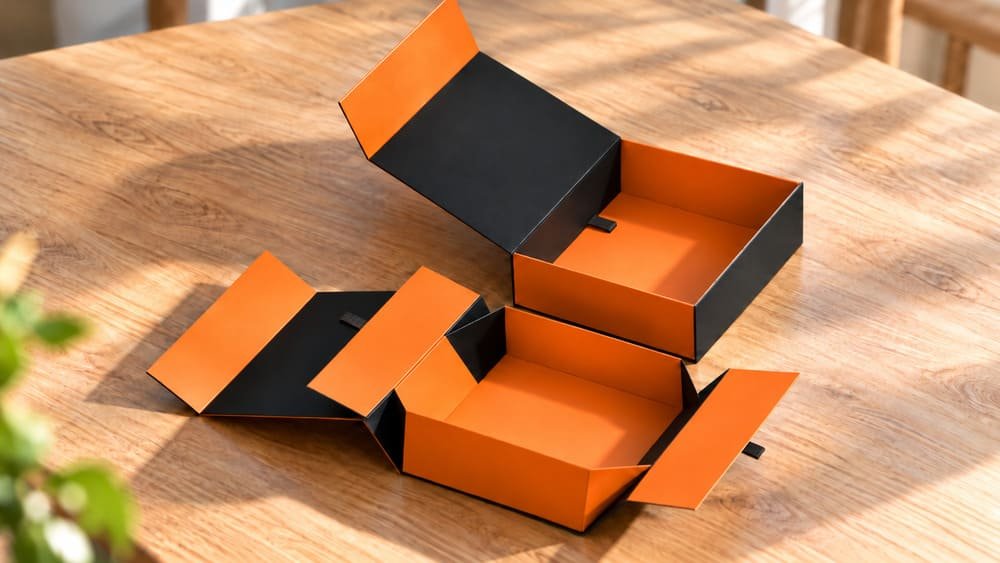
This eliminates the four release-liner peeling steps and the resulting liner waste. In a Klong project, a customer switched from an adhesive-fixed 5-piece box because the peeling and disposal were cumbersome. The two reinforcement panels also make the assembled 7-piece structure more stable, rather than merely faster to form.
For repeat flattening: Klong has made 7-piece boxes with fabric pull tabs that help lift the reinforcement panels, as well as a tab-free structural release option. Pull tabs make reopening easier; the tab-free solution saves the tab material and the work needed to install it. Neither option is automatically necessary for a box intended to stay assembled.
For heavier products, Klong generally recommends evaluating the reinforced 7-piece structure, subject to the product and box specifications.
However, 7-piece production requires more demanding equipment and can be difficult for small runs. In such cases, a traditional rigid box may be more practical when fixed, supportive construction is needed.
5-Piece vs 7-Piece: The Buyer Decision Difference
| Factor | Traditional Rigid | 5-Piece Adhesive | 5-Piece Magnet | 7-Piece Collapsible |
|---|---|---|---|---|
| Shipping form | Fully formed | Flat | Flat | Flat |
| Customer assembly | Ready to fill | Peel four liners; fix corners; clear liner scraps | Open; secure magnetic panels | Open; fold two reinforcement panels inward |
| Inner box fixation | Fixed corners | Adhesive | Structural magnets | Fold-in reinforcement panels |
| Repeated folding | No | Generally no after bonding | Generally possible | Possible with pull tabs or a tab-free release design |
| Structural support | Fixed geometry | Bonded corners | Magnet-fixed panels | Two fold-in reinforcement panels |
| Factory forming | Manual or automated | Manual or machine, depending on quantity | Manual or machine, depending on quantity | More demanding equipment |
| Main limitation | Shipping volume | Peeling time and liner waste | Component cost and end-of-life separation | Small-run feasibility; optional release-feature cost |
When comparing suppliers, confirm the materials, final assembly method, and whether factory forming is manual or machine-based. The same box label does not necessarily mean the same construction.
The Commercial Equation: Manufacturing Cost vs Logistics Savings
A collapsible rigid box usually costs more at the factory, but may cost less to ship and store. Whether it saves money depends on the actual order, freight charges, and final assembly work.
Why Collapsible Rigid Boxes Usually Cost More at the Factory
For comparable dimensions, materials, finishes, and quantities, traditional rigid boxes generally have a lower factory price. Collapsible designs involve additional forming and fixing operations, but the cost difference depends heavily on order quantity and production method.
At Klong, smaller 5-piece orders can be formed manually, while larger runs may use machine forming. Our 7-piece construction places higher demands on production equipment, making some small runs less economical. We choose the production method based on the customer's specifications and order volume rather than assuming one process fits every order.
Ask suppliers to quote both structures against the same specifications and quantity, with applicable production costs included. Otherwise, the price difference may reflect the quotation scope rather than the box structure.
Where Logistics Savings Come From—and How to Verify Them
Flat-packed rigid boxes occupy less space before filling, allowing more units per master carton. This matters most when boxes are relatively large and order quantities are substantial.
For the same order, compare both structures' factory prices, master carton dimensions, units per carton, and total carton counts.
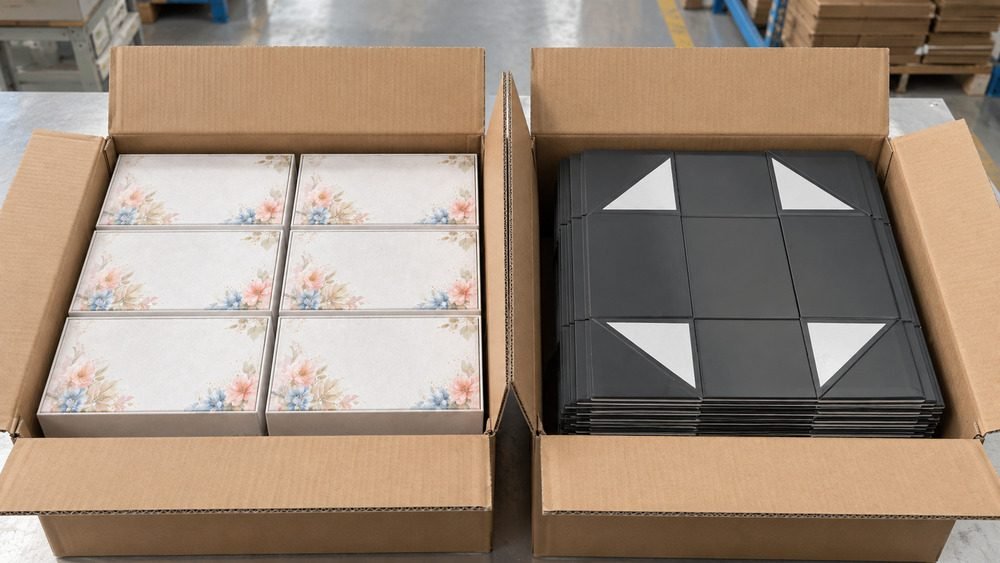
Total Shipping CBM = Master Carton CBM × Number of Master Cartons
Use the packing data to check actual freight and warehouse costs. Lower CBM does not necessarily mean an equivalent reduction in freight charges.
For CIF, DAP, or DDP orders, Klong can compare both structures within the agreed quotation scope. For FOB orders, we provide packing details and can suggest alternatives for the buyer to evaluate with their freight forwarder. The two options should be assessed on the same delivery and cost basis.
Count flat-pack savings only during the stages when the boxes are shipped or stored unassembled—not after they have been filled as finished products.
Assembly Labor Must Be Added Back Into the Cost
Flat-pack boxes shift final forming work to the customer's packing operation.
Klong's adhesive-fixed 5-piece design requires workers to peel four liners, secure the corners, and clear the discarded backing paper. The magnet-fixed version removes the peeling step; the 7-piece structure uses two inward-folding reinforcement panels instead. Those extra seconds are a real packing-line expense, especially across large orders.
Assembly-line friction is part of the landed cost. Release liners can cling to hands, cartons, or work surfaces and interrupt a steady packing rhythm. Count both corner-fixing time and scrap-handling time when comparing structures; the labor cost per box is the measured extra seconds divided by 3,600, multiplied by the buyer's fully loaded hourly labor rate.
We provide physical samples so customers can try the assembly process with their own packing team. Based on their feedback, order quantity, and project requirements, we review the available structures rather than recommending one folding method by default.
The additional packing labor must be considered alongside freight and warehouse savings.
The Total-Cost Decision: When Does Flat-Pack Actually Pay Off?
Actual Freight Savings + Warehouse Savings > Extra Factory Cost + Assembly and Liner-Cleanup Labor + Other Incremental Costs
Compare both options using the same order quantity and delivery scope, without counting expenses already included in the supplier's quotation.
For the assembly line, measure seconds per box with the actual team and include peeling, forming, liner disposal, and any extra rework. The cheapest factory quote can lose its advantage once those tasks are repeated across an entire shipment. Avoid double-counting labor already included in a delivered or assembly-inclusive quote.
Choose collapsible when the verified savings outweigh the additional costs and final assembly works within the buyer's packing operation.
Stay with traditional rigid when the cost savings are insufficient or final assembly makes the folding option less practical.
Larger boxes and higher-volume international orders are often stronger candidates for flat-pack construction. For smaller or lower-volume orders, the factory price difference may be harder to recover.
The right structure is the one that meets the buyer's requirements at the lower practical total cost.
Engineering Quality Control: Adhesives, Load-Bearing, and Shelf-Life
A collapsible rigid box must do more than fold flat. It needs to support the product, hold its shape after assembly, and maintain a reliable fit throughout production.
Load-Bearing: Where Does the Product Weight Go?
Traditional rigid boxes have fixed corners. Collapsible boxes rely on folding joints and panels secured during assembly, so load-bearing depends on the assembled structure.
For heavier products, Klong checks how the insert supports the product and how weight transfers through the bottom, side walls, and corners. A 5-piece box is not automatically unsuitable; its performance depends on the product weight, dimensions, board construction, and insert.
Klong's 7-piece design adds two inward-folding reinforcement panels that may improve support, but it is not automatically as strong as a traditional rigid box.
Check the product's load path before choosing the box structure.
Adhesive Shelf-Life: Will the Corners Still Bond After Storage?
In Klong's adhesive-fixed 5-piece design, customers remove four release liners and secure the corners during assembly. The adhesive must still bond properly when the customer uses the boxes.
For orders involving long storage periods or demanding temperature and humidity conditions, Klong reviews the adhesive specification, storage requirements, and expected assembly date.
A tape supplier's shelf-life rating does not automatically tell you how long pre-applied adhesive will remain suitable on a finished box.
If storage conditions create uncertainty, Klong can evaluate magnet-fixed 5-piece construction or a 7-piece design with inward-folding reinforcement panels instead of customer-applied corner adhesive.
For long-storage orders, confirm the fixing method is suitable for the planned storage and assembly conditions before approving production.
Hinges, Magnets, and Panel Alignment: What Can Go Wrong?
Folding joints, corner fixation, magnetic engagement, and panel alignment affect how a collapsible box works after assembly. Insert fit is especially sensitive to positioning differences.
At Klong, folding-machine positioning typically varies by about ±1 mm on either side. That becomes a real fit problem when the folded box lands at the smaller end of its internal-size tolerance while the paper insert lands at the larger end of its external-size tolerance. Forcing the insert into the box can wrinkle or distort its paper surface—even when both components individually appear to meet their dimensional targets.
Klong checks the first formed box with the actual insert, rather than relying only on separate drawings or dimension readings. If the insert fits too tightly, we adjust the position of the two side wings to provide the necessary clearance. The first-piece fit must be confirmed before the machine operator starts the production run. Tighter projects may also require additional in-process or finished-box checks, including 100% fit inspection where specified.
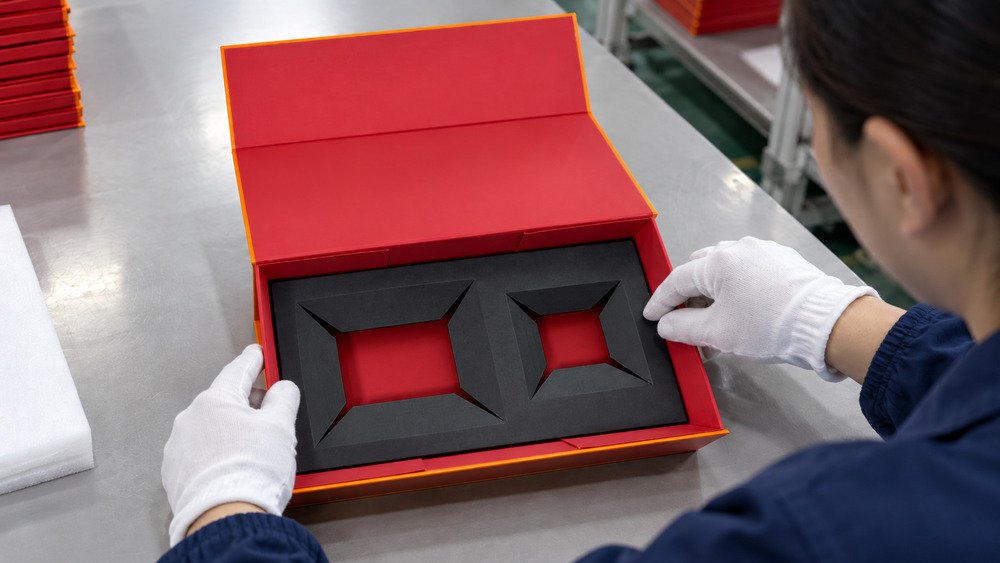
Klong also checks forming smoothness, corner fixation, lid alignment, magnet engagement where applicable, and surface finish.
For a tight-fitting insert, the production gate is a verified first-piece assembly with the real insert—not a drawing alone. Confirm the acceptable fit and inspection method before the production run.
What Must Be Verified Before Production Approval?
Klong reviews samples in three conditions:
Flat-packed: Panels stack properly, with folding areas and surfaces protected for shipping.
During assembly: The box forms smoothly, corners secure correctly, and the steps work for the customer's packing team.
Fully assembled: The box holds its shape, the lid aligns, the insert fits, and the product is adequately supported.
For heavier products, Klong checks the support provided by the insert, bottom, and side walls. When the customer supplies the product and relevant accessories, Klong can conduct in-house drop checks using a 10-drop sequence—one corner, three edges, and six faces—with weight-based drop heights referenced from ISTA 1A.
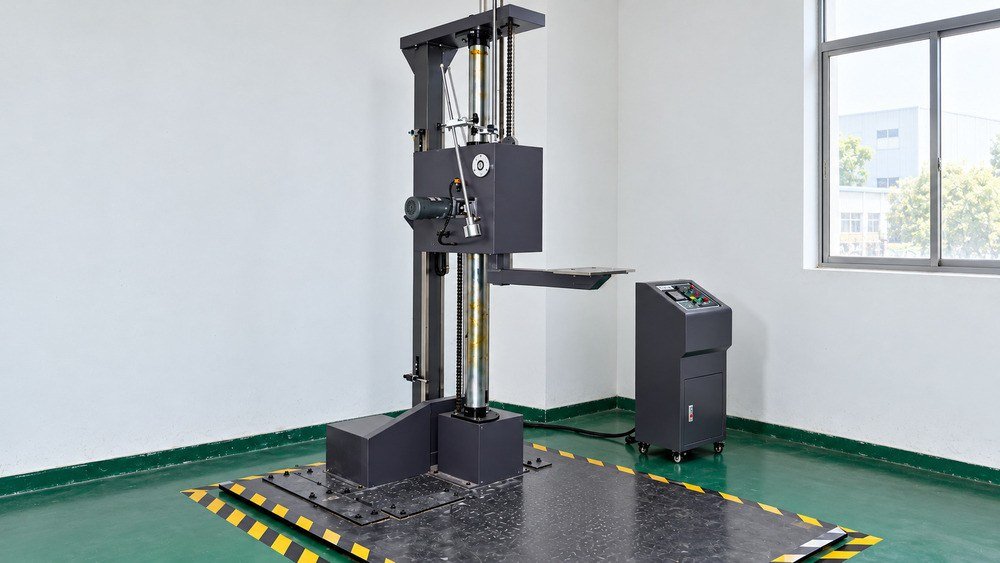
These internal checks are not a full ISTA 1A test. If the customer requires the complete ISTA 1A procedure or third-party laboratory testing, the scope must be agreed separately.
For other project-specific requirements, Klong can arrange additional checks or review existing test evidence with the customer.
Approve production only when the sample's fit, assembly, structural support, and agreed verification results meet the project's requirements.
FAQ: Foldable Rigid Box Logistics and Costs
Choosing between traditional, 5-piece, and 7-piece rigid boxes involves more than shipping volume. These answers address the practical questions buyers should resolve before approving a structure, from total cost and final assembly to storage, product support, and repeat use.
1. What is the difference between a collapsible rigid box and a traditional rigid box?
Traditional rigid boxes arrive fully formed and ready to fill. Collapsible rigid boxes ship flat and require final assembly. Flat packing can reduce empty-box freight and storage space, but adds assembly work. The better choice depends on factory cost, actual logistics savings, product support, and the customer's packing process.
2. What is the difference between a 5-piece and 7-piece collapsible rigid box?
Klong’s 5-piece options use corner adhesive or structural magnets, while the 7-piece design uses two inward-folding reinforcement panels. Adhesive boxes require peeling and disposing of four release liners. Magnet fixing avoids that step but adds components and raises end-of-life separation questions. The reinforced 7-piece generally makes final assembly simpler and the assembled structure more stable.
3. Can collapsible rigid boxes hold heavy products, and is a 7-piece box stronger?
Yes, collapsible rigid boxes can hold heavy products when properly engineered. A 7-piece design may offer additional support through its reinforcement panels, but is not automatically stronger than every 5-piece box. Check actual product weight, insert support, board construction, corner stability, and the fully assembled sample before approving the structure.
4. Are collapsible rigid boxes cheaper overall than traditional rigid boxes?
Not automatically. Compare factory price, freight and storage savings, and the buyer’s assembly costs—including time spent peeling four corner liners and clearing the scraps. A flat-pack box saves money only when the verified logistics benefit exceeds the extra costs.
5. How do you calculate freight savings for collapsible rigid boxes?
Compare actual master-carton dimensions, units per carton, and total carton count for each structure. Total shipping CBM equals master-carton CBM multiplied by carton count. Then check freight quotations for the same shipment. Lower CBM only produces a financial benefit when it reduces actual charges or releases usable transport capacity.
6. Can collapsible rigid boxes be folded flat again after assembly?
It depends on the fixing method. A bonded 5-piece adhesive box generally cannot be flattened without damaging the corner joints. Magnet-fixed 5-piece boxes can often be reopened. Klong also makes 7-piece boxes with fabric pull tabs or a tab-free structural release: tabs are easier to lift, while the tab-free option saves tab material and installation cost.
7. Can double-sided adhesive lose performance during one year of storage?
Yes, adhesive performance can change during storage, but one year is not a universal expiry date. Performance depends on the adhesive, bonding surface, release liner, temperature, and humidity. If empty boxes are expected to remain unused for around a year, confirm suitable storage conditions and the pre-applied adhesive's performance before selecting the fixing method.
8. Will a fitted insert still fit after mass production?
The folding-machine positioning reference at Klong is approximately ±1 mm on either side. If a box is slightly smaller and the paper insert slightly larger, forcing the insert in can wrinkle its surface. Klong verifies the first formed box using the actual insert; if necessary, the two side-wing positions are adjusted. The machine operator starts the run only after first-piece fit is confirmed.
9. Do collapsible rigid boxes still feel premium?
Yes. Customers experience the assembled box, not its flat shipping form. Board rigidity, wrapping quality, forming accuracy, lid alignment, closure feel, and insert presentation determine the final experience. Check the physical sample for smooth opening and product removal. For keepsake packaging, also consider whether customers can repeatedly flatten and reform the box without damage.
10. When should a brand choose a traditional rigid box instead?
Choose traditional rigid construction when ready-to-fill convenience, fixed geometry, or minimal assembly matters more than flat-pack savings. It may also be more economical for smaller orders or short shipping routes. However, low order quantity alone does not rule out collapsible boxes: Klong can manually form smaller 5-piece runs when appropriate.
Conclusion: Flat-Pack Savings Only Count After Assembly
A lower shipping CBM means little if overseas assembly, release-liner cleanup, and poor insert fit consume the saving.
Compare the fully assembled result and total landed cost before choosing a 5-piece, 7-piece, or traditional rigid box.
Use the Packaging Cost & Shipping Risk Checklist to compare factory price, freight, storage, and the assembly work your team will actually perform.