
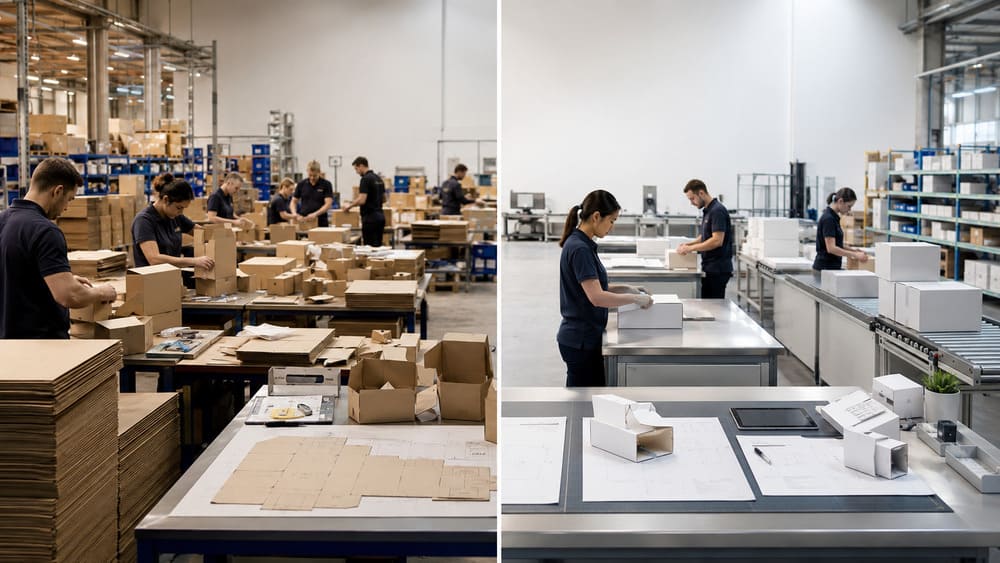
Why lower packaging prices can create higher fulfillment labor costs — and how engineering reviews reduce hidden packaging risks.
A lower box price does not always create a lower total packaging cost.
For many brands, the real expense appears after packaging arrives at the warehouse. Box structure influences assembly time, fulfillment labor cost, and overall packaging landed cost.
This is why packaging decisions should be evaluated beyond supplier pricing and reviewed through the entire fulfillment workflow.
Table of Contents
Why Packaging Assembly Cost Goes Beyond Box Price
The easiest number for buyers to compare is the packaging unit price.
The problem is that unit price does not reveal the labor and operational impact after packaging enters daily fulfillment operations.
For many buyers, the supplier quotation is only the starting point of the real cost calculation.
Many packaging decisions are made by comparing supplier quotations only. However, the final cost is also influenced by assembly time, warehouse handling, and workflow efficiency.
For high-volume orders, a few extra seconds per box can become a significant labor cost over thousands of units.
This is why packaging should be evaluated through landed cost in packaging, not only the purchase price.
The Hidden Cost Behind Low Packaging Prices
A lower unit price does not always create a lower total packaging cost.
A cheaper packaging solution may require:
- More manual assembly steps
- Longer preparation time
- Additional handling during fulfillment
- More operator training
These costs are often not visible during supplier comparison.
The lowest unit price is only one part of the total cost equation.
Before selecting packaging, buyers should evaluate:
- How many seconds are required to assemble each box
- How many manual actions are involved
- Whether the structure fits the existing fulfillment workflow
The lowest unit price is only one part of the total cost equation.
Calculate Total Packaging Landed Cost Before Choosing a Supplier
Packaging landed cost should include all costs created throughout the packaging lifecycle.
Packaging Landed Cost Should Consider:
- Packaging Price
- Assembly Labor
- Warehouse Handling
- Quality Risk
- Operational Impact
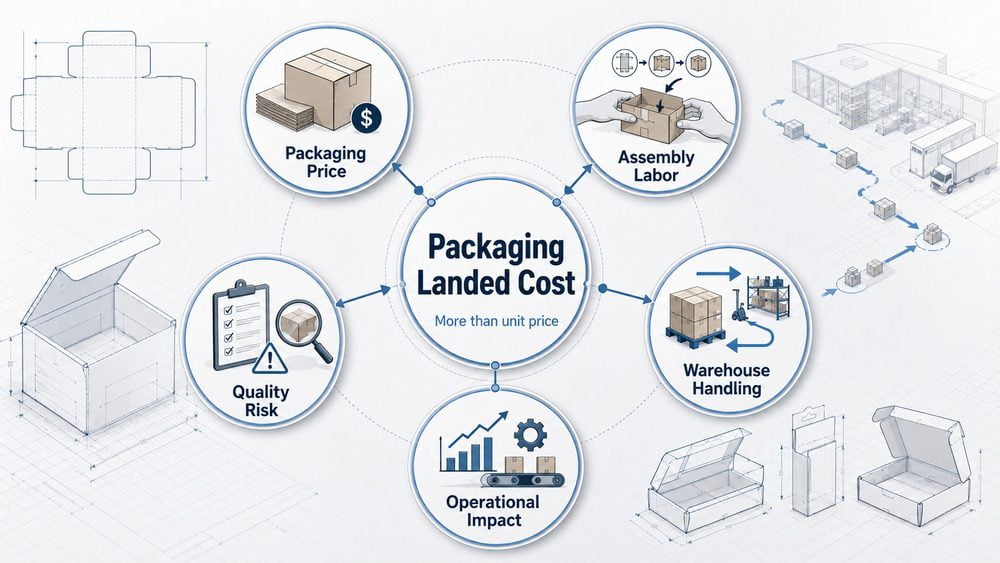
A supplier quotation usually reflects manufacturing cost.
It does not always reflect the labor and workflow impact after the packaging enters fulfillment.
| Cost Factor | Buyer Should Evaluate |
|---|---|
| Packaging Price | Supplier quotation and production cost |
| Assembly Labor | Seconds required per box |
| Warehouse Handling | Manual steps during fulfillment |
| Quality Risk | Whether the design has been validated |
| Operational Impact | Compatibility with the current workflow |
Packaging dimensions and loading efficiency can also influence the final landed cost. Learn more about packaging space optimization.
A packaging decision with a slightly higher unit price may create better cost predictability if it reduces unnecessary handling and operational complexity.
Buyer Decision Framework: 5 Questions Before Approving Packaging
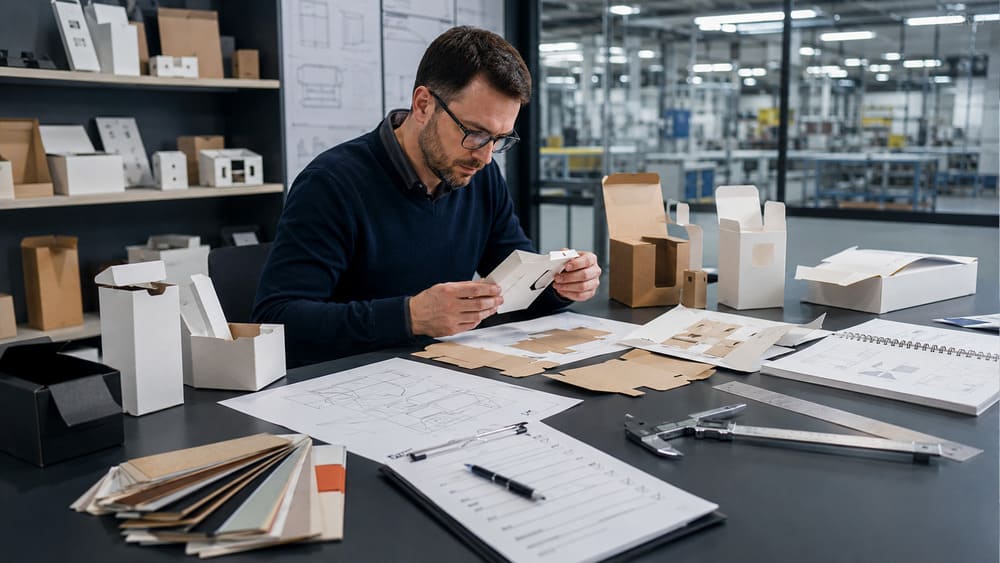
Before approving a packaging solution, buyers should ask:
1. How many seconds does assembly take?
Assembly time becomes a labor cost when multiplied by production volume.
2. How many manual steps are required?
Each additional folding, locking, or adjustment action creates another handling point.
3. Has the packaging been tested?
A structure that looks correct in design files may still create problems during real assembly. Sample validation helps identify potential issues before production. A production-focused design review helps identify structural risks before scaling.
4. Will warehouse staff need training?
Packaging should support a repeatable process. Complex assembly requirements may reduce workflow consistency.
5. What is the real landed cost?
The final evaluation should include packaging price, labor, handling, quality risk, and operational impact together.
| Cost Factor | Low Unit Price Packaging | Optimized Packaging |
|---|---|---|
| Purchase Price | Lower | May be higher |
| Assembly Time | Longer | Shorter |
| Labor Cost | Higher | Lower |
| Risk | Higher | Lower |
| Total Cost Predictability | Lower | Higher |
💡 Engineering Insight: A packaging quotation can look attractive during sourcing review, but the real cost often appears after packaging enters daily fulfillment operations. Experienced buyers validate assembly efficiency and workflow compatibility before scaling production.
How Box Structure Directly Impacts Fulfillment Labor Cost
Packaging assembly cost is often underestimated during supplier evaluation.
Have you calculated how many seconds your packaging structure requires for each assembly step?
For high-volume fulfillment, those seconds can become measurable labor hours and fulfillment costs.
Many buyers focus on:
- Packaging unit price
- Material selection
- Production cost
However, the time required to assemble each package can create a significant fulfillment labor impact when multiplied across large order volumes.
A packaging structure that requires only a few extra seconds per unit may increase warehouse workload, operator time, and total fulfillment cost.
This is why packaging structure should be evaluated not only from a manufacturing perspective, but also from the perspective of daily assembly operations.
Small Assembly Differences Create Large Labor Cost Differences
Assembly labor can be calculated using a simple formula:
Labor Cost per Box = (Assembly Time in Seconds / 3600) × Hourly Warehouse Wage
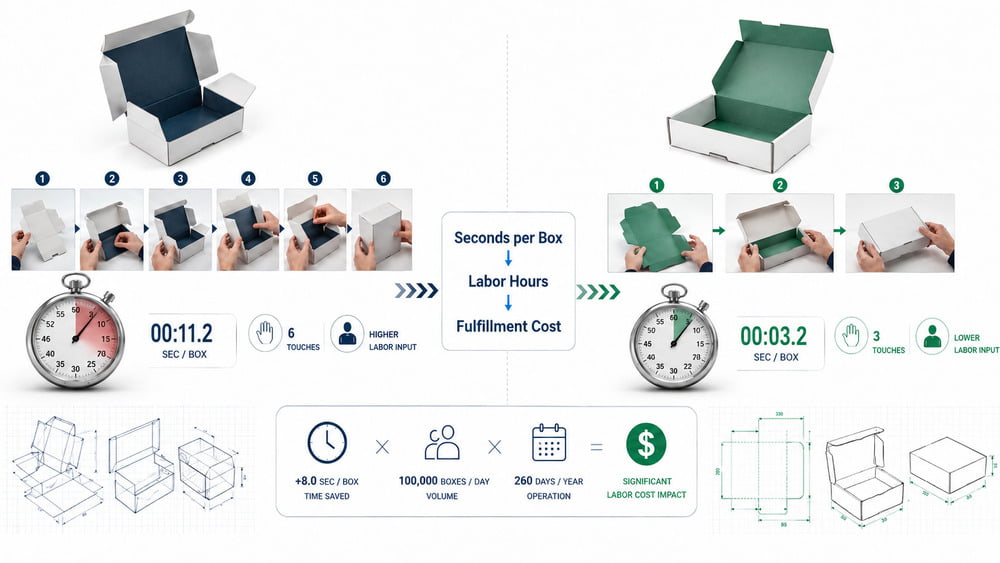
Assumption:
Warehouse labor rate: $25/hour (example)
For example:
A packaging structure requires:
10 seconds assembly time per box
with a warehouse labor rate of:
$25/hour
Calculation:
(10 / 3600) × $25 = $0.069 per box
Another structure requires:
6 seconds assembly time per box
Calculation:
(6 / 3600) × $25 = $0.042 per box
The difference is:
$0.027 per box
At small quantities, this difference may not appear significant.
At higher volumes, however, every additional second is multiplied into additional labor hours and fulfillment costs.
This is why assembly seconds should be considered during packaging development, especially for products with repeated fulfillment operations.
Compare Assembly Efficiency in Real Order Volume
A small difference in assembly time can become measurable when applied to a large production quantity.
The following example focuses only on assembly efficiency. Actual packaging structure selection should consider product requirements, workflow conditions, and production needs.
Example scenario:
Order Quantity: 50,000 units
Warehouse Labor Rate: $25/hour
| Factor | Traditional Tuck-End Folding Carton | Auto-Lock Bottom Carton |
|---|---|---|
| Assembly Time per Box | 12 seconds | 7 seconds |
| Total Assembly Time | 166.7 hours | 97.2 hours |
| Estimated Labor Cost | $4,167.50 | $2,430.00 |
Estimated difference:
Labor Time Difference: 69.5 hours
Labor Cost Difference: Approximately $1,737.50
The purpose of this calculation is not to suggest one structure is always better than another.
The correct structure depends on:
- Product requirements
- Packaging workflow
- Order volume
- Fulfillment process
The key point is that assembly time is measurable, and small structural decisions can create different labor outcomes at scale.
Structural Factors That Influence Assembly Labor
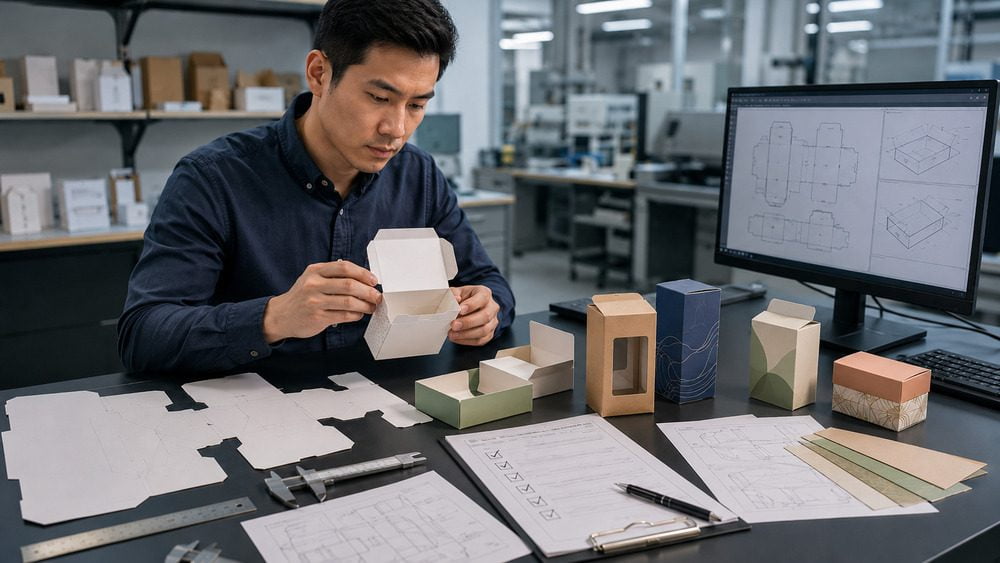
Packaging structures affect fulfillment labor through several practical factors:
Number of assembly actions
Each additional folding, locking, or adjustment step creates another operator action.
More actions usually mean more handling time per unit, increasing labor exposure in repetitive fulfillment operations.
Folding complexity
A structure with more complicated folding sequences may require more time and create greater variation between operators.
Simple and repeatable assembly processes are easier to standardize.
Locking method
The closing mechanism influences how quickly operators can complete the package.
A structure that requires additional alignment or adjustment may slow down repetitive fulfillment tasks.
Product insertion difficulty
The relationship between the packaging structure and the product also affects packing efficiency.
If the product requires additional positioning or adjustment during insertion, the assembly process may become slower.
💡 Engineering Insight: The difference between a good packaging structure and a costly one is often measured in seconds, not dollars. A few extra seconds per assembly may seem insignificant during design review, but the impact becomes measurable when repeated across thousands of fulfillment cycles.
How Klong Reduces Packaging Assembly Risk Before Mass Production
For custom packaging, preventing problems before production is usually far more effective than correcting them after mass production begins.
Once structural design, printing specifications, tooling, and production methods are confirmed, changing packaging decisions becomes costly and difficult.
This is why experienced buyers validate key risks before scaling:
- Can the structure be produced consistently?
- Can operators assemble it efficiently?
- Will the packaging perform as expected in real use?
A small amount of engineering review before production can prevent much larger assembly and production problems after scaling begins.
DFM Review Before Production
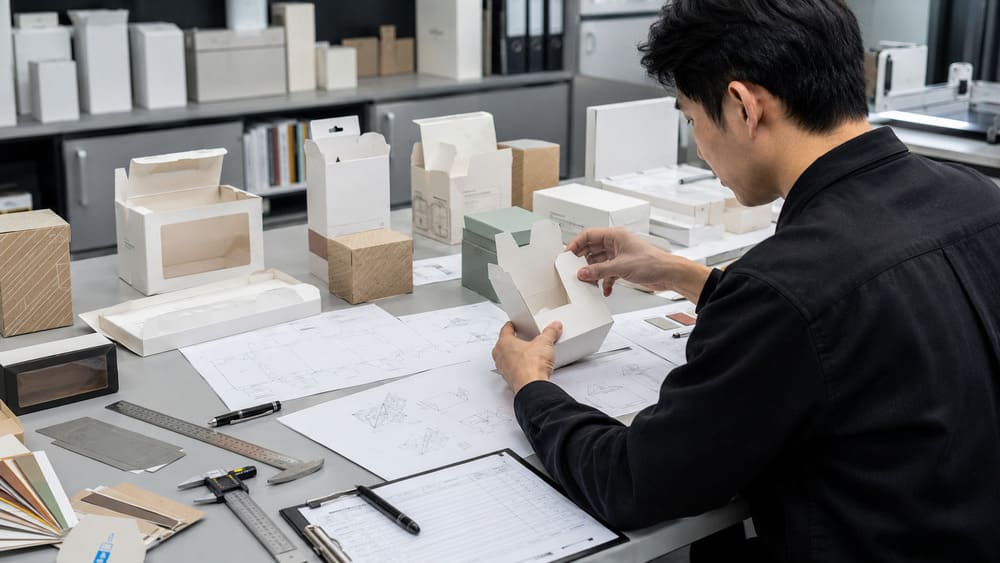
A packaging design should be reviewed from both manufacturing and assembly perspectives before production.
During DFM review, the packaging design is evaluated for:
- Manufacturing feasibility
- Assembly efficiency
- Cost risks
- Production stability
The purpose is not only to confirm that a box can be produced, but also to verify that it can be assembled efficiently and consistently at scale.
It is to identify potential problems before they become fixed production decisions.
Key questions include:
- Are the folding and locking steps practical?
- Can operators assemble the packaging efficiently?
- Could the structure create unnecessary production variation?
Early engineering review helps ensure the packaging is designed for both production and fulfillment needs.
Sample Testing Before Scaling
A sample should do more than confirm appearance.
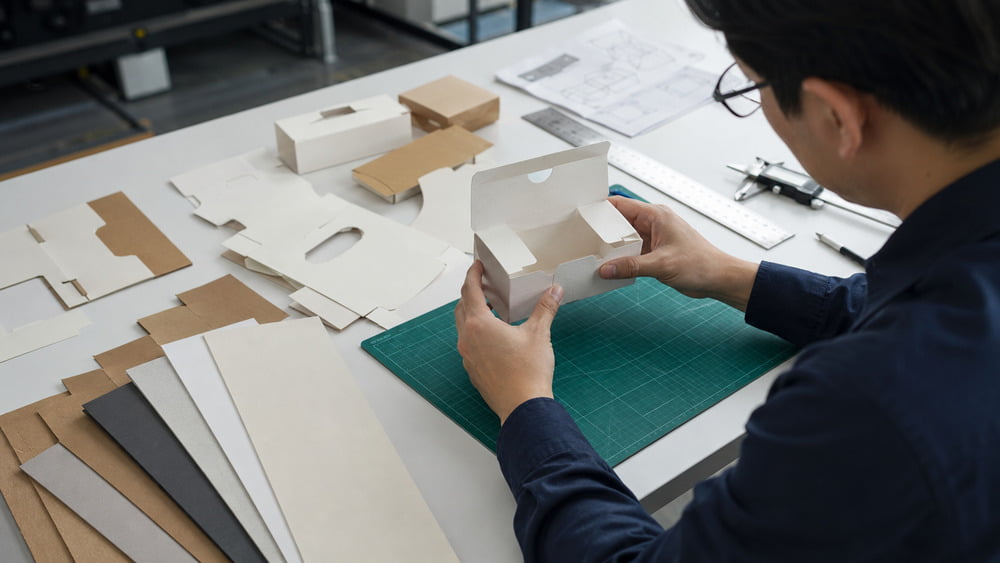
It should verify whether the packaging works as a real product solution.
Klong provides:
- 5–7 day sample development for structural verification
Sample testing helps evaluate:
- Structure performance
- Assembly sequence
- Folding and locking process
- Handling requirements
A packaging sample is the stage where potential issues can still be identified and corrected before production commitments become expensive.
Waiting until mass production to find assembly problems usually leaves fewer options.
Pilot Production Before Full Scale Orders
Not every packaging project requires a pilot run.
However, for projects with higher volume, complex structures, or strict fulfillment requirements, a pilot production stage can provide valuable validation before scaling.
Klong can support:
- 200 pcs pilot MOQ
- 500 pcs regular MOQ
Pilot runs help evaluate:
- Assembly problems
- Handling issues
- Production consistency
The purpose is not to create an extra ordering step.
It is to give buyers a lower-risk opportunity to confirm that the packaging process works before committing to larger quantities.
Maintain Efficiency Without Sacrificing Quality
Improving assembly speed only matters when the result remains consistent.
Packaging optimization must continue to protect:
- Product protection
- Manufacturing consistency
- Quality reliability
Klong applies an AQL 1.0 inspection standard to maintain production quality control.
A faster assembly process that creates inconsistent quality is not a real improvement.
The goal is stable performance that can be repeated across production volume.
💡 Engineering Insight: In custom packaging, problems are usually easiest to solve before the production decision is locked. A structure that saves a few seconds during assembly is only valuable if it can be produced consistently at scale. The goal is not simply faster packaging — it is predictable production performance without assembly issues, production adjustments, or quality concerns after scaling begins.
FAQ About Packaging Assembly Cost
Packaging assembly cost depends on more than the packaging price itself.
These common questions help buyers understand how structure, labor, and validation affect the real packaging cost before mass production.
How is packaging assembly cost calculated?
Packaging assembly cost depends on assembly time, warehouse labor rate, order volume, and packaging complexity.
A common calculation method is:
Labor Cost per Box = (Assembly Time in Seconds ÷ 3600) × Hourly Warehouse Labor Rate.
Small differences in assembly time can create measurable labor cost differences at larger volumes.
Does box structure affect fulfillment labor cost?
Yes.
Box structure affects fulfillment labor through manual steps, folding sequence, locking method, and product insertion process.
A structure requiring more operator actions may increase handling time. The best structure should match the actual fulfillment workflow, not only appearance or unit price.
Why can cheaper packaging increase total cost?
A lower packaging price does not always create a lower total cost.
The actual packaging landed cost may also include assembly labor, warehouse handling, operational impact, and quality risks.
Buyers should evaluate total cost instead of comparing supplier quotations only.
How can brands reduce warehouse assembly labor?
Brands can reduce warehouse assembly labor through better packaging decisions before production.
Common approaches include DFM review, structure planning, sample validation, and assembly testing.
Early validation helps identify unnecessary handling steps before packaging enters daily operations.
Can packaging assembly cost be tested before mass production?
Yes.
Packaging assembly cost can be evaluated before mass production through sample testing, structural verification, and pilot production when required.
Klong provides:
5–7 day sample development for structural verification
200 pcs pilot MOQ when validation is needed
500 pcs regular MOQ
These steps help buyers evaluate packaging performance before committing to larger production volumes.
💡 Engineering Insight: Packaging cost is not decided by box price alone. A structure that looks economical during quotation may create additional labor during daily operations. Reviewing assembly requirements before production helps buyers understand the real cost impact.
Is Your Packaging Cost Higher Than It Should Be?
Packaging cost is not only about the supplier quotation. Hidden labor and operational factors can significantly affect your real packaging cost.
Use this checklist to review:
✓ Hidden assembly labor costs
✓ Packaging structure efficiency
✓ Shipping space risks
✓ Pre-production cost risks
Don’t let hidden assembly seconds drain your margin. Download the checklist to evaluate your real packaging landed cost.
Enter your email to receive the checklist and review key packaging cost risks before production.