
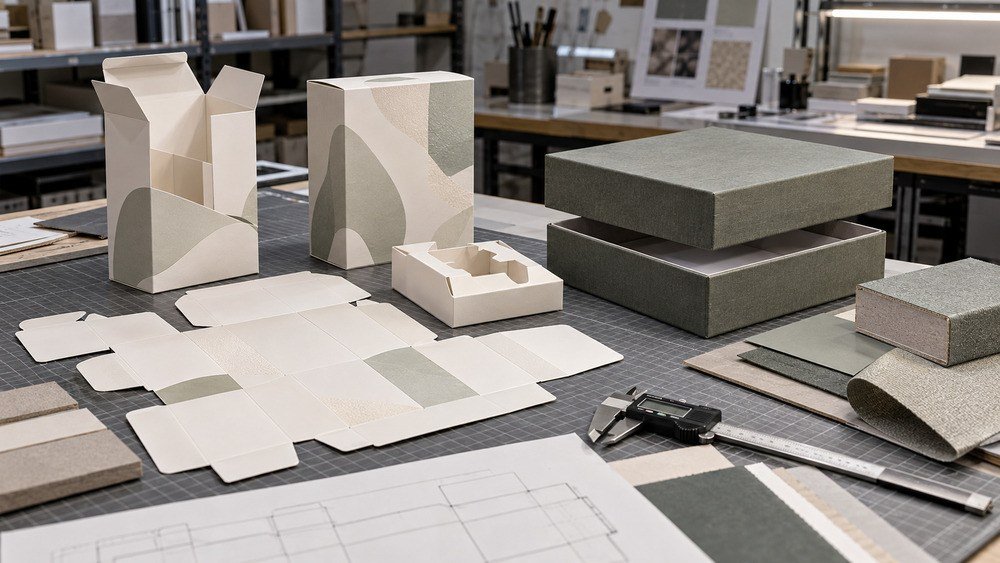
Choosing between premium folding cartons and rigid boxes is not simply a luxury-versus-budget decision. The wrong structure can add unnecessary tooling, sampling time, freight volume, storage, and manufacturing complexity.
The real question is: when does a rigid box create enough brand or functional value to justify that complexity—and when can a premium folding carton achieve the same objective more efficiently?
Table of Contents
Folding Cartons vs Rigid Boxes: What Is the Real Structural Difference?
The main difference is not simply board thickness. A premium folding carton is formed from printed paperboard, while a traditional rigid box is built from rigid board and then wrapped.
That construction changes how the package creates premium value, how much physical structure it carries, and how carefully dimensional performance needs to be controlled.
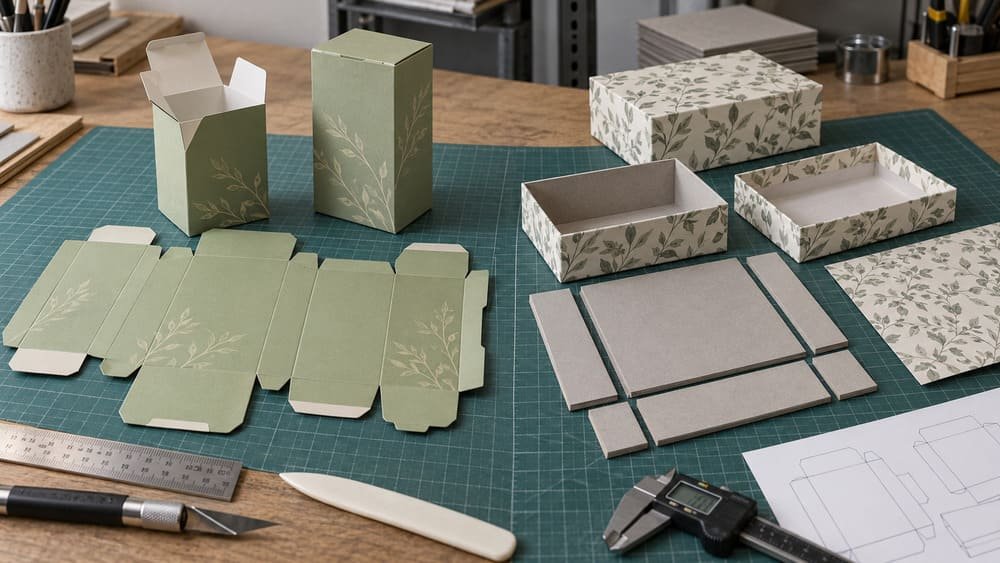
Premium Folding Cartons: Premium Does Not Require a Thick Box
Premium folding cartons rely more on structure, print quality, finishing, and presentation than physical thickness.
In one Klong project, the customer originally specified a rigid box because they believed it would feel more premium. After comparing well-designed folding-carton alternatives internally with colleagues acting simply as consumers, they did not perceive enough difference to justify the heavier structure. The project moved to a folding carton.
Smooth coated paperboard can also provide a controlled surface for fine graphics, foil, embossing, spot UV, and other precise finishes.
If the premium experience comes mainly from visual execution and presentation, it is worth checking whether rigid-board construction adds anything the customer will actually notice.
Rigid Boxes: Use the Structure When Physical Substance Matters
Traditional rigid boxes create value differently. Their main advantage is the solid feel, tactile depth, and physical presence that comes from the built-up structure.
In Klong projects, we are more likely to recommend rigid construction when that heavier, solid opening experience is itself part of what the customer is buying—especially when the product value and use case support it.
The wrap and artwork still need practical review. If fine text, reverse text, foil, or a subtle coating will not reproduce clearly on the selected surface, that should be identified before sampling. We have also recommended removing finishes where the visual difference would be too small to justify the added process cost.
Rigid construction makes sense when its physical character serves the product—not simply because the brief says “premium.”
Rigid Box Dimensional Risk: Rigidity Is Not the Same as Fit
A rigid box can feel very solid and still have dimensional issues.
Greyboard, wrapping paper, adhesive, drying, and humidity all affect the finished structure. On sensitive lid-and-base boxes, this can show up as bowing, fit variation, or a lid that opens tighter or looser than the customer expected.
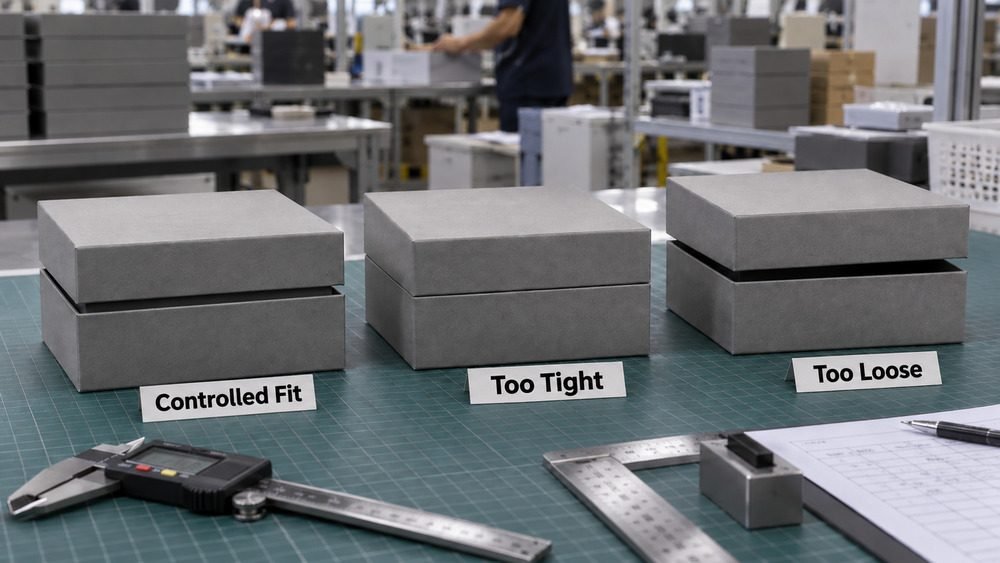
When a Klong customer specifies how closely the lid and base should fit or how the box should slide during opening, that behavior becomes an inspection point during production and final QC—not just something checked visually on the first sample.
Structural rigidity and dimensional stability are two different approval questions.
The Core Difference: How Much Premium Real Estate It Actually Needs
A premium folding carton creates value with less built-up structure and more design flexibility.
A traditional rigid box creates value through greater physical substance and tactile presence.
Klong also sees small-product projects where a rigid box would make the finished package feel bulky rather than premium. In those cases, a well-engineered folding structure can protect the product while creating a more compact, refined presentation.
So the first question should not be:
“Which box looks more premium?”
It should be:
“What job does the extra rigid structure actually need to do?”
Folding Cartons vs Rigid Boxes: Cost, Tooling, Sampling, Brand Experience and Supply Chain Comparison
Once both structures can deliver the required presentation, the comparison becomes commercial.
The buyer should look beyond the quoted box price and ask what each structure will cost to develop, produce, move, store, pack, protect, and repeat at scale.
Unit Cost vs Perceived Value: Is the Extra Structure Worth Paying For?
Traditional rigid boxes generally cost more to manufacture because they use more structural material and involve additional forming, wrapping, positioning, and handling.
In Klong projects, the cost gap becomes especially noticeable when order quantity is low or the box format is large. Setup and manual operations are then spread across fewer units, while larger rigid structures require more material and production handling.
The economics can also change as volume increases. A structure that works for a limited launch may not remain the best choice at scale.
But the decision is not simply which quotation is lower.
Some products genuinely benefit from the physical substance of a rigid box. In other projects, customer comparisons show that a well-designed folding carton delivers enough perceived value without the extra structure.
Does the additional rigid-box cost create something the customer will actually notice or need?
Tooling, Setup and Sampling Agility: How Early Should You Lock the Design?
Tooling cost matters, but paying to prepare the wrong version can matter more.
Even pilot orders may require artwork output, die-cut tooling, and production setup. If the structure, dimensions, or artwork are already expected to change, Klong normally recommends correcting them before the trial rather than paying twice for a temporary version.
Folding cartons also allow very fast structural checking once CAD is ready. In Klong production, the cutting stage for a straightforward white structural blank can sometimes take around 10 minutes.
That is the cutting stage—not the total sample lead time.
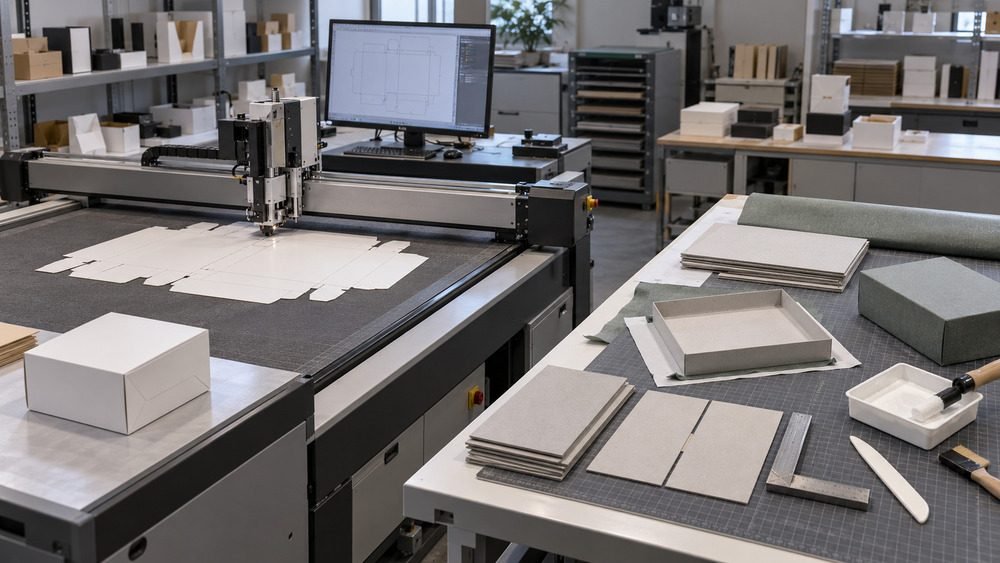
Rigid-box samples generally require more manual construction, so physical revisions take longer. But Klong more often sees late approval of structure, artwork, or specification turn a normal schedule into an urgent project.
Fast sampling is most valuable because it leaves more room for:
Sample → Review → Decision → Revision
before the launch date becomes critical.
Supply Chain and Packing Efficiency: Freight, Storage and Labor
Folding cartons usually have a clear logistics advantage while supplied flat. From the packaging factory to the assembly plant or packing location, much less volume is being used to move empty packaging.
Traditional rigid boxes normally move and store closer to their finished volume.
But freight is only part of the cost.
Klong has seen buyers select the lowest unit-price quote, then later find poor pallet utilization, unused edge space, greater warehouse occupancy, or project rework. In some cases, the packaging eventually moved back to a simpler structure.
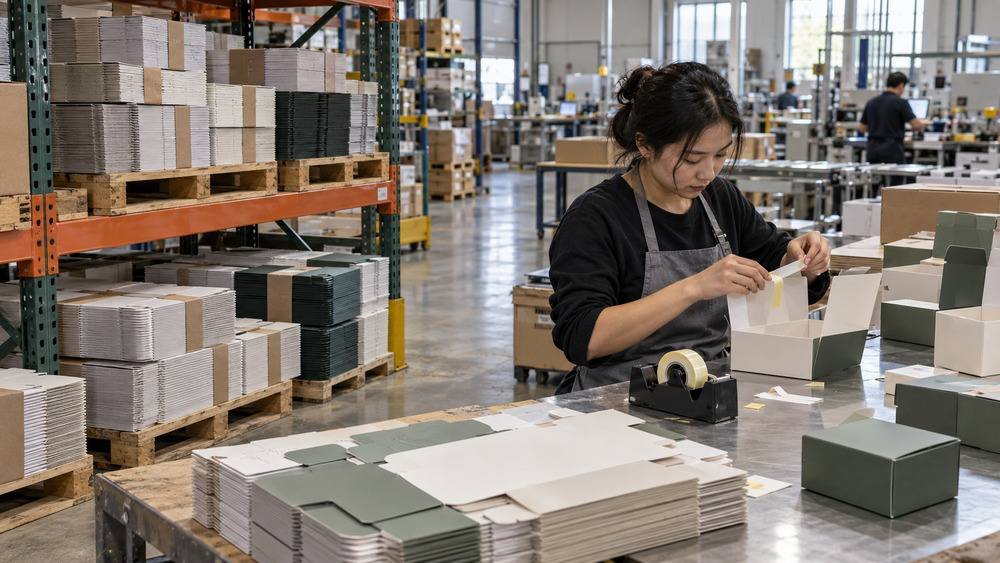
Packing labor can reverse the expected result too.
A simple folding carton may run efficiently through automatic equipment. But some folding structures require several pieces of 3M double-sided tape and skilled manual forming. In those cases, assembly may be slower and more expensive than a rigid-box program suited to automation.
So compare the actual process:
Empty-packaging volume + pallet use + warehouse space + forming + adhesive + insert placement + product loading + achievable automation
—not box price alone.
Protection and Structural Performance
More structure does not automatically mean better protection.
In Klong projects, when damage is concentrated at corners or specific impact points, increasing board strength alone may produce little improvement. Reinforcing the actual impact path—for example with properly designed paper corner protection—can be more effective than simply making the whole package heavier.
The same principle applies here:
Identify the protection failure before upgrading the entire box structure.
Protection should be evaluated as:
Outer structure + insert + product restraint + distribution risk
If rigid walls are genuinely required, use them. If a lighter engineered structure and insert solve the same failure mode, additional mass may only add cost.
Material Complexity and Recyclability
Premium presentation can add components that are not always functionally necessary.
Rigid packs may include magnets, ribbons, foam, plastic parts, or decorative hardware. Folding cartons can also become complex through windows, laminations, foams, coatings, and mixed-material inserts.
So neither structure should be treated as automatically recyclable or automatically mono-material.
Klong also checks whether the required function can be created structurally instead. Magnets and ribbon handles are familiar solutions, for example, but some projects can achieve the required closure or carrying function with a paper handle, locking tab, or folded paper structure.
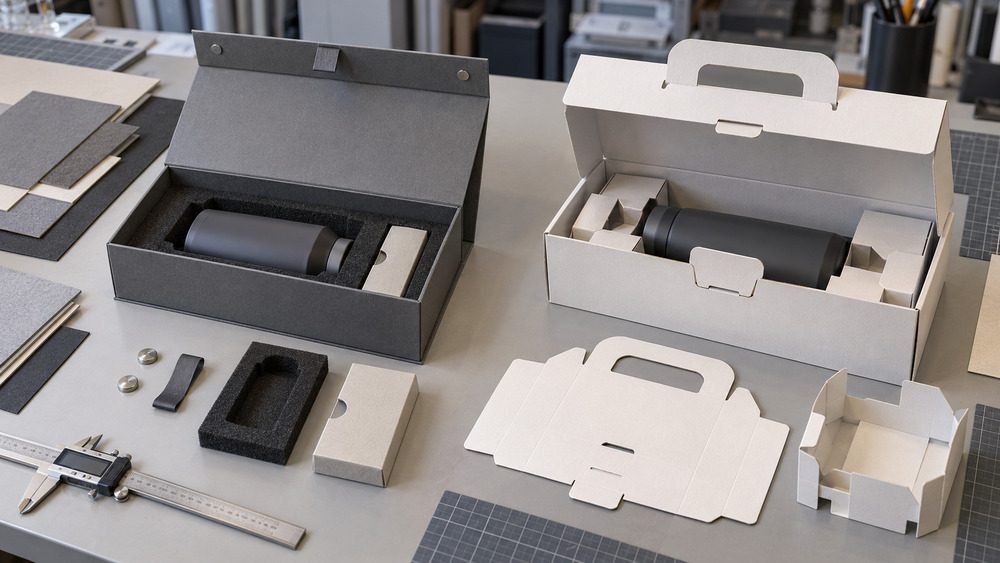
The better BOM question is:
Which component is genuinely required for function—and which effect can be created through structure instead?
Folding Carton vs Rigid Box Comparison Matrix
| Decision Factor | Premium Folding Carton | Traditional Rigid Box | What the Buyer Should Check |
|---|---|---|---|
| Unit Manufacturing Cost | Generally lower | Generally higher | Is the added structure worth paying for at the actual size and quantity? |
| Setup Commitment | Usually simpler | More process-dependent | Is the design mature enough to lock production setup? |
| Sampling Agility | Fast structural iteration | More manual build steps | How much approval time remains before launch? |
| Premium Experience | Precision and presentation | Substance and tactile depth | Will the customer actually perceive the difference? |
| Shipping Efficiency | Strong while supplied flat | Higher empty-pack volume | What is the inbound packaging volume? |
| Warehouse Space | Usually efficient before forming | Requires more formed storage | How much empty packaging must be stored? |
| Assembly | Can be simple or labor-intensive | Can arrive formed or be automated | What does the actual packing process require? |
| Protection | Depends on structure + insert | High wall rigidity | What is the real failure mode? |
| Material Complexity | Can often be simplified | Often has more added components | Which materials and accessories are truly necessary? |
| Scalability | Efficient for many volume programs | More process-dependent | Will the same structure still make sense at higher volume? |
Choose the lighter structure when it already does the job. Pay for rigid construction when the product or customer experience genuinely needs it.
How Buyers Should Choose Between a Premium Folding Carton and a Rigid Box
Do not start with price or appearance. Start with four questions: What should the customer feel? Does the product really need more structure? Can that structure be repeated consistently in production? Has it been checked with a physical sample?
Step 1: Define What “Premium” Actually Means
When a customer says they want the packaging to feel premium, we usually ask what that means in practice: more texture, a stronger gifting feel, a more distinctive opening, or simply a cleaner and more refined presentation?
Premium does not automatically mean rigid. If the effect mainly comes from printing, finishing, presentation, and structural design, a premium folding carton may already do the job. If the customer wants a slow sliding action, book-style opening, noticeable thickness, or more weight in the hand, rigid construction has a clearer purpose.
Before adding structure, be clear about what that extra structure is supposed to achieve.
Step 2: Check Whether the Product Really Needs Rigid Walls
Next, look at the product itself. Check its weight and fragility, how much it can move inside the box, the insert requirement, the wall rigidity needed, and how precise the final fit must be.
Then ask: Does the product actually need rigid-wall construction? If the answer is not obvious, first confirm what problem needs to be solved. If a folding carton and a properly designed insert can protect and present the product well, extra rigidity may add cost without solving anything new.
If rigid walls are needed for product support, restraint, or dimensional control, then the added structure has a clear engineering purpose.
Step 3: Check Whether the Structure Still Works in Mass Production
A good sample does not automatically mean an easy production process.
Klong has handled folding structures that needed certain panels to be pre-folded beyond 120° before final forming. A sample technician could do this without much trouble, but once more operators were involved in production, some finished boxes became less square or less vertical than the approved sample.
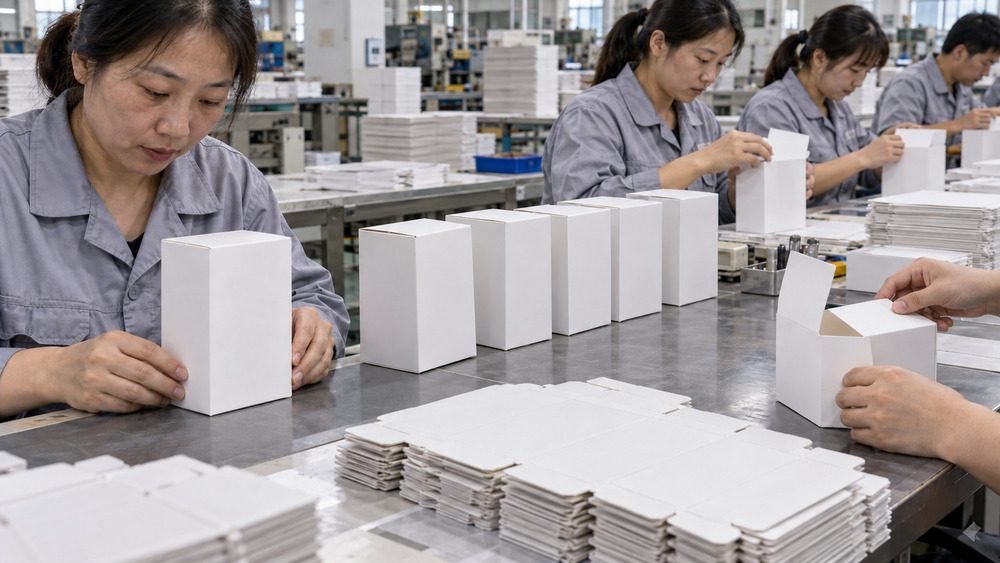
Before locking the structure, check whether the forming method can be repeated consistently, whether the process still makes sense at the expected volume, and whether extra materials or manual steps are really necessary.
A structure has to be repeatable, not just possible.
Step 4: Check the Complete Pack With a Physical Sample
A quotation tells you the price. A physical sample tells you whether the packaging actually works.
For tight-fit projects, check the outer box, insert, and product together. Component tolerance and assembled fit are not the same thing. For example, if a specific project allows ±0.5 mm on both the outer box and insert, each part may still meet its own drawing while the assembled fit differs by about 1 mm—enough to affect a premium presentation.
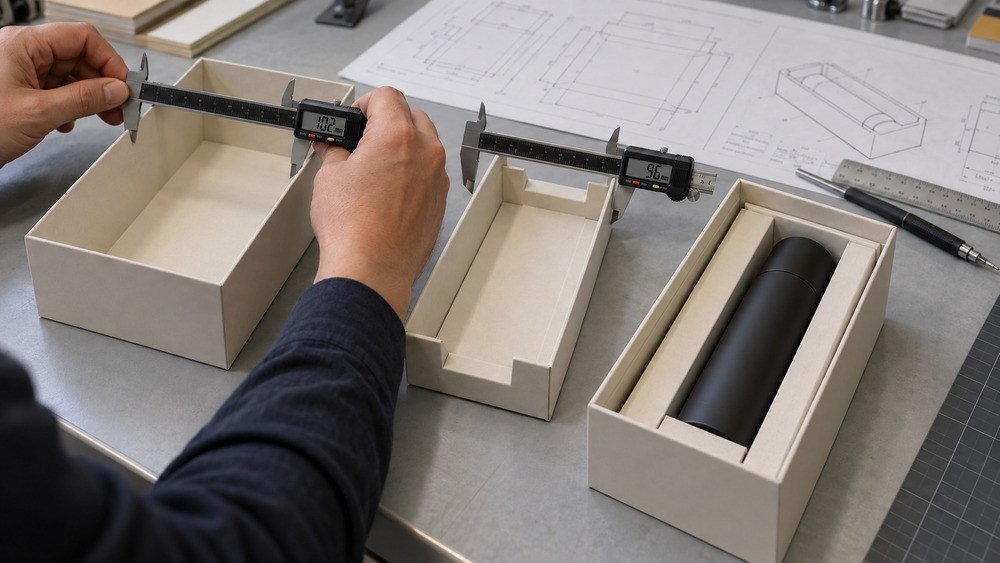
Check the assembled fit, not only the individual component dimensions.
During sample approval, check product fit, opening behavior, packing effort, squareness, forming quality, and the final assembled fit.
Size changes matter too. Klong has seen small mailer-style boxes lock successfully through internal paper details, while a much larger version of the same idea opened or distorted too much to hold reliably without additional structure.
A structure that works at one size may not work the same way when scaled up. If the sample exposes that kind of problem, change the structure before releasing the order for production.
The Klong Structure Selection Decision Framework™
Experience → Structural Need → Production Fit → Physical Validation → Final Choice
Choose the simplest structure that still delivers the required experience, protection, and production consistency.
FAQ: Folding Cartons vs Rigid Boxes
Choosing between a folding carton and a rigid box usually comes down to more than appearance. Buyers also need to consider cost, order volume, sampling, tooling, protection, logistics, materials, and whether the structure can be repeated reliably in production.
Are rigid boxes more premium than folding cartons?
Rigid boxes usually create more physical weight, thickness, and tactile substance, but that does not make every rigid box more premium. Folding cartons can also achieve a high-end result through precise printing, board selection, finishing, structure, and insert presentation. The better choice depends on what “premium” is supposed to feel like.
Are folding cartons cheaper than rigid boxes?
Generally, yes at the manufacturing level because folding cartons usually use less structural material and require fewer forming and wrapping operations. But the real project cost also depends on quantity, finishing, inserts, tooling, packing labor, freight, and storage. Compare the complete packaging program, not just the quoted box price.
Does order quantity affect whether a folding carton or rigid box makes more sense?
Yes. Setup, manual forming, logistics, and production efficiency behave differently as volume changes. A structure that makes sense for a pilot may not remain economical at scale. For an early launch, avoid adding structure or setup cost unless it creates a clear product or brand benefit; there is no universal MOQ breakpoint.
Which packaging structure is faster to sample?
Folding cartons usually allow faster structural iteration because CAD blanks can be digitally cut without completing the full forming and wrapping process of a rigid box. In Klong production, the cutting stage for a straightforward white folding-carton blank can sometimes take around 10 minutes once CAD is ready, but that is only the cutting step—not the total sample lead time.
Which has lower tooling and setup cost: folding cartons or rigid boxes?
Folding cartons generally use simpler die-cut tooling, while rigid-box production may need additional forming, positioning, wrapping, fixtures, or machine setup. Actual cost depends on the structure and production method. More importantly, avoid locking tooling or setup while the dimensions, structure, or artwork are still likely to change.
Do rigid boxes protect products better?
Rigid boxes provide greater wall stiffness, but stiffness alone does not guarantee better protection. The result depends on the outer box, insert, product restraint, fit, and distribution conditions working together. If a folding carton and engineered insert control the real failure points, adding rigid walls may increase cost without solving another protection problem.
Which is better for shipping and storage: folding cartons or rigid boxes?
Folding cartons usually require less inbound shipping volume and warehouse space because they can be supplied flat, while traditional rigid boxes normally occupy much more of their finished volume. But flat shipping is not automatically cheaper overall: a complicated folding structure can give some of that saving back through slower manual forming and packing.
Are folding cartons easier to recycle than rigid boxes?
Not automatically. Folding cartons can often use a simpler material system, but laminations, windows, coatings, foam, and inserts can complicate recycling. Rigid boxes may also contain magnets, ribbons, plastics, or bonded materials. Check the actual BOM, separability, adhesives, surface treatments, and accessories rather than judging recyclability by the box name.
Is one good packaging sample enough to approve mass production?
No. A good sample proves that one pack can be made correctly; it does not automatically prove that the same result can be repeated across production. Klong also checks forming consistency, assembled fit, packing behavior, and dimensional interaction between the box, insert, and product before treating a structure as production-ready.
What if I want a rigid-box experience with lower shipping volume?
Foldable or collapsible rigid-box structures can reduce empty-packaging volume while keeping more of the rigid-box feel and opening experience. They have their own tooling, assembly, durability, and production trade-offs, so they should be evaluated separately from traditional rigid boxes rather than treated as a simple cheaper substitute.
Conclusion: Don’t Let the Wrong Structure Drain Your Margins
Choosing the wrong packaging structure means overpaying to ship empty air, slowing down your fulfillment, or risking damaged products.
Don’t commit to mass production before validating the physical pack.
Let Klong’s engineering team review your structural design and validate your physical pack before you lock in an expensive mistake.