
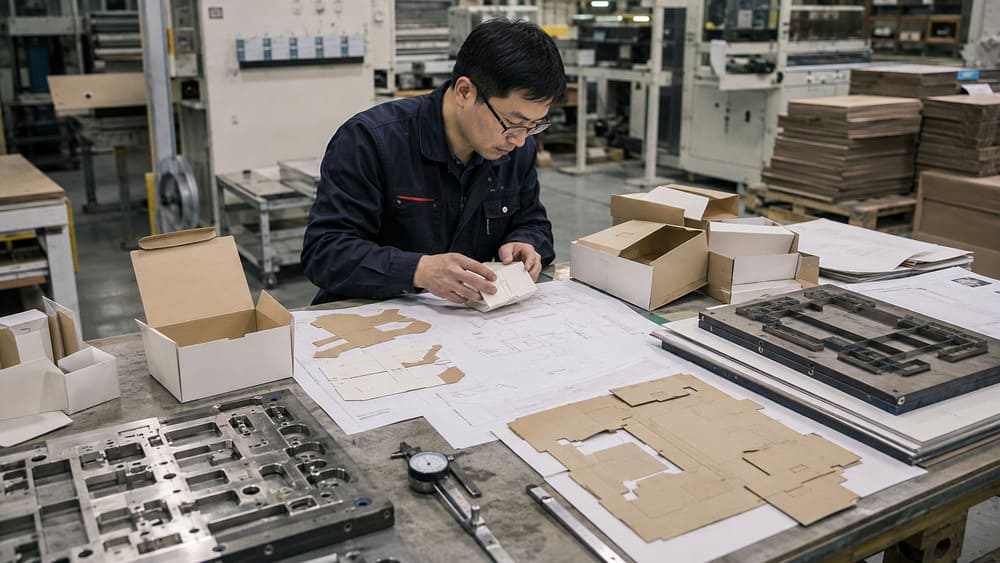
Packaging tooling cost is often treated as a simple extra charge, but the wrong tooling decision can create production delays, repeated adjustments, and unexpected development risks before mass production starts.
This article helps procurement teams understand what drives packaging tooling cost, how tooling requirements vary by packaging structure, and how to evaluate tooling investment before approving a production plan.
Table of Contents
Why Packaging Tooling Is an Investment Before Mass Production
Packaging tooling matters because mass production requires repeatability, not just one successful sample. The right tooling helps turn an approved packaging structure into a production-ready format that can be reproduced consistently at scale.
Why Custom Packaging Requires Tooling
Custom packaging needs tooling to control how the structure is cut, creased, formed, or molded during production. Without the correct tooling, a design may work in one sample but become difficult to reproduce consistently in mass production.
An approved sample shows that a design can work once; the correct tooling helps ensure that the approved structure can be reproduced consistently throughout production.
Tooling mainly supports three production needs:
- Repeatable structure: each unit follows the approved geometry.
- Stable production quality: the process is less dependent on manual adjustment.
- Consistent dimensions: fit, folding, and assembly remain controlled across the production run.
Before approving production, buyers should understand what tooling their packaging type requires and whether a manufacturing feasibility review is needed before moving to mass production.
Tooling Cost Depends on Packaging Structure and Production Method
Tooling investment varies because different packaging structures require different manufacturing methods. A folding carton or paper insert may only need die-cut tooling, while molded pulp packaging requires tooling built around the product shape and molding process.
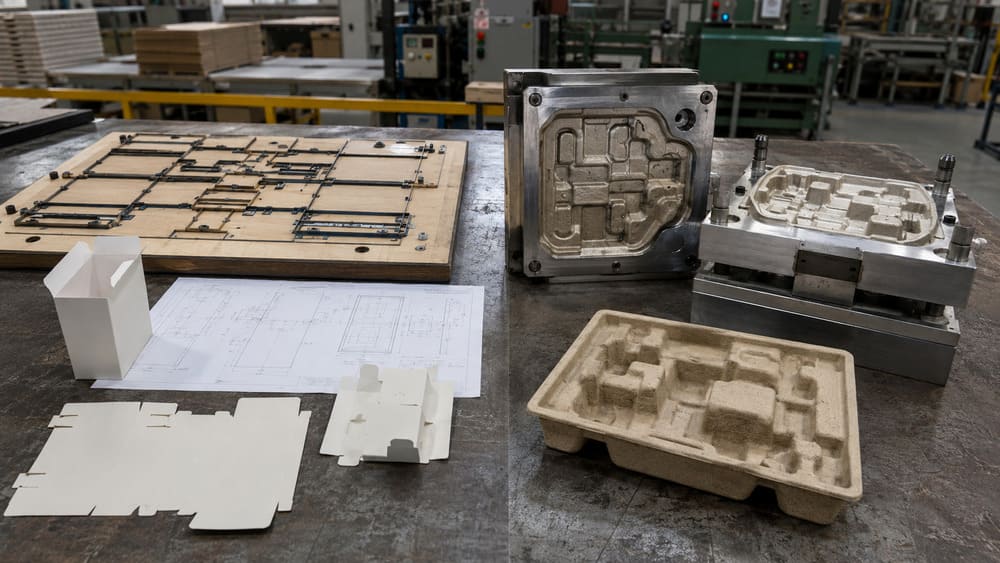
Material choice and production requirements also affect the tooling setup, so tooling cost should not be compared as an isolated line item.
Buyer Decision Point: Compare tooling quotations only after confirming that suppliers are quoting the same tooling stage, packaging structure, and production requirement.
Packaging Tooling Cost Breakdown: What Buyers Should Expect
Packaging tooling cost varies by packaging structure, size, material, and production method. The ranges below are approximate reference costs from Klong’s actual B2B packaging projects and should be used for planning purposes rather than treated as fixed industry-wide pricing.
For buyers, the key is to understand what stage of tooling the quotation covers, how long that stage takes, and whether the tooling is intended for verification, formal sample validation, or mass production.
Folding Cartons and Paper Inserts: Die-Cut Mold Cost
For folding cartons and paper inserts, tooling is typically a die-cut mold that controls the cutting and creasing geometry used in production.
Typical reference:
- Tooling cost: USD 50–100 per design
- Tooling lead time: 24–48 hours
- Applicable to: Folding cartons and paper inserts
This is generally a lower tooling investment because the tool reproduces a flat structural pattern rather than forming a three-dimensional molded shape.
The USD 50–100 reference applies to die-cut mold preparation only. Actual cost can vary with structural complexity, dimensions, and production requirements, and should not be interpreted as the complete packaging development or sampling cost.
Molded Pulp Tray Tooling: Sample vs Production Investment
Molded pulp follows a different tooling path because the tray must be formed around a three-dimensional product shape rather than cut from a flat sheet.
Stage 1 — Computer-Cut EPS Foam Prototype
- Cost: Free
- Lead time: 3–5 days
- Purpose: Check basic tray geometry, dimensions, product fit, and structural concept before mold-based sampling
This first-stage prototype is typically cut from EPS foam according to the engineering drawing. It allows the product position, cavity layout, dimensions, and basic fit to be checked quickly, but it is not a molded pulp sample and cannot represent the final pulp material or molding behavior.
Stage 2 — Single-Cavity Sample Tooling
- Cost: USD 650–1,000
- Lead time: 12–15 days
- Purpose: Produce a formal molded pulp sample for structure, fit, protection, and pre-production testing
This stage uses dedicated single-cavity tooling to produce a real molded pulp tray with the intended molded structure. The result is not simply a more accurate visual prototype; it is the formal molded pulp sample used to verify how the tray actually performs before production tooling is approved.
Depending on project requirements, the sample can be used for drop testing, vibration testing, product-fit verification, and other protection evaluations. Because molded pulp performance depends on both the material and the formed structure, this validation stage is an important checkpoint before committing to production tooling.
Stage 3 — Production Tooling
For typical projects, approximate production-tooling references are:
- Dry-press production tooling: USD 1,600–2,500
- Wet-press production tooling: USD 3,000–5,000
- Typical timeline to first production delivery: approximately 20–25 days, including production-tooling preparation and the first mass-production batch for normal order quantities
Production tooling is built for repeatable mass production. Actual investment and timing can vary with tray size, geometry, molding process, order requirements, and production planning.
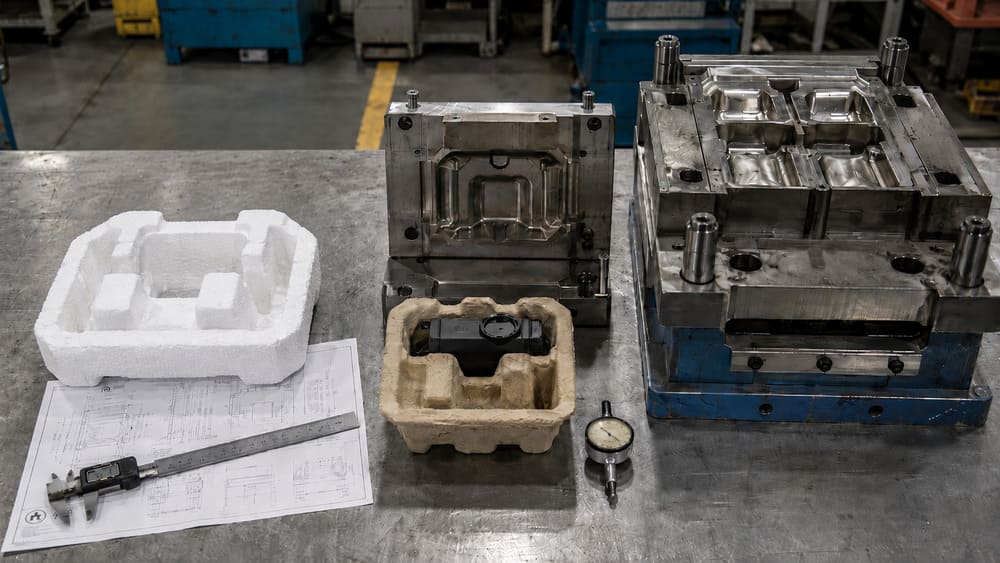
Buyer Decision Point: Do not compare EPS prototypes, sample tooling, and production tooling as if they are equivalent. Before comparing quotations, confirm exactly which development stage the quoted cost covers and whether it is intended for geometry verification, formal molded-sample validation, or mass production.
Packaging Tooling Cost Comparison Table
| Packaging Type | Tooling Stage | Approx. Reference Cost | Typical Lead Time | What Buyers Should Know |
|---|---|---|---|---|
| Folding Carton / Paper Insert | Die-cut Mold | USD 50–100 per design | 24–48 hours | Used to reproduce the approved cutting and creasing geometry in production |
| Molded Pulp Tray | Computer-Cut EPS Foam Prototype | Free | 3–5 days | Checks basic geometry, dimensions, and product fit; not a molded pulp sample |
| Molded Pulp Tray | Single-Cavity Sample Tooling | USD 650–1,000 | 12–15 days | Produces a formal molded pulp sample for structure, fit, protection, and project-required testing |
| Molded Pulp Tray | Dry-Press Production Tooling | USD 1,600–2,500 | Approx. 20–25 days to first production delivery | Built for repeatable dry-press mass production |
| Molded Pulp Tray | Wet-Press Production Tooling | USD 3,000–5,000 | Approx. 20–25 days to first production delivery | Built for repeatable wet-press mass production |
The important comparison is not simply USD 50 versus USD 5,000. These tooling stages perform different manufacturing functions and represent different levels of production commitment. Buyers should first identify the packaging structure and development stage, then compare quotations on an equivalent basis.
How Tooling Cost and Lead Time Affect Packaging Decisions
Tooling should be evaluated as part of the production plan, not as a standalone development expense.
Balancing Tooling Investment With Expected Production Volume
For many projects, the real decision is whether the order volume and reorder pattern justify molded pulp tooling.
If order quantities are relatively small, reorders are infrequent, or the project is still being tested, folding paper inserts are usually the more economical and faster option. They require lower upfront tooling investment and avoid spreading a higher mold cost across too few units.
Molded pulp becomes more reasonable when:
- order volumes are consistently larger;
- repeat orders are expected;
- the same tray design will be used over multiple production runs;
- the tooling cost can be spread across enough units.
Molded pulp may still make sense for a moderate first order if the same tray is expected to be reordered consistently.
Buyer Decision Point: For low-volume or irregular orders, folding paper inserts are usually the safer choice. Molded pulp is better suited to projects with stable volume and repeat demand.
Why Large Orders May Require Additional Pulp Tray Mold Sets
A single molded pulp production mold set has limited daily output. If the required quantity or delivery window exceeds that capacity, additional mold sets may be needed.
More mold sets increase upfront tooling investment, but they also increase production capacity and help protect the delivery schedule. Additional mold sets are a capacity decision, not simply an added tooling charge.
For buyers, the key question is simple: Can the planned mold capacity support the required daily output and delivery date?
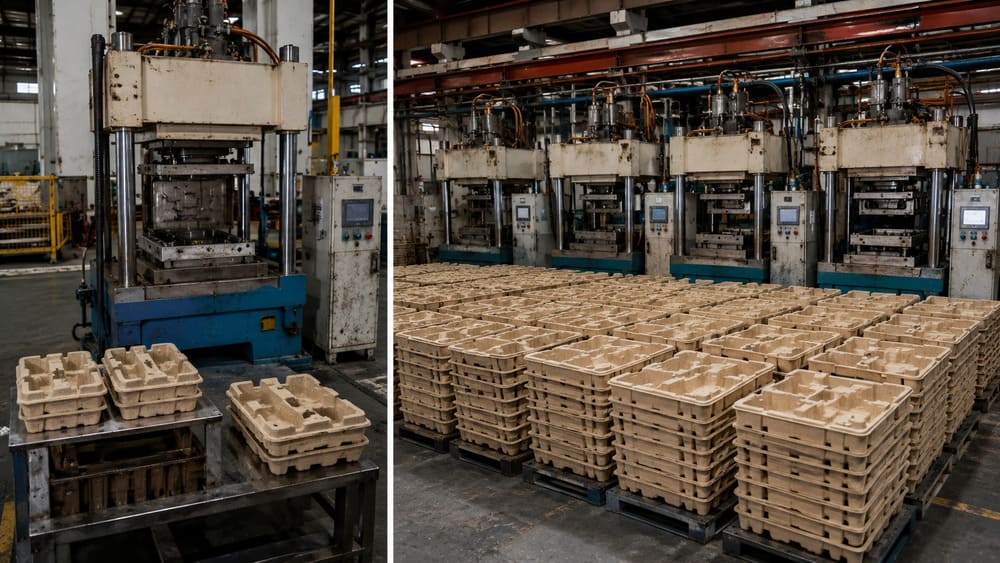
Engineering Insight: Tooling planning is also capacity planning. Fewer mold sets may reduce upfront cost, but they can extend production time if the required output is too high.
How Tooling Timing Influences Overall Project Schedule
Tooling can sit directly on the project’s critical path. If a formal sample or mass production cannot proceed until the required tooling stage is completed, any delay can push the next approval or production milestone back as well.
Typical development timing references include:
- Computer-cut EPS foam prototype: 3–5 days
Used to check basic tray geometry, dimensions, and product fit before molded pulp sample tooling is opened. - Folding carton / paper insert die-cut mold: 24–48 hours
- Molded pulp sample tooling: 12–15 days
- Molded pulp production tooling to first production delivery: approximately 20–25 days for typical order quantities
For procurement teams, these stages should be confirmed early enough to protect the required sample approval, production start, and final delivery schedule.
FAQ: Packaging Tooling Cost Questions Buyers Ask
Packaging tooling questions usually come down to cost, timing, reuse, and whether the investment fits the production plan. The answers below give buyers the key points to confirm before approving tooling.
How much does custom packaging tooling cost?
Typical Klong project references are USD 50–100 per design for folding carton or paper insert die-cut molds, USD 650–1,000 for molded pulp sample tooling, USD 1,600–2,500 for dry-press production tooling, and USD 3,000–5,000 for wet-press tooling. Actual cost varies by structure, size, and production requirements.
What is the difference between sample tooling and production tooling?
Sample tooling is built mainly for validation at lower development cost: typically a single-position die for folding paper inserts or a single-cavity mold for molded pulp. Production tooling is configured for order volume, machine efficiency, labor, and material utilization.
How long does packaging tooling take?
Typical references are 24–48 hours for folding carton or paper insert dies, 12–15 days for molded pulp sample tooling, and about 20–25 days to first production delivery for molded pulp, including production-tooling preparation and the first production batch. A computer-cut EPS prototype usually takes 3–5 days before sample tooling.
Is packaging tooling a one-time cost, and can it be reused for repeat orders?
Usually, yes, while the structure remains unchanged and the tooling is still usable. Folding-carton and paper-insert dies are relatively inexpensive to replace and may not be recharged on stable repeat orders. Molded pulp replacement tooling is generally chargeable.
What should buyers confirm in a packaging tooling quote?
Confirm the tooling stage, packaging structure, quoted scope, lead time, and whether the cost is for validation or mass production. Tooling prices are only comparable when suppliers are quoting the same requirement.
How can buyers reduce unnecessary tooling costs?
Validate the structure before opening tooling. Use plotter-cut samples for folding paper structures and an EPS prototype for molded pulp to confirm fit, dimensions, and basic protection before moving into sample or production tooling.
When does molded pulp tooling make more sense than folding paper inserts?
Molded pulp makes more sense when order volumes are stable and repeat orders are expected. For smaller, irregular, or test-market orders, folding paper inserts are usually faster and more economical.
When does a packaging design change require new tooling?
Structural changes require tooling changes. Folding-carton and paper-insert dies are relatively inexpensive to revise or replace. In typical Klong projects, molded pulp mold modifications may cost about USD 500–1,000, while major structural changes may require completely new tooling.
Conclusion: Don’t Pay for the Same Tooling Twice
Tooling is a sunk cost. Approving a design without a proper engineering review often leads to modifying or completely remaking expensive molds—wiping out your budget and delaying your launch by weeks.
Don’t let a preventable design flaw force you to pay double for tooling.
Download the DFM & Sampling Checklist to validate your structural design early, avoid hidden mold modification fees, and lock in your tooling investment with confidence.