
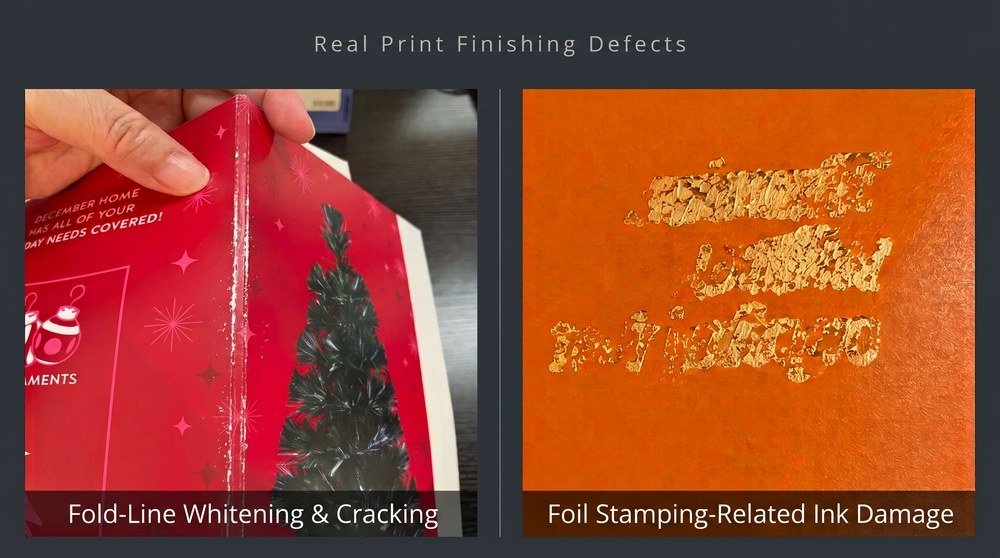
A finish that looks flawless on a presentation sample can cause costly problems on the production line. Dark printed folds can crack, hot foil stamping can mark the reverse side, Spot UV can turn uneven, and a coated carton may reject the customer's batch-code printer. These are print-finishing decisions that need to be settled before mass production—not after cartons have been made.
Print finishing DFM examines the complete system: paperboard, ink, varnish, foil, lamination, folding and printing after delivery. The goal is to choose a finish that meets the brand's appearance requirements, runs consistently in production and works in the customer's operation—without paying for upgrades that solve the wrong problem.
Table of Contents
Why Print Finishing Fails Between Design Approval and Mass Production
An approved packaging sample may look perfect without proving that the same result can be repeated across a full production order. What matters is whether the sample reflects the materials, processes, and conditions intended for mass production.
A Perfect Sample Does Not Guarantee Production Repeatability
Different samples confirm different things. An on-screen artwork proof checks layout, while a standard digitally printed sample provides an overall color reference—not a final color standard for offset printing. A structural sample checks fit and folding. A production-representative sample provides stronger evidence when it uses the intended materials and processes.
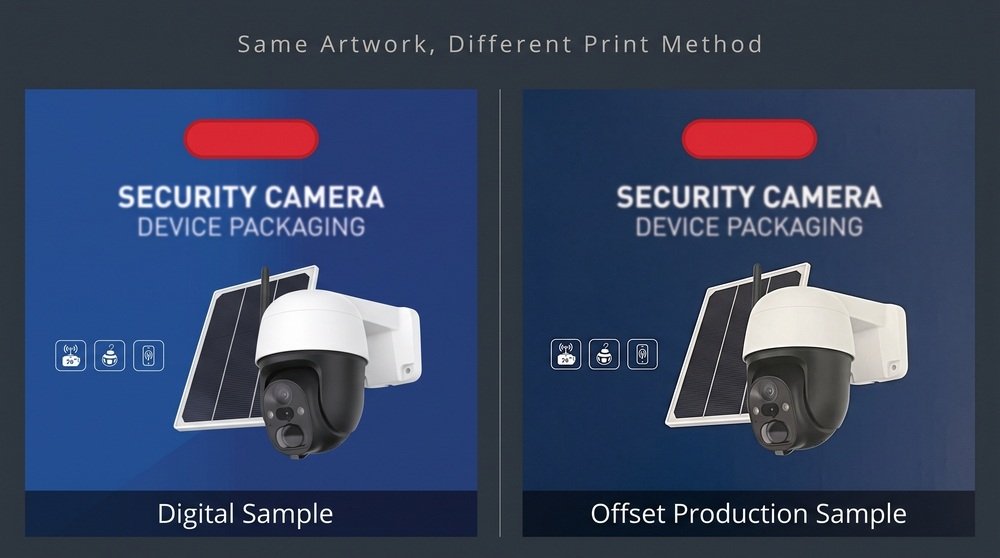
One presentation sample can be adjusted by a technician until it looks perfect. At Klong, a sampling run often produces around 50 sheets or more, giving the team a chance to observe the finish across consecutive sheets rather than judge a single selected piece. Running material through the relevant equipment can reveal uneven Spot UV penetration on white kraft, registration drift or sheet movement that a hand-adjusted sample conceals. A brand-critical CMYK color may also need a dedicated spot color for better repeatability.
Buyers should ask not only whether the sample looks right, but whether the factory has checked repeatability using the proposed materials and finishing process. Agree on the approved reference and the defects that would trigger a correction before production starts.
Three Main Failure Sources: Material, Surface Compatibility and Process Conditions
Print-finishing defects often involve three interacting factors:
1. Material Characteristics
Paper roughness, absorbency, stiffness, moisture, and surface consistency can affect finishing results, even when two paperboards look similar.
2. Surface and Layer Compatibility
Inks, primers, varnishes, Spot UV, coatings, lamination, and foil must work with the surfaces they contact. Incompatibility may cause uneven gloss, weak adhesion, ink transfer, or layer separation.
3. Production and Converting Conditions
Drying, curing, heat, pressure, processing speed, and folding affect the finished surface. Problems may include blocking, cracking, flaking, or abrasion.
Dark, heavily printed folds make the difference particularly visible: ordinary gloss or matte varnish can crack or whiten as the paperboard bends. The coating has no continuous plastic film to bridge the crease. Buyers need to decide whether that appearance is acceptable or whether the structure, crease or finish should change—before approving the production sample.
Material and Surface-Treatment Compatibility: White Kraft, UV, Foil, Coatings and Lamination
The same finish can perform differently depending on the paper, ink, and production process. A mismatch can affect appearance, durability, cost, or delivery—even when the approved sample looks right.
White Kraft Paper: Spot UV Appearance and Crease-Cracking Risks
White kraft paper can receive Spot UV, but its absorbent surface makes an even, high-gloss finish harder to achieve than on smooth coated board. Without the right application method, the coating may penetrate unevenly, leaving patchy gloss or darker-looking areas.
For white kraft Spot UV, Klong uses a more open screen mesh with an angled mesh arrangement and a dedicated anti-penetration coating. This helps control how the UV coating is applied and produces a more even finish. Simply adding more UV varnish may not solve the problem.
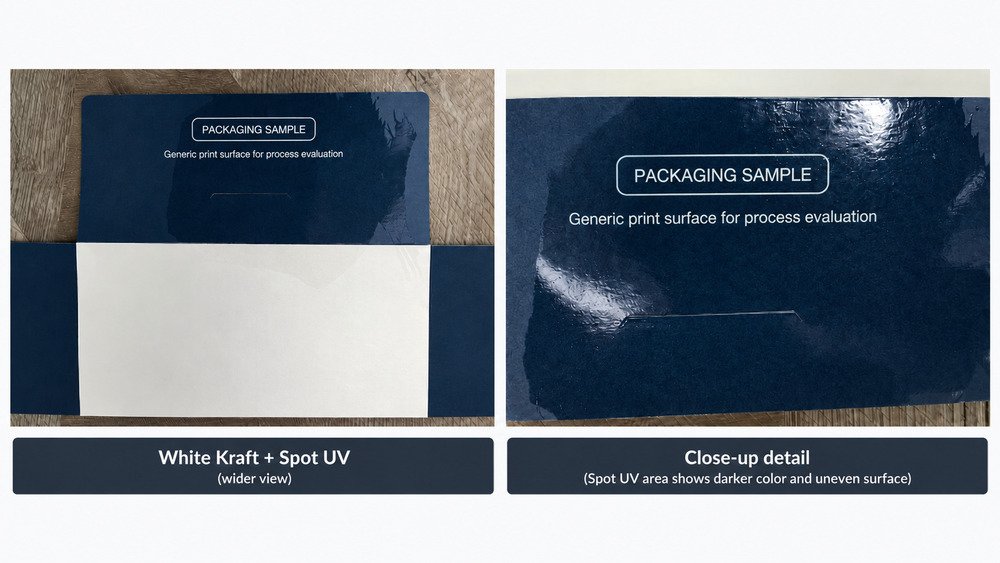
White kraft generally tolerates normal folding, but repeated reverse folding or an overly thick or inflexible UV layer can still cause cracking or flaking, particularly near creases.
Check the Spot UV position against the dieline and review the actual folded sample. The finish should meet the approved appearance after folding, not just on a flat sheet.
Downstream Overprinting: When Smooth White Board Fails the Customer's Printer
A paperboard that prints beautifully at the factory may fail when the customer needs to add barcodes, batch numbers, or other variable information after delivery.
In one Klong project, the customer's printer produced text that rubbed off easily on coated white board. Leaving the printing area unprinted, applying varnish, and trying the slightly rougher reverse side did not solve the problem. The customer also rejected separate labels. Switching to white kraft paper allowed direct printing with their existing equipment.
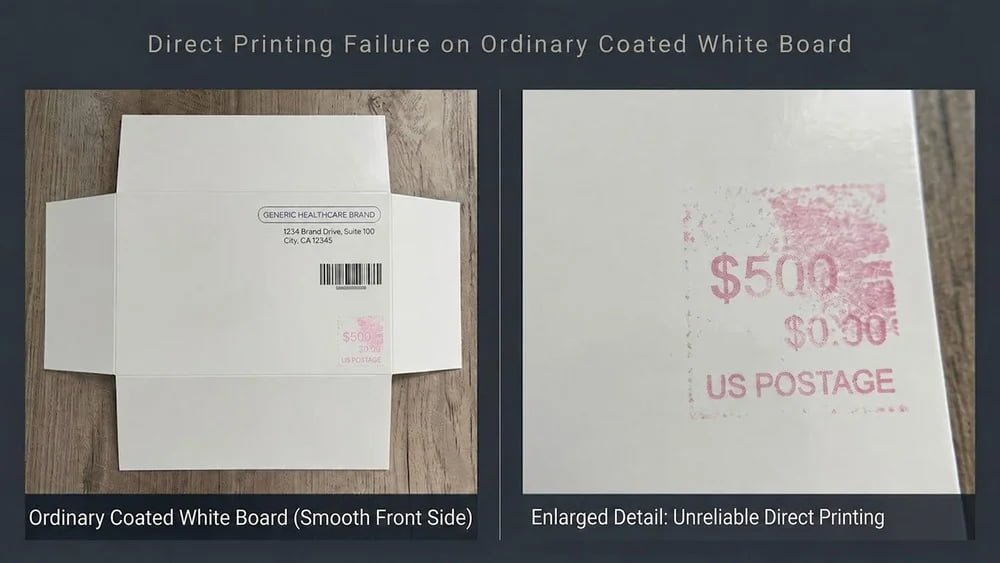
The original paperboard met the factory's printing needs but not the customer's fulfillment requirements. Keeping it would have forced an unwanted change to their workflow.
If variable data must be printed after delivery, confirm this before selecting the paperboard. Test the finished material using the customer's actual printer and consumables, checking legibility, rub resistance, and barcode readability where needed.
Double-Sided Solid Printing + Hot Foil: Blocking and Reverse-Side Ink Transfer
Double-sided, full-coverage printing followed by hot foil stamping can damage the printed reverse side. Heat, pressure, residual ink tack, and contact with the supporting surface may contribute to ink transfer or localized damage.
Klong encountered this on a double-sided, heavily printed project. After the sheets rested for approximately two weeks, another foil-stamping trial improved the result. But a solution that depends on waiting two weeks is not workable for an urgent production order that may need to ship in roughly ten days. Improving a small trial was not the same as solving the production schedule.
The practical solution was to print two thinner sheets separately, then mount them together to form the required board. The extra converting step was weighed against the time and reverse-side damage associated with direct double-sided printing and stamping. The buyer received a manufacturable construction rather than a promise that longer drying would always work.
The lesson for buyers: if your approved finish relies on an unusually long waiting period, ask the supplier to evaluate another board construction or production sequence before locking the launch schedule.
Gloss, Matte, Plastic-Free Coatings and Lamination: Choosing a Production-Stable Surface System
Conventional varnish, plastic lamination, and premium plastic-free coatings may look similar on a flat sample, but their cost, folding performance, and production requirements differ.
1. Conventional Gloss / Matte Varnish
Standard varnish is the lowest-cost of these three systems in Klong's current production experience. On dark, full-coverage printing, folding can expose white lines or cracked ink and varnish at the crease. Varnish does not have the same continuous film reinforcement as plastic lamination. If clean fold lines are critical to the brand, the buyer should see a folded production-representative sample—not just a flat print.
2. Gloss / Matte Plastic Lamination
Plastic lamination adds a continuous flexible film over the print, helping the surface stay intact through normal converting and handling. Standard matte lamination is a widely used, practical choice for export packaging and normally provides the surface protection needed for routine shipping. The outer carton and product protection system—not an expensive anti-scratch film—do the main work of preventing transit damage.
It costs more than varnish but less than Klong's current premium plastic-free coating systems. Anti-scratch matte film serves a different purpose: it helps reduce visible fingernail scuffs and handling marks during retail display and unboxing. Do not pay for an anti-scratch upgrade simply because your packaging will travel by sea; first identify whether the problem is transit damage or visible surface marks after handling.
3. Premium Plastic-Free Gloss / Matte Coating
For customers avoiding plastic film, Klong uses premium basecoat-and-topcoat systems. They can give a high-quality appearance and perform well under normal folding, but coating is still coating—not a continuous plastic film. On a dark, heavily printed crease, aggressive fingernail scraping can still lift ink or coating. That physical limit matters when a buyer expects film-like scratch resistance from a film-free finish.
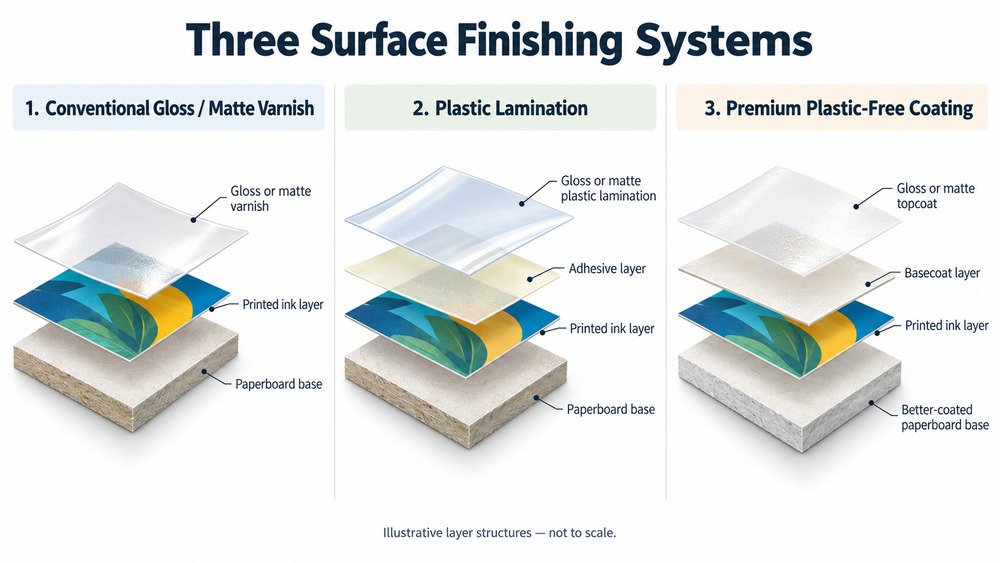
These systems currently cost significantly more than standard lamination and need compatible, higher-grade coated paperboard. The additional cost should be justified by a clear film-free requirement, not by an assumption that the coating is mechanically identical to plastic film.
Before using a new coating system in mass production, Klong checks production-representative samples, rub resistance, folding performance, and any tests required for the packaging application. Alcohol or eraser tests may apply to particular customer requirements but are not routine for every order.
For European customers seeking film-free alternatives, premium plastic-free coatings may be considered first. Removing plastic film alone, however, does not prove recyclability or compliance with the EU Packaging and Packaging Waste Regulation (PPWR).
Surface-Treatment Comparison
| Surface Treatment | Relative Cost at Klong | Main Consideration |
|---|---|---|
| Conventional gloss / matte varnish | Lowest | On dark folds, visible whitening and cracking; no film reinforcement |
| Standard gloss / matte plastic lamination | Higher | Widely used for routine shipping; flexible film and fold-surface continuity |
| Anti-scratch matte lamination | Premium film option | Helps reduce visible scuffs from retail handling and unboxing—not a transit-protection substitute |
| Premium plastic-free gloss / matte coating | Highest among the three main systems | Film-free appearance and normal folding; fingernail scraping at creases can still lift ink or coating |
Cost comparison reflects Klong's current materials and production methods. Actual pricing depends on order specifications and quantity.
How to Diagnose and Validate Print Finishing Before Mass Production
When a print-finishing defect appears, changing the ink or coating may not fix it. The first question is which material layer or process caused the problem—and whether the proposed correction will work for the actual order.
Identify the Failed Interface: Dyne Pen, Tape Peel and Controlled Heat Checks
Ink lifting, coating peeling, and film delamination can look alike but require different fixes. Before changing materials or machine settings, identify where the separation occurs and choose a check that addresses the suspected problem.
Dyne Pen — Surface-Wetting Checks
Dyne pens are useful during lamination first-article checks and when comparing coated cartons intended for customer-side date printing with an approved sample. Klong uses these readings to flag possible changes in surface wetting, not to approve printing performance.
A matching or higher reading does not mean the customer's printer will work reliably. The finished cartons still need to be checked with the actual printing equipment and consumables.
Tape Checks — Surface Adhesion and Customer Handling
A quick pull with ordinary clear tape can reveal obvious coating or lamination lifting, but it is not a standardized bond-strength test.
In one Klong project, the box had matte lamination with full-coverage matte UV. The customer wanted consumers to remove a transparent sealing sticker without tearing or damaging the finished surface. A tape-pull check helped identify whether the UV layer would lift from the lamination.
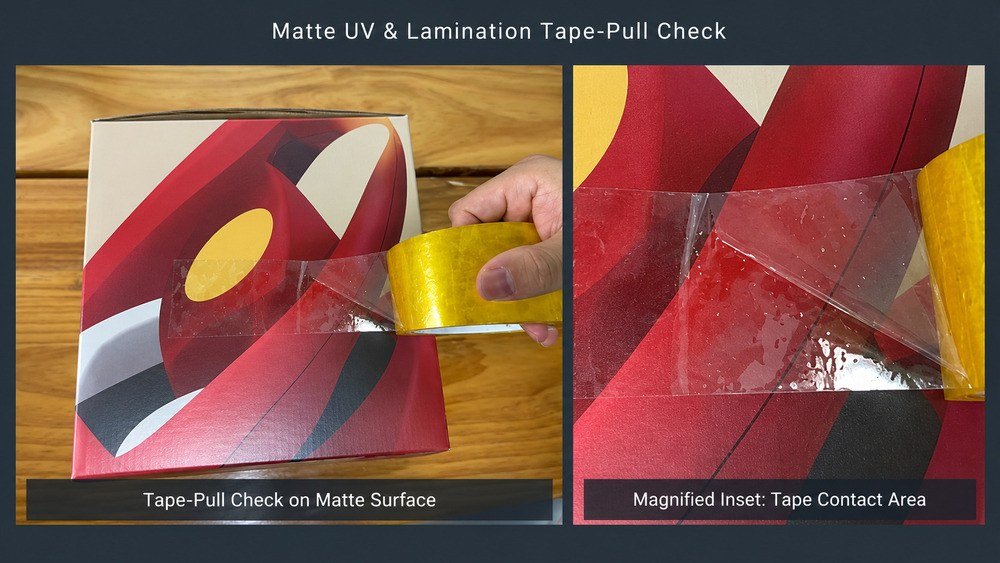
The real test is whether the box survives the intended use. If clean sticker removal matters, verify the actual sticker and removal conditions before approval. A shop-floor tape check should not be confused with a controlled adhesion or cross-cut test.
Controlled Heat Checks — Thick Ink and Color Changes
Heavy ink coverage can show color changes during drying, especially on absorbent paper or with sensitive colors. Klong uses controlled heat-gun checks to spot potential changes early, then relies on representative printing and normal production drying conditions for final color approval.
Downstream Printing — Testing the Actual Use
If the customer will add dates, barcodes, or batch numbers after delivery, test the finished packaging with their existing printer and consumables. Surface-wetting readings alone cannot confirm print durability or barcode readability.
The Klong Print Finishing Production-Readiness Framework™
The purpose of a print finishing DFM review is straightforward: confirm that the approved design can be produced reliably without introducing unnecessary sampling, delays, or changes to the customer's requirements.
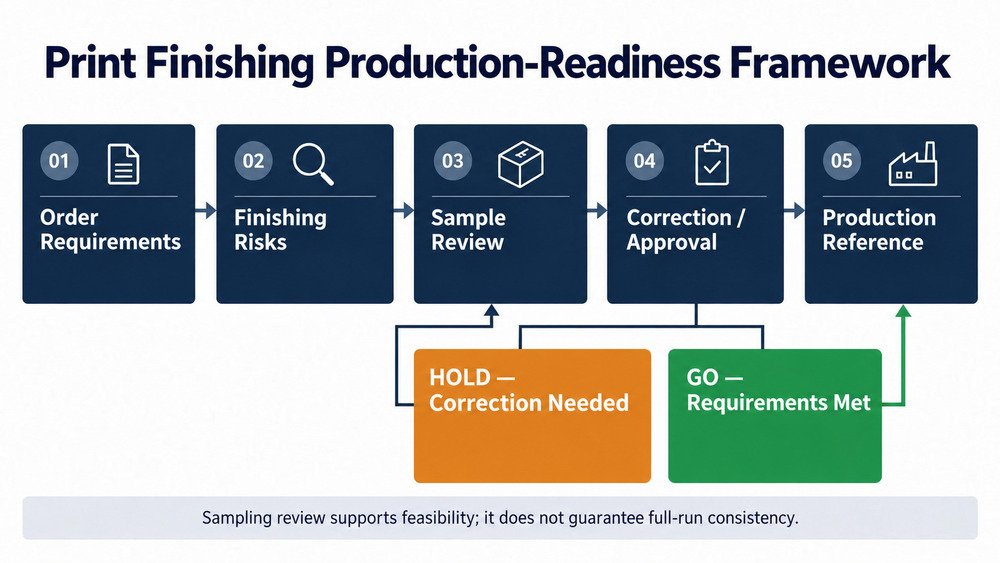
1. Confirm What the Order Requires
Start with the artwork, paperboard, print coverage, finishing layout, folding, downstream use, and delivery schedule. A sealing sticker or customer-side date printing may introduce requirements that are not visible in the artwork.
2. Check the Material and Process Risks
Focus on interactions likely to affect the finished result, then use the relevant physical samples or checks. If a problem appears, identify the affected layer or process before deciding what to change.
3. Review More Than the Samples Sent to the Customer
The customer may see only a few selected samples. Klong often checks around 50 sheets or more during sampling to observe how the finish behaves across consecutive sheets. White-kraft UV coverage, registration and material movement become easier to judge when the machine actually runs than when one sheet is manually adjusted. See why selected presentation samples do not tell the whole production story.
This is a practical check of repeatability during sampling, not a demand to run a separate full-scale trial for every order. The right level of verification follows the finishing risk.
4. Decide Whether the Change Needs Customer Reapproval
If a finish fails, correct the cause and check the result again. An internal process change may not require new approval if the agreed materials, appearance, function, and approval conditions remain unchanged.
If the correction changes an approved requirement or triggers a customer-specified approval condition, obtain the required confirmation before production.
5. Produce Against the Approved Reference
The approved sample and agreed specifications should guide production checks. First-article and in-process inspections can detect variation, but they should not be used to postpone resolving a known finishing problem until mass production.
Print Finishing DFM Review Matrix
Use this table to identify what needs checking before approving a finishing combination for production.
| Material / Process | Potential Failure | What to Verify |
|---|---|---|
| White kraft + Spot UV | Uneven gloss or darkened areas | Check Spot UV appearance on the finished sample |
| Spot UV near creases | Cracking or flaking | Review the dieline and fold the finished sample |
| Coated white board + downstream printing | Smearing or poor print durability | Test the customer's printer and consumables on finished cartons |
| Double-sided printing + hot foil | Reverse-side ink damage | Check the stamping result and production lead time |
| Printed board + lamination | Film lifting or separation | Check for lifting and confirm adhesion as required |
| Matte UV over matte lamination | Surface damage when removing the seal | Screen coating adhesion and check actual sticker removal |
| Premium plastic-free coating | Ink or coating loss at dark creases under scraping | Check normal folding and agreed surface-handling expectations |
| Standard matte vs. anti-scratch film | Unnecessary premium for the wrong failure mode | Separate transit packaging needs from visible scuffs during unboxing |
| Heavy ink coverage on absorbent paper | Color changes during drying | Compare heat-check observations with normally dried prints |
Validation methods and acceptance criteria depend on the material, finishing process, and agreed order requirements.
FAQ: Print Finishing DFM and Mass Production
These FAQs address common questions about print-finishing compatibility, adhesion checks, and production approval. Use them to identify what needs verification before committing to a packaging material, finish, or production order.
Can Spot UV be applied to white kraft paper?
Yes. Spot UV can be applied to white kraft paper, but coated areas may appear darker, and the absorbent surface can make gloss less uniform. Adding more UV coating is not necessarily the solution and may increase cracking risks near folds. Approve the actual finish and folded sample.
Can customers print barcodes or batch numbers on coated white paperboard?
Yes, if the finished surface works with the customer's printer and consumables. Even coated board without additional finishing may not accept printing from an ordinary printer. Test feeding, print durability, and barcode readability where required using the actual packaging and equipment before selecting the material.
Is white kraft paper better for downstream overprinting?
Sometimes. White kraft worked with a customer's existing printer when coated white board failed in a Klong project. But it is not a universal solution. Check the paper grade, printer compatibility, feeding performance, and ink or toner durability before switching materials.
Why can hot foil stamping damage printing on the reverse side?
Heat and pressure during hot foil stamping may disturb printing on the reverse side, especially with heavy ink coverage. Ink condition, paper construction, and contact surfaces can also contribute. Review the actual stamping result before deciding whether blocking, ink set-off, or another process issue caused the damage.
Is ordinary clear tape useful for checking plastic lamination adhesion?
Yes, for quick screening of visible surface lifting or separation. However, pulling tape from the surface does not necessarily test the film-to-paper bond. If layers detach, identify the failed interface and arrange appropriate adhesion or peel testing when the order requires formal verification.
Can a sealing sticker damage matte UV or laminated packaging when removed?
Yes. Removing a sealing sticker can lift the UV coating or damage the finished box surface. This risk arose on a Klong project using matte lamination and full-coverage matte UV. A quick tape check helped screen the surface, but actual sticker-removal performance should guide approval.
Can dyne pens and heat guns prove coating adhesion?
No. Dyne pens can screen surface wetting on suitable materials, while controlled heat checks may reveal color changes in heavily printed areas. Neither proves coating adhesion, complete curing, or long-term durability. Use tests suited to the actual finish and the performance required by the order.
What must be approved before print finishing enters mass production?
Approve the actual paperboard, printing and finishing appearance, folding result, downstream-printing performance where needed, and agreed acceptance criteria. At Klong, reviewing around 50 sheets or more during sampling can help reveal variation that a hand-adjusted presentation sample hides. Correct significant finishing issues before the production order is released.
Does every finishing adjustment require a new sample or customer reapproval?
No. Internal process adjustments may not require renewed approval if the agreed material, appearance, function, and approval conditions remain unchanged. If a change affects an approved requirement or triggers a customer-specified approval condition, verify the revised result and obtain the required confirmation before production.
Conclusion: Don't Let a Print Finish Failure Scrap Your Production Run
A beautiful sample is expensive if its finish cracks, transfers or fails the customer's printer once production begins. The cheapest time to fix the material, surface treatment or process sequence is before the order goes to press.
Choose the finish for the failure it needs to prevent—not for the most impressive name on the quotation.
Klong can review your artwork, paperboard and finishing requirements to identify practical production risks before you approve the order.