
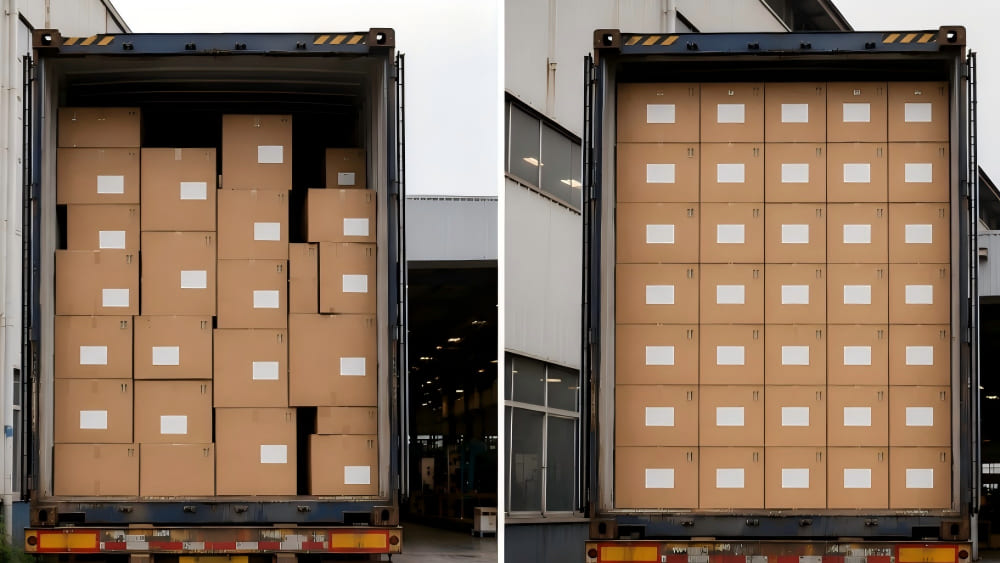
A cheaper box can still make every shipment more expensive.
In export packaging, real cost is not decided by unit price alone. It is shaped by product orientation, master carton dimensions, stacking logic, and how many sellable units fit into each 40HQ container. This is the core of packaging space optimization.
If these details are not reviewed before production, freight waste is already built into the packaging design.
That is why Klong treats container utilization as a packaging KPI…
Table of Contents
What Is a Good 40HQ Container Utilization Rate?
For full-container export shipments, a good 40HQ utilization rate is usually 90–95%.
Below 90%, the packaging and master carton dimensions should be reviewed.
Around 95%, the packaging system is usually performing efficiently for real export loading.
The 40HQ Utilization Benchmark
| 40HQ Utilization Rate | Project Signal | Action |
|---|---|---|
| Below 90% | Space waste warning | Recheck carton dimensions, mixed loading, or packaging design |
| 90–95% | Practical operating range | Acceptable, but still worth reviewing |
| Around 95% | Ideal KPI | Strong packaging space planning result |
Below 90% usually means the problem starts before shipping — often with carton dimensions.
Why 95% Becomes the Practical Sweet Spot
Actual 40HQ dimensions may vary by carrier, container type, and container condition, so theoretical loading should only be used as a planning reference.
Each master carton usually occupies slightly more space than its measured length, width, and height. In real projects, we often allow about 5 mm extra per side for carton thickness, bulging, tape, and handling tolerance.
Cartons also cannot sit 100% gap-free inside a container.
That is why around 95% is a practical target: efficient enough to reduce freight waste, but still realistic for real export loading.
Why Container Utilization Should Be a Packaging KPI
Once the master carton is confirmed, the main space efficiency is already locked.
The chain is simple:
Single package shipping size → Master carton size → 40HQ loading quantity → Freight cost per shipped unit
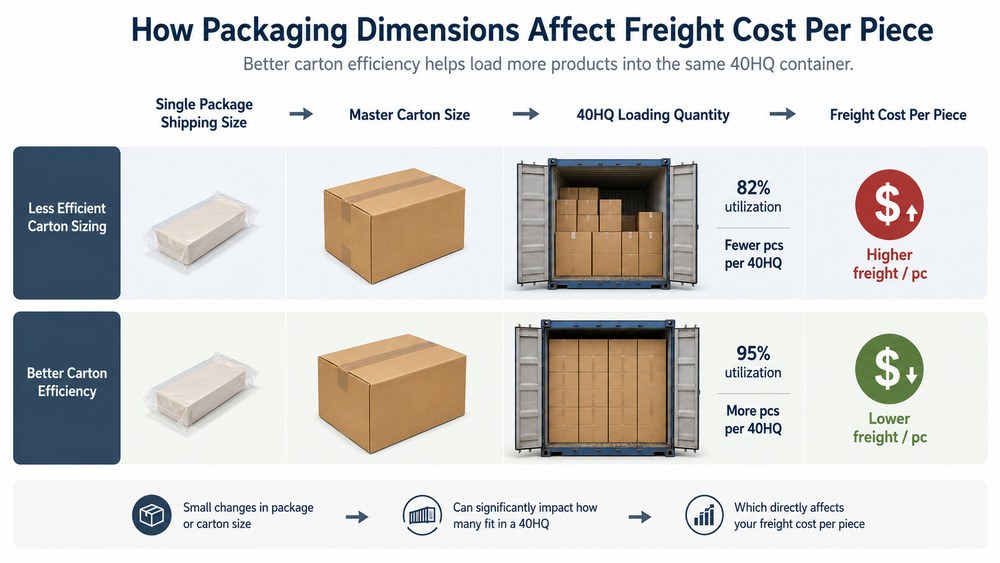
For full-container shipments, this should be checked before final samples or production approval.
Otherwise, the same carton size may keep wasting freight space shipment after shipment.
For full-container shipments, the real value is simple: the same 40HQ freight can carry more sellable products, so shipped cost per unit goes down. That is why we check package size and master carton efficiency before production — before the carton size is locked and the same cost repeats in every shipment.
The Hidden Cost Most Teams Never Measure
Packaging cost is visible.
Container waste is usually invisible.
That is why many teams spend weeks trying to save $0.01–$0.02 per box, but never calculate how much money is lost when the same 40HQ carries fewer sellable products.
For full-container shipments, the hidden cost is simple:
Same freight cost. Fewer products. Higher freight cost per unit.
The Illusion of Saving $0.01–$0.02 Per Unit
A small packaging saving is easy to see.
It appears clearly on the quotation.
But wasted container space is harder to see because it never appears as a separate line item.
That is the trap.
A cheaper box can still increase the shipped cost per unit if its dimensions reduce how many products fit into the same 40HQ.
The real question is not:
“Did we lower the box price?”
It is:
“Did we lower the cost to ship each product?”
Why Cheap Packaging Can Create Expensive Freight
Freight is paid by container.
But buyers recover that freight cost piece by piece.
If a package or master carton layout reduces the loading quantity, the same ocean freight is divided across fewer units.
That is how cheap packaging can create expensive freight.
This is why packaging cost should be reviewed together with shipped cost per unit rather than in isolation, it’s the most effective way to deal with packaging cost reduction.
Why Packaging Dimensions Often Stay Unchallenged
This problem survives because it sits between packaging and logistics.
The factory produces according to approved dimensions.
The logistics team arranges shipment based on finished cargo data.
Both sides may be doing their jobs correctly.
But if nobody checks package size, master carton size, and 40HQ loading quantity before production, the cost gets locked in quietly.
By the time the goods are ready, the container utilization result has already been decided. The shipment is simply exposing a packaging decision made weeks earlier.
The Dead Air Reality Check
Here is the cost most teams never put on the table:
20% wasted space
↓
80% utilization
↓
100 containers/year
↓
Equivalent to losing the shipping capacity of 20 containers annually
↓
Thousands of additional products could have been shipped instead
↓
Higher freight cost per shipped unit
This is not about blaming the loading team.
It is about catching the problem before the carton size is approved.
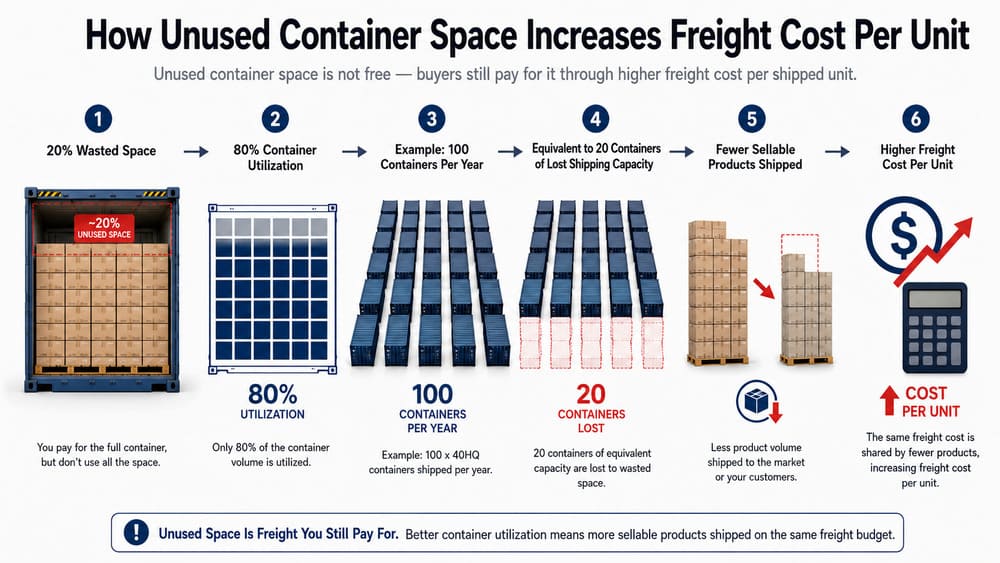
In full-container programs, we often find more savings by improving loading quantity than by negotiating another cent off the box price. Once the carton size is approved, the freight impact repeats in every shipment that follows. That is why space efficiency should be reviewed before production, when it can still reduce shipped cost per unit instead of becoming a permanent part of it.
The Klong Reverse Engineering Method
Most packaging projects start with the product.
The problem is that container space does not.
A 40HQ does not care what your product costs, how it looks, or how much packaging was saved.
It only cares how efficiently the final cartons fit inside it.
That is why many loading problems are created long before loading starts.
Start from the 40HQ Physical Baseline
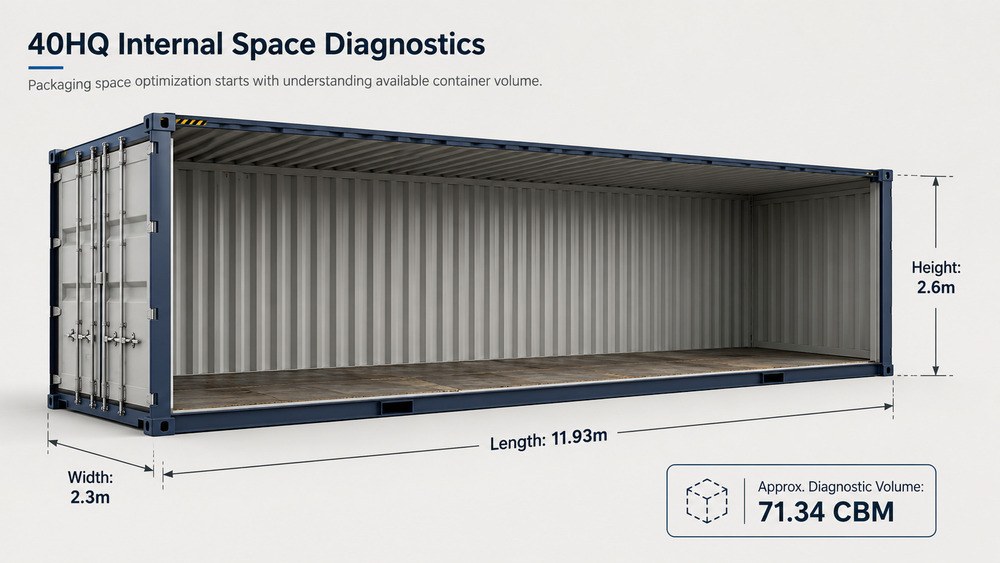
Before we look at the package, we look at the space it must fit into.
For packaging space diagnostics, we use a practical 40HQ baseline:
11.93m × 2.3m × 2.6m
Approximate diagnostic volume:
≈ 71.34 CBM
Actual container dimensions may vary slightly by carrier and container type.
The point is not finding a perfect number.
The point is measuring every packaging option against the same reference.
Otherwise, utilization becomes a guess instead of a calculation.
The True Reverse Calculation Chain
Most teams ask:
“How many cartons fit after the packaging is finalized?”
We ask the question earlier.
“What packaging dimensions create the best loading result before the design is locked?”
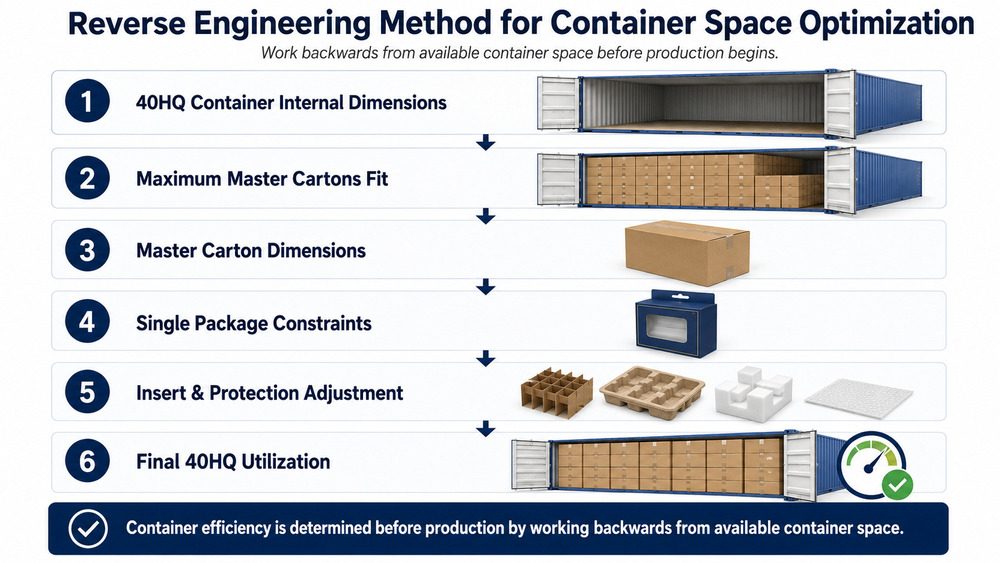
The calculation works backwards:
Container Internal Dimensions
↓
Maximum Master Cartons Fit
↓
Master Carton Dimensions
↓
Single Package Constraints
↓
Insert & Protection Adjustment
↓
Final 40HQ Utilization
A small change near the bottom of this chain can affect everything above it.
That is why packaging efficiency is usually decided before production, not before shipment.
Why Loading Software Still Needs Packaging Constraints
Loading software is useful.
But software only sees geometry.
Real packaging projects have rules.
Some products cannot be turned sideways.
Some cartons cannot carry extra stacking weight.
Some display-facing products must remain in a specific orientation.
A loading plan can look perfect on a screen and still create damage risk in transit.
That is why software should support decisions, not make them.
The best loading result happens when packaging constraints are reviewed before the calculation begins.
One of the most common mistakes we see is treating container utilization as a shipping problem.
In reality, it is usually a packaging decision.
By the time the container is being loaded, most of the result has already been decided.
If You Are Below 90%, Fix These Before Redesigning Everything
If your 40HQ utilization is below 90%, do not rush to redesign the product package.
That is usually the most expensive place to change.
In most projects, we review the problem in this order:
- Master cartons
- Inserts and empty air
- Mixed loading opportunities
- Product package dimensions
The reason is simple.
Start with the changes that affect loading most, but disturb the project least.
Change Master Cartons Before Touching Individual Packaging
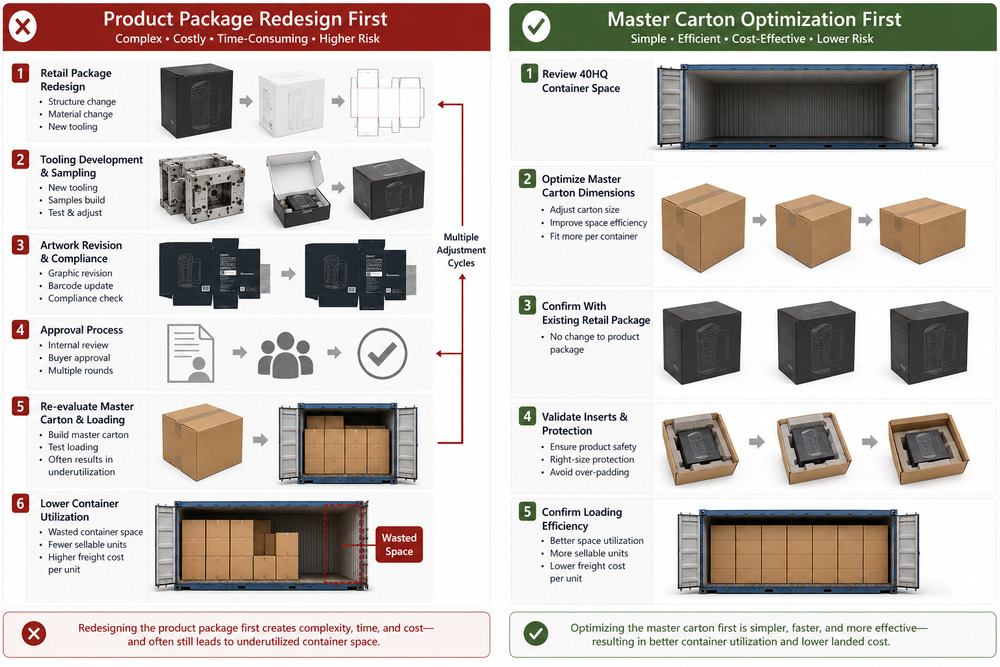
The master carton is usually the first thing worth checking.
It decides how products are grouped, stacked, and loaded into the container.
We have seen projects where the product box was fine, but the outer carton created poor loading results.
In those cases, changing the master carton was faster, cheaper, and less risky than changing the retail package.
That is why we start there.
Optimize Inserts & Remove Empty Air
Protection matters.
But not every empty space is protection.
Sometimes a package has space that was added for safety, then never reviewed again.
That space may look harmless in one box.
But after it is multiplied across cartons, pallets, and containers, it becomes real freight cost.
The practical question is:
Is this space protecting the product, or are we just shipping air?
Use Strategic Mixed Loading
If utilization is already close to 90%, do not overcorrect.
Sometimes the better move is to fill the small gaps intelligently.
Small items can often help improve total loading efficiency, such as:
- inserts
- manuals
- labels
- warranty cards
- supporting printed materials
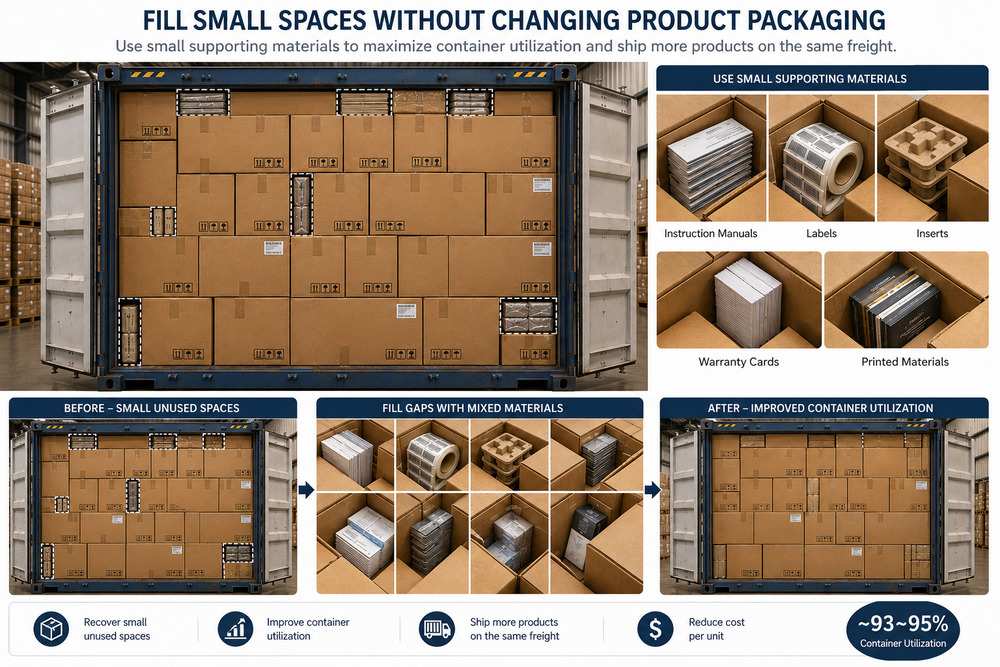
This does not fix a bad carton size.
But when the loading result is close, it can help recover space that would otherwise be wasted.
Adjust Single Package Dimensions Only When Necessary
Changing the product package should be the last serious option.
It can affect artwork, tooling, approvals, testing, inventory, and launch timing.
That is a lot of disruption.
So before changing the retail package, we first ask:
Can the same result be achieved by adjusting the master carton, insert layout, or loading mix?
If yes, that is usually the better path.
Protect the Non-Negotiables
Container efficiency is important.
But it should never damage the product or weaken the brand experience.
Some things are not worth trading away.
Product Protection
A damaged product costs more than wasted space.
If a size change increases compression risk, movement, or breakage, it is not a real packaging space optimization.
It is just moving the cost somewhere else.
Display Effect
For retail products, the package also has a selling job.
If a smaller package hurts shelf presence, opening experience, or brand value, the saving may not be worth it.
Good packaging space optimization should reduce freight waste without making the product feel cheaper.
Most packaging space optimization mistakes start with the wrong first move.
Buyers often think they need to change the product package, but many projects can improve loading efficiency by fixing the master carton first.
That is usually the cleaner path: less disruption, lower risk, and lower freight cost per shipped unit.
From Packaging Supplier to Space Diagnostics Partner
Why Packaging Discussions Should Start Before the Quotation
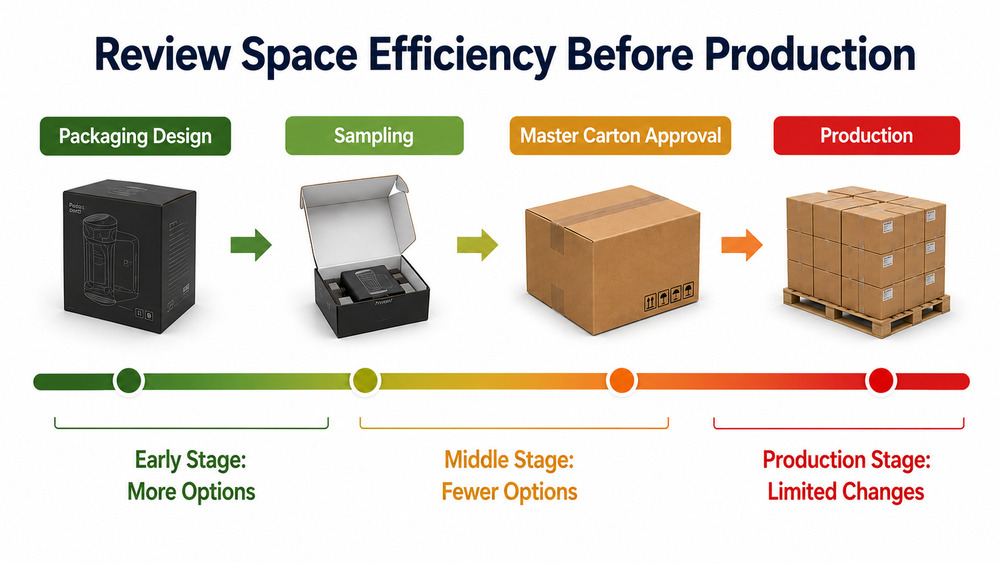
The best time to improve container efficiency is before packaging dimensions are finalized.
Once packaging enters the sampling stage, many key dimensions start becoming fixed. If loading efficiency is not reviewed at the same time, the quotation may simply confirm a packaging solution that already carries hidden freight waste.
Packaging sampling is not only about confirming that the product fits inside the box.
It is also the easiest time to check:
- how many units fit into a master carton
- whether a different packing arrangement makes more sense
- whether the carton can use container space more efficiently
The earlier these questions are asked, the more options are available.
A small adjustment at this stage can sometimes improve loading efficiency far more than a much larger change made later.
Why Timing Matters More Than Most Teams Realize
Many teams assume container utilization is decided when the shipment is loaded.
In reality, much of the result is determined much earlier.
The best time to review space efficiency is:
- before packaging structure is finalized
- before master carton approval
- before production starts
Even if the individual package size is already fixed, packging space optimization is not necessarily over.
Many projects can still improve utilization through:
- carton quantity adjustments
- packing arrangement changes
- practical master carton improvements
But once the master carton is approved and production begins, the remaining room for adjustment becomes very limited. At that point, the only practical opportunity may be finding ways to combine manuals, labels, inserts, or other supporting materials into the shipment and recover unused space where possible.
When Is Packaging Space Optimization Worth Reviewing?
Not every packaging project needs a detailed space review.
The greatest value usually comes from programs where the same packaging decisions will affect many future shipments.
Packaging space optimization is often worth reviewing for:
- large-volume orders
- long-term repeat orders
- projects that regularly ship by full container
- low-value but high-volume products
- multi-SKU shipments that can be combined into full-container shipments
On the other hand, some projects may see limited benefit from a detailed review. For example, if a 40HQ already carries several million units, the freight cost allocated to each product may already be very low, making further optimization less meaningful.
A one-time shipment may not justify a detailed review.
The more often the same container ships, the more valuable a review becomes.
What a 40HQ Space Diagnostic Should Include
A useful space review should do more than estimate loading quantity.
It should identify where meaningful improvements are actually possible.
A typical 40HQ space diagnostic may include:
- product orientation review
- single package size review
- master carton dimension review
- 40HQ loading quantity estimate
- utilization rate result
- mixed loading recommendation
- practical adjustment range for packaging dimensions
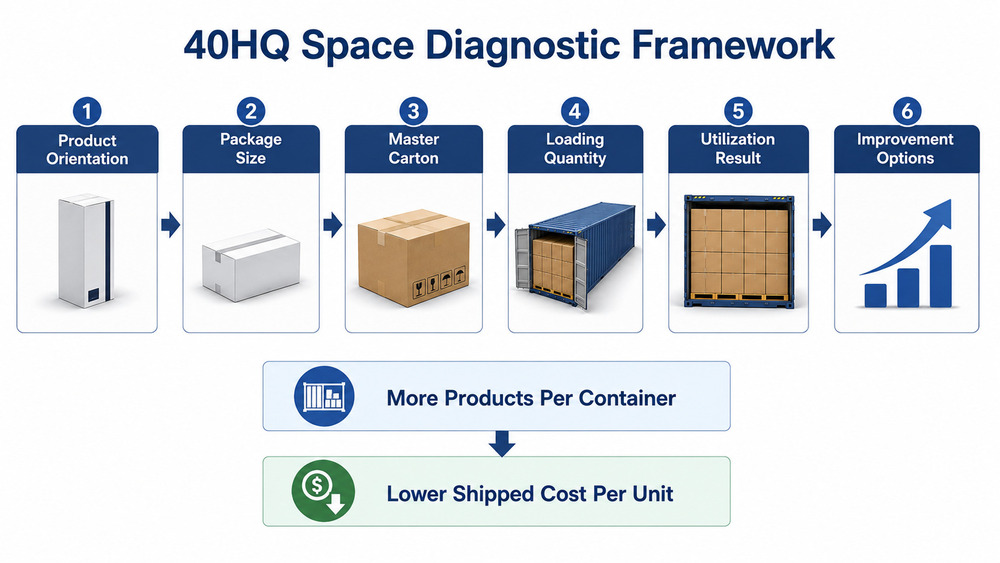
The goal is not producing another report.
The goal is identifying the few dimensions and packing decisions that have the biggest impact on loading efficiency.
The best optimization projects improve utilization without creating unnecessary changes to packaging, production, or product presentation.
Why a Higher Packaging Cost Can Still Lower Shipped Cost Per Unit
A packaging decision should not be judged by packaging cost alone.
It should be judged by what happens to the total shipped cost.
For example:
+$0.03 packaging cost
↓
+2,000 units per 40HQ
↓
lower shipped cost per unit
This is why the cheapest packaging option is not always the lowest-cost option to ship.
A few cents of packaging cost is visible on a quotation.
Lost container capacity usually is not.
If a small packaging adjustment allows more products to travel in the same container, the additional packaging cost may be offset through better container utilization.
The important question is not:
“Did packaging cost increase?”
The more useful question is:
“What happened to the shipped cost per unit?”
If the same product has been shipping in the same carton for years, that is usually the first project worth reviewing.
Many of the easiest freight savings come from packaging layouts that nobody has questioned for a long time.
Frequently Asked Questions About 40HQ Container Utilization
These are practical questions that often come up when reviewing real container loading efficiency.
Does Collapsible Packaging Always Improve 40HQ Loading Efficiency?
Not always.
From a shipping perspective, collapsible packaging usually saves space. However, collapsible rigid boxes also cost more to manufacture and assemble than standard rigid boxes. We’ve seen them work very well for large-volume shipments or large-size packaging, but for smaller orders or extra small packaging, the freight saving is sometimes too small to justify the additional box cost.
How Does Palletization Affect Actual Utilization?
Pallets make warehousing and receiving easier, but they also consume container space.
A pallet that fits the warehouse perfectly does not always fit the container efficiently. That is why pallet size and stack height should be reviewed together, especially for full-container shipments.
Why Is the Usable CBM of a 40HQ Lower Than the Theoretical Volume?
Because real containers are never loaded under perfect conditions.
There are always small gaps between cartons, and container dimensions can vary slightly between carriers, newer containers, and older containers. That is why experienced exporters focus on practical utilization rather than theoretical volume.
Why Doesn’t Loading Software Always Match Real-World Loading Results?
On paper, everything fits. In a real container, it is rarely that perfect.
Loading software works with ideal dimensions, while real cartons and containers rarely do. We’ve seen carton structures occupy more space than their production dimensions, which is why software should be treated as a guide, not a final answer.
Can Packaging Protection Requirements Limit Container Utilization?
Yes, and sometimes they should.
For packaging products, protection may require liner boards, carton reinforcement, inserts, or additional spacing for special box structures. A damaged carton costs far more than a few centimeters of container space.
Do You Know Your Current 40HQ Utilization Rate?
If your products ship by full container, do you know your current 40HQ utilization rate?
Many packaging programs run for years without anyone reviewing whether the same packaging is still using container space efficiently. Even a small improvement can repeat across every future shipment.
Stop Guessing Freight Costs. Get a Free 40HQ Space Review Before Your Next Shipment.
We’ll review your packaging dimensions, master carton layout, and estimated container utilization to identify practical opportunities for improvement before your next production run.